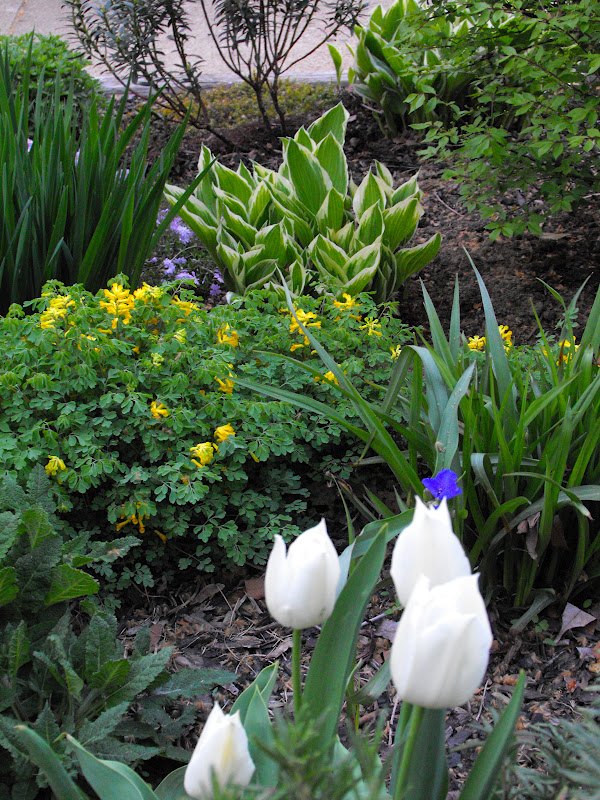
If you live in the mid-Atlantic region, you might be puzzled by the title of today's post.
We haven't had rain in weeks. Early summer-like temperatures add to the misery (misery for plants, parched as they are).
I recently adjoined two flower beds: the lantern bed and the crescent bed bordering the stone patio. Even 14 inches down, the soil is arid. With merely traceable snow this winter, above-average temperatures for months, and limited spring rains, we face a considerable problem moving into the summer.
So when I see my Tiarella Dark Star Foam Flower, rather neighborly with Brunnera and its sky blue flowers (or might that be sea blue?), I think of the sea foam that forms on (some) beaches--and I feel refreshed.
Tiarella, some websites inform us, like consistently moist soil.
However, I purchased it at Mt. Cuba in Delaware (one of the several DuPont estates and gardens), and was told it tolerated well dry soil, being a native of woodlands (where tree roots presumably absorb all available moisture).
And mine is doing extraordinarily well in its raised bed underneath a Norwegian maple tree (the most notorious moisture thief transplanted to North America)!
Despite her nomenclature, she is a good natured gal.
(Some may take offense at that statement.)
But really, with her name, what can you expect?
Tiarella, as in from the Greek tiara. Think princess. Stuck-up. Bossy. Demanding. Some prissy prima donna, first lady of the stage, a Maria Callas refusing to sing because of some pretense or intuited offense.
If you think her given name is any indication of her personality, well, then, meet her family: Saxifragaceae.
Yes, Sax.
How about this spelling: Saks (as in Fifth Avenue)?
Our darling little princess, it seems, has expensive taste, or is from a family of expensive tastes!
But, alas, she is quite modest--so modest that she has rewarded my virtual neglect of her with masses of foam flowers (even during Mother Nature's desertification of Delaware).
Corydalis, the harlot of my garden, accents Tiarella's bright yellow anthers (a bit of seduction, eh?! I hear her whisper: "come, burst forth my darling, give me your seed..."),
while the blue of Brunnera communes so nicely with Tiarella's lavender-colored unopened buds. They are intimate friends; you can see that in the way they delicately reach out to each other, comforted by the other's presence.
In the distance, Solomon's Seal shamelessly offers himself to her: unburdened by undergarments, his flowers dangle from his stems. One wonders if they know that their displays of purity white belie their highly sexualized presence.
So we wait. We wait for sexual contact, made possible through the few honey bees I've seen and massive sized bumble bees (so large they don't have stingers but carry switchblades).
We wait for rain.
Yet here we have a collection of drought-tolerant plants: Brunnera (macrophylla), Corydalis, Solomon's Seal, and of course, Tiarella, the star of the garden. How do we know? Her leaves tell us so...
Showing posts with label Corydalis Lutea. Show all posts
Thursday, April 19, 2012
Sunday, March 25, 2012
Axis of Evil, and all that...
Politicians wed a while ago that contemporary communication malaise called the "sound-byte." Of course, we might attribute this unholy alliance to Twitter and Tweets and Feeds and Status Updates, but really, the sound-byte has a protracted, though not necessarily venerable, history.
"Tippecanoe and Tyler Too."
"A Day that will Live in Infamy."
"The Buck Stops Here."
"Labour is not Working" (for you Anglophiles and those on that side of the pond).
There are certainly more colorful ones, such as the unwittingly sexualized "We Polked You in '44,We Shall Pierce You in '45" (boy did that one work!) and more ominous ones, such as "Arbeit Macht Frei."
The Sound-byte, the slogan, is supposed to capture an essence, a Weltanschauung, through rhythm or metaphor or some form of word play. For the most part, it does that even if ones from times past may have lost resonance to contemporary ears.
Of course, there are inadvertent slogans, such as "Read My Lips" or "It's the Economy Stupid" or "Where's the Beef?!" that assume the de facto status of slogo-sound-byte. These are perhaps the best ones, in part because they are so ostensibly off-the-cuff, though I can't help but find geekish infatuation in the devised "Labour is not Working."
In 2002, George W. most famously gave us the "axis of evil" in reference to that unholy trinity of Iraq, Iran, and North Korea, to which John Bolton added Cuba, Libya, and Syria as a "beyond the axis" category. Not to be outdone, Condoleezza Rice constructed an "outposts of tyranny" label for Belarus, Zimbabwe, and Myanmar. That's the thing about slogo-sound-bytes: they demand one-up-(wo)manship, such that "Four More Years" became "Four More Wars."
The garden is not immune to the creation of axes, and even to one-up-manship.
Corydalis lutea, in a sort of women's lib protest, inserted herself in the axis of white in the entrance sun garden,
while reds of the most alluring sort provide stimulation in an otherwise calming front garden-scape dominated as it is this time of year by whites, blues, pale greens, and a few accompanying splashes of yellow. Here, the vibrancy of the red tulips (which, to remind my reader, were labeled Tulipa Triumph Deep Blue) is pulled through to the other side of the garden in the delicate chartreuse flowers of Rudold Waleuphrud Euphorbia.
Looked at from another angle, reds appear in deeper, regal hues (in the guise of the Ben Franklin Double Red Peony) and the ruddy legs of Rudolf Waleuphrud. Yes, dear reader, his carpet matches the drapes.
In the gardening world, "repetition" is the equivalent of the slogo-sound-byte. Repetition of color or particular plant "draws the eye" around and through the garden, and provides some continuity that lends coherence to the whole. In the East Side Shade Bed I use the rather pedestrian Diamond Tiara Hosta as a a visual avenue linking the whole bed. Diamond Tiara also finds limited homes in other parts of the rear garden, thereby providing a continuity of flow and a respite for one's eyes.
Diamond Tiara Hosta is good-natured, for it knows that its presence--really only spectacular in the early spring before other plants emerge--allows the spotlight to always shine upon others: whether Kirengeshoma palmata Yellow Waxbells, Kerria japonica, the late spring blooming fuchsia Astilbes, or the Nikko Blue Hydrangea.
In the rear garden, yellows and whites provide the visual axes. But this is a special time of year, for deep blues make a pronounced appearance. Kerria japonica put on quite the show this year with its brilliant, luteous flowers. For a brief spell, golds and yellows dominated; whites, notably on the margins of the Diamond Tiara but also in the stands of bell-like flowers of Pieris japonica and now in the Leatherleaf Viburnum which overhangs the Buddha bed, help alleviate the visual stress. Now, streams of blue thread through the garden, rather explosive in their appearance, yet always, simultaneously, exuding a sense of respite.
Lysimachia (Creeping Jenny) accentuates the margins of Golden Tiara Hosta, set as they are against a backdrop of black mulch. The drama in the lantern bed is provided by jessamy axis, which begins with the Golden Tiaras, extends through the Lemon Drop Hostas (one of which is seen at the top of the above photo), accented only at this time of year by June Plantain Hosta, and filtered out through the pale-yellow white (ochroleucous) of the Ghost Fern at the far end of the bed, situated at the base of Nandina.
All of the visual axes, and all of these insertions, remind us of the sheer ephemerality of the construction, whether that construction be the garden or the slogo-sound-byte. For blooming times pass, and politicians go. Tweets flutter away with alarming alacrity, making a mockery of the person we are and the things we do, just as the status update demands not stagnation but contemporization. But in the end something remains: the principle remains...the principle that gives our lives and our myriad of activities meaning, the principle that evidences our desire to be in this world, remains. And so we have Vita's Sissinghurst and Johnston's Hidcote, Jeckyll's Munstead Wood and Lloyd's Great Dixter, and for you mid-Atlantic folk, the DuPonts' Winterthur and Longwood, and Bartram's garden to join all of those slogo-sound-bytes that are now the residue of history.
"Tippecanoe and Tyler Too."
"A Day that will Live in Infamy."
"The Buck Stops Here."
"Labour is not Working" (for you Anglophiles and those on that side of the pond).
There are certainly more colorful ones, such as the unwittingly sexualized "We Polked You in '44,We Shall Pierce You in '45" (boy did that one work!) and more ominous ones, such as "Arbeit Macht Frei."
The Sound-byte, the slogan, is supposed to capture an essence, a Weltanschauung, through rhythm or metaphor or some form of word play. For the most part, it does that even if ones from times past may have lost resonance to contemporary ears.
Of course, there are inadvertent slogans, such as "Read My Lips" or "It's the Economy Stupid" or "Where's the Beef?!" that assume the de facto status of slogo-sound-byte. These are perhaps the best ones, in part because they are so ostensibly off-the-cuff, though I can't help but find geekish infatuation in the devised "Labour is not Working."
In 2002, George W. most famously gave us the "axis of evil" in reference to that unholy trinity of Iraq, Iran, and North Korea, to which John Bolton added Cuba, Libya, and Syria as a "beyond the axis" category. Not to be outdone, Condoleezza Rice constructed an "outposts of tyranny" label for Belarus, Zimbabwe, and Myanmar. That's the thing about slogo-sound-bytes: they demand one-up-(wo)manship, such that "Four More Years" became "Four More Wars."
The garden is not immune to the creation of axes, and even to one-up-manship.
Corydalis lutea, in a sort of women's lib protest, inserted herself in the axis of white in the entrance sun garden,
while reds of the most alluring sort provide stimulation in an otherwise calming front garden-scape dominated as it is this time of year by whites, blues, pale greens, and a few accompanying splashes of yellow. Here, the vibrancy of the red tulips (which, to remind my reader, were labeled Tulipa Triumph Deep Blue) is pulled through to the other side of the garden in the delicate chartreuse flowers of Rudold Waleuphrud Euphorbia.
Looked at from another angle, reds appear in deeper, regal hues (in the guise of the Ben Franklin Double Red Peony) and the ruddy legs of Rudolf Waleuphrud. Yes, dear reader, his carpet matches the drapes.
Diamond Tiara Hosta is good-natured, for it knows that its presence--really only spectacular in the early spring before other plants emerge--allows the spotlight to always shine upon others: whether Kirengeshoma palmata Yellow Waxbells, Kerria japonica, the late spring blooming fuchsia Astilbes, or the Nikko Blue Hydrangea.
In the rear garden, yellows and whites provide the visual axes. But this is a special time of year, for deep blues make a pronounced appearance. Kerria japonica put on quite the show this year with its brilliant, luteous flowers. For a brief spell, golds and yellows dominated; whites, notably on the margins of the Diamond Tiara but also in the stands of bell-like flowers of Pieris japonica and now in the Leatherleaf Viburnum which overhangs the Buddha bed, help alleviate the visual stress. Now, streams of blue thread through the garden, rather explosive in their appearance, yet always, simultaneously, exuding a sense of respite.
All of the visual axes, and all of these insertions, remind us of the sheer ephemerality of the construction, whether that construction be the garden or the slogo-sound-byte. For blooming times pass, and politicians go. Tweets flutter away with alarming alacrity, making a mockery of the person we are and the things we do, just as the status update demands not stagnation but contemporization. But in the end something remains: the principle remains...the principle that gives our lives and our myriad of activities meaning, the principle that evidences our desire to be in this world, remains. And so we have Vita's Sissinghurst and Johnston's Hidcote, Jeckyll's Munstead Wood and Lloyd's Great Dixter, and for you mid-Atlantic folk, the DuPonts' Winterthur and Longwood, and Bartram's garden to join all of those slogo-sound-bytes that are now the residue of history.
Monday, May 30, 2011
Divisions: The Thin Blue Line
Gardeners often speak of divisions. This is not to suggest that gardeners like mathematics, or speak in a private language framed by numerology. No, though I do surmise it may have to do with dollar signs and being "cheap." After all, garden centers (not Lowes or Home Depot, but those local specialty garden shops and nurseries) charge premium prices (albeit for very fine, very robust, generally disease resistant plants),and in these times we may feel the need to "economize."
"Division" refers to the act of digging up a plant and breaking it up (dividing) into smaller plants, each new plant equipped with foliage and roots (click here to see a brief video on how to divide perennials, or to read this article). The gardener can share these with others; keep the plants in one's gardens manageable by controlling plants' tendency to overcrowd; and expand one's gardens themselves by getting more plants for one's money.
Yesterday, restless, I ventured outside at dusk--at the fleeting moment of time when blues, especially, glow in the not quite daylight/not quite darkness. And there I saw a different kind of division: my own thin blue line.
I seem to recall the UN peacekeeping presence in Cyprus described as a "thin blue line" separating the Turkish occupied north from the Greek south. The description is apt: blue helmeted UN peacekeeping forces occupy a swath of land stretching across the island country, a buffer between the parties, both a symbol of the de facto division of the country and a symbol of the inability of the parties to come to a final agreement.
[Side note: A search for "thin blue line" yielded no direct application of the term to Cyprus, though it did produce references to police forces as the "thin blue line" between law abiding civilians and criminal elements and non-law abiding citizens.]
My thin blue line does not separate combatants, but rather the warmer yellows (Corydalis Lutea and the now blooming Sedum ellacombanium) from the calming, meditative whites (of the Siberian Iris, the Diamond Tiara Hosta, Husker Red Penstemon, and Feverfew).
It begins with the Blue Fescue (or Festuca glauca) Grass, extends to the Maynight Salvia, Spiderwort, and the other Blue Fescue Grass, onwards to Blue Star Lithodora (difficult to see in the photo, and at the very end of its flowering season), the Variegated Siberian and Purple Siberian Iris (now both out of bloom), and, on the other side of the garden, the Provence Lavender (though it is neither blue nor in bloom, but it does echo the color).
But no garden deserves to be divided along such stalwart, impenetrable lines. Colors must flow. The eye must be allowed to wander with ease. And so the gardener must visualize in the language of politics infiltrations, spies, and irregular combatants, and place them strategically in the garden to unite the parts and create flow. The red berries of Hypericum (St. John's Wort) and the chartreuse of Lysimachia on the "white side" are my irregulars, and converse with the warm colors on the other side of the thin blue line. The blues themselves, later in the gardening season, will begin to melt into the lower bed as the blue/purple day lily blooms and the Tall Purpletop Verbena rewards us with its July 4th fireworks-quality flowers.
And when the recently relocated Rose Mallow blooms later this summer--right in the middle of the thin blue line--well, then, the blast will no doubt resonate and the effect of the thin blue line will be lost.

For now, though, I enjoy seeing my little blue headed flowers march not in formation, but staggered, through my garden, drawing my eye and my mind into the future, imagining how the garden changes.
"Division" refers to the act of digging up a plant and breaking it up (dividing) into smaller plants, each new plant equipped with foliage and roots (click here to see a brief video on how to divide perennials, or to read this article). The gardener can share these with others; keep the plants in one's gardens manageable by controlling plants' tendency to overcrowd; and expand one's gardens themselves by getting more plants for one's money.
Yesterday, restless, I ventured outside at dusk--at the fleeting moment of time when blues, especially, glow in the not quite daylight/not quite darkness. And there I saw a different kind of division: my own thin blue line.
I seem to recall the UN peacekeeping presence in Cyprus described as a "thin blue line" separating the Turkish occupied north from the Greek south. The description is apt: blue helmeted UN peacekeeping forces occupy a swath of land stretching across the island country, a buffer between the parties, both a symbol of the de facto division of the country and a symbol of the inability of the parties to come to a final agreement.
[Side note: A search for "thin blue line" yielded no direct application of the term to Cyprus, though it did produce references to police forces as the "thin blue line" between law abiding civilians and criminal elements and non-law abiding citizens.]
It begins with the Blue Fescue (or Festuca glauca) Grass, extends to the Maynight Salvia, Spiderwort, and the other Blue Fescue Grass, onwards to Blue Star Lithodora (difficult to see in the photo, and at the very end of its flowering season), the Variegated Siberian and Purple Siberian Iris (now both out of bloom), and, on the other side of the garden, the Provence Lavender (though it is neither blue nor in bloom, but it does echo the color).
And when the recently relocated Rose Mallow blooms later this summer--right in the middle of the thin blue line--well, then, the blast will no doubt resonate and the effect of the thin blue line will be lost.
For now, though, I enjoy seeing my little blue headed flowers march not in formation, but staggered, through my garden, drawing my eye and my mind into the future, imagining how the garden changes.
Tuesday, May 25, 2010
"Anything Goes"
My friend Melinda took me to a stripper bar recently—though I am convinced that the strippers were actually drag queens. How could they not be, with names like Rose Campion and Anise Hyssop? Don’t let Anise’s redolent scent fool you: she (he?) isn’t part of the staid Licorice family but rather of the saucier mint family. Anise—sometimes s/he likes to be called Hyssop, which sounds quite slutty in and of itself—must be a drag queen, going out of her way as s/he does to fool the wayward observer with her leggy square stems and olfactory emissions.
To be sure, her name gives her history away. The Lamiaceae family is itself quite respectable, and has given us such aristocratic, venerable personalities as sage and oregano, and the prissier, prudish lavender. But every celebrated family has its skeletons, and Hyssop counts as such: s/he hails from the Agastache clan (genus), the name of which derives from the Greek aga, meaning “very much,” and stachys, meaning “spiky” or as some render it, “like stalks of wheat.” Leggy, indeed! (And even more promiscuous!)
But Hyssop has a secret life (don’t all drag queens or strippers?!), which, sociologically speaking, may be the reason why the Lamiaceaes have not expelled its prodigal child: it is the sacral herb used in ancient Judaic purification rituals. Exodus 12:22 lays it out: “Take a bunch of hyssop, dip it in the blood [of the Passover offering] … and apply some of that blood … to the lintel and to the two doorposts.” The clincher for me follows: “And don’t go outside the door of this house until morning!” Why, I ask? So the blood doesn’t drip on your head? I’d much rather post a mezuzah; it’s so much easier, and not as messy. We moderns have it easy.
Of course, this raises a question: how could a harlot like Hyssop be so integral to observant religious life?

In any case, Melinda’s trip was an imaginary one, and she had me howling with the kinds of things she thought and wrote (this blog entry is as much her invention as it is mine). The stripper bar is the garden, and several plants reveal themselves to be quite addicted to the promiscuous life.
Take Corydalis lutea, for instance. Like Rose and Hyssop, she has a reputation. I’ve been warned about her wily ways, but last year’s experience with her proved to be less than exhilarating. If the rumors titillated, then the reality deflated; apparently, Corydalis intuited that her advances would have been wasted on me. This spring, both plants have offered appreciable displays. I even bought her cousin for the shade garden, Corydalis flexuousa “Blue Panda,” yet he, to my chagrin, is not known for his casual sexual proclivities and thus has snubbed my own shameless flirtations.
Yet no offspring populated the garden. Until a few weeks ago. Suddenly, manifestations of her nighttime activities proliferate the opposite side of the garden, in the corner where the stairwell meets the front porch (hence the detritus in the photo, where the wind loses velocity and deposits its loot—and all an exhibition of my laziness). And yesterday morning, after two cool, rainy days, another child appeared at the base of the stairwell. Her productivity astounds!
I could pluck these little children, or let them grow. I’ve settled on the latter, at least until they threaten to overpopulate the garden. For now, they add a bit of charm, and a Cole Porter dose of cavalier sexuality to the garden.
Written in honor of my venerable gardener friend, Melinda
To be sure, her name gives her history away. The Lamiaceae family is itself quite respectable, and has given us such aristocratic, venerable personalities as sage and oregano, and the prissier, prudish lavender. But every celebrated family has its skeletons, and Hyssop counts as such: s/he hails from the Agastache clan (genus), the name of which derives from the Greek aga, meaning “very much,” and stachys, meaning “spiky” or as some render it, “like stalks of wheat.” Leggy, indeed! (And even more promiscuous!)
But Hyssop has a secret life (don’t all drag queens or strippers?!), which, sociologically speaking, may be the reason why the Lamiaceaes have not expelled its prodigal child: it is the sacral herb used in ancient Judaic purification rituals. Exodus 12:22 lays it out: “Take a bunch of hyssop, dip it in the blood [of the Passover offering] … and apply some of that blood … to the lintel and to the two doorposts.” The clincher for me follows: “And don’t go outside the door of this house until morning!” Why, I ask? So the blood doesn’t drip on your head? I’d much rather post a mezuzah; it’s so much easier, and not as messy. We moderns have it easy.
Of course, this raises a question: how could a harlot like Hyssop be so integral to observant religious life?
In any case, Melinda’s trip was an imaginary one, and she had me howling with the kinds of things she thought and wrote (this blog entry is as much her invention as it is mine). The stripper bar is the garden, and several plants reveal themselves to be quite addicted to the promiscuous life.
Take Corydalis lutea, for instance. Like Rose and Hyssop, she has a reputation. I’ve been warned about her wily ways, but last year’s experience with her proved to be less than exhilarating. If the rumors titillated, then the reality deflated; apparently, Corydalis intuited that her advances would have been wasted on me. This spring, both plants have offered appreciable displays. I even bought her cousin for the shade garden, Corydalis flexuousa “Blue Panda,” yet he, to my chagrin, is not known for his casual sexual proclivities and thus has snubbed my own shameless flirtations.
I could pluck these little children, or let them grow. I’ve settled on the latter, at least until they threaten to overpopulate the garden. For now, they add a bit of charm, and a Cole Porter dose of cavalier sexuality to the garden.
Written in honor of my venerable gardener friend, Melinda
Subscribe to:
Posts (Atom)