
In a season festooned with vibrant reds and jovial greens, glistening whites and royal blues, sparkling silvers and gleaming golds, the hit television show Glee opted to forgo some of the more eye-catching spectacles in its 2011 Christmas offering. Bathed in black and white and peppered with suave banter, the episode was a show within a show: an homage to a 1963 Judy Garland Christmas show (mixed with, in my narrow view, ridiculous references to a 1978 Star Wars holiday special).
In our color saturated world, black and white stands out: it is construed either as the antithesis of color or the absence of color. Black and white (taken in the singular) is the "there-ness" of that which is simultaneously "there" and "not there." The mandala riot of color of our everyday lived lives becomes, in the black-and-white rendition, a monochromatic subduction. The interplay of light and shadow rendered as variations of gray, not a panoply of color, expresses mood and emotion, and manifests an artistic, yet no less realistic, version of life. Black and white: subject matter in stark relief.
 Yet we live our lives in color: we cannot escape it, save for in (some) photography or cinema. By comparison, the use of black and white seems almost indulgent--indulgent not in the contemporary sense of self-gratification (always immediate and always perpetual) yet in the ecclesiastical sense: a remission of punishment, a forgiveness, an act of reconciliation.
Viewed through that prism, black and white dons an ethereal character: a "there-ness" of the seemingly improbable that otherwise would go unnoticed.
And it is this fleetingness of our exposure to the black and white image, the flirtation with the "there-ness" that is simultaneously "there" and "not there," an almost mystical experience with rawness that I find a parallel to the appearance of COLOR in the garden: not color in an ordinary sense, but those pops of preternatural colors that elicit certain responses of wonderment. These are the rich colors of sunrises and sunsets, but also of unexpected juxtapositions of color that, by virtue of the juxtaposition, make a particular color seem more other-worldly than it really is.
If color writ large is merely a vehicle to help us view the world, it is those preternatural pops of color or the unexpected juxtapositions or the black and white moment that really teach us how to see that world.

And so on this New Year's morning, I was fortunate to catch this fleeting glimpse of the first sunrise of 2012 from my third floor:

The cool intellectual blues of the morning give way to the burning promise of the dawn. The coloration represents a day unadulterated, a calmness of spirit and mind, a readiness.
But compare this to the burnt sky in the November sunset: this is a day in decline, a day spent and readying for its respite.
And then I thought of the cerulean blue of the Hardy Geranium Rozanne (a.k.a. Cranesbill), an unexpected late autumnal appearance in a world dominated by a warm/hot palette of simultaneously fiery yet subdued hues of ochres, red, oranges, yellows and rusts.
And that starkness reminded me of a seemingly distant spring, and the creaminess of White Feather Hosta that soon gave way to a snowy white, complemented as it were by Hakuro-nishiki Dappled Willow (which died during this summer): an unexpected color if only because it appeared not as flower but as foliage.


Those blues....yes, those blues arrest me. The blue-purple of the Ajuga proves a stunning sea in early spring, and thus makes an exquisite addition to any garden. Yet it relinquishes some of its singular drama when paired with this June Plantain Hosta, the blues of each complementing and accentuating the virtues of the other,

while Ajuga properly fades into the background when the gardener needs it to do so, as when paired with this Lemon Drop hosta.

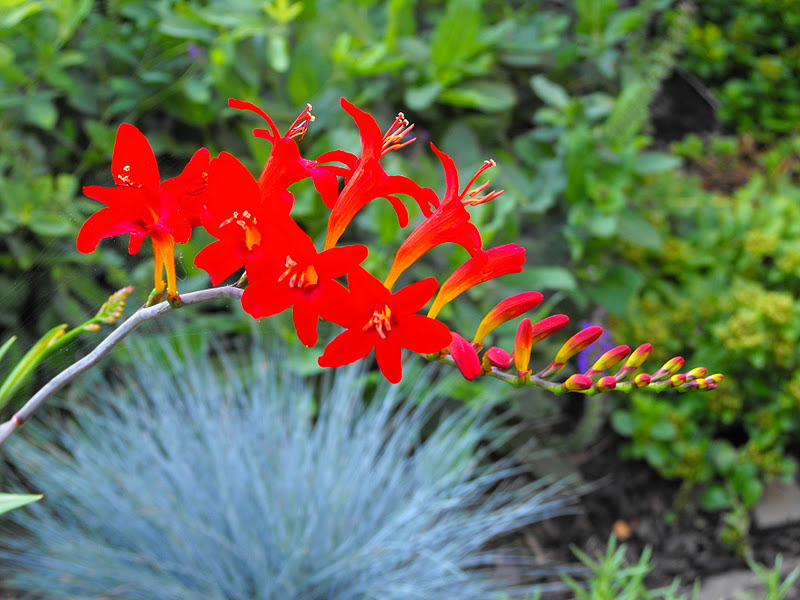
Blue Fescue Grass proves a diaphanous companion to Crocosmia Lucifer. Far from dousing the devilish heat of Lucifer, Blue Fescue spurs it on to extravagant license, all the while Crocosmia urges Blue Fescue into hypnotic decadence.
Likewise, red makes otherwise pedestrian greens burst in improbable ways. This blood-red geranium (no, the photos do not capture this) accentuates the dappled texture of the otherwise ordinary green of the Sum and Substance Hosta, while making the blue/gray greens of the Iris' sword-like leaves sharper, crisper. Of what did these swords prick or penetrate to make the blood run so red?

At the same time, the black pansies appear as spent embers of a blazing fire, each flower both a backdrop and a centerpiece.

A blanket of gold created by fallen gingko leaves does enliven the otherwise drab landscape. But notice what else it does: it allows the greens to self-distinguish to sublime effect,

just as the bronzing leaves and burgundy legs of Rose Mallow in the mid-autumn garden allow the varying greens of Blue Star Lithodora, the sheaths of Spiderwort, and the gossamers of (a now faded) Blue Fescue to announce their differences in ways they otherwise could not.

But I leave the final word to red, not because it is my favorite color (it is not), but because of the harbinger of spring the photo represents. The quintessential vernal flower--the tulip, in this case, Corona kaufmanniana tulip (the earliest blooming varietal, which I brought back from the Netherlands)--converses with Euphorbia x martinii Rudolph Waleuphrud.
They speak, by virtue of the coloration they share, the same language. Yet like the old year that has passed, Rudolph Waleuphrud appears aged and speaks in hushed, measured tones, while Corona, adorned in vibrant attire, speaks with alacrity and a brightness appropriate for youth. The conversation, though, would hardly be complete without the other, and in this briefest of moments we intuit the "there-ness" we otherwise miss, experience the subduction of all that occupies and seduces, and revel in the majesty that is.

Happy New Year to all!!!


