Showing posts with label Rudolph Waleuphrud Euphorbia. Show all posts

Thursday, April 26, 2012

Impressionable Youth

I was an advertisers' wet dream when I was younger.

I absorbed everything and remembered every jingle, no matter if it was for cereal or BMWs.

These days, I neither watch TV nor pay attention to much...in fact, Viet often blurts out some judgment or statement while we are on road trips and I look at him quizzically.

"You know, the billboard."

"Huh?"

" Um.... you didn't see that 30 foot high sign with a blazingly hot, and nearly naked, guy advertising hair removal?" (Note to reader: there really is such a billboard on I-95 just north of downtown Philadelphia...though I think there might also be an attractive woman posing with the guy...)

"Really?!" I ask incredulously, thinking he makes these things up.

"Yeah." He's resigned to accept my inability to see the world around me.

"Damn it. How could I have missed that?!  I didn't see it."

My advertising memory remains stuck in the 1980s.

Thus when I came upon the fuchsia azalea and the flaming red legs of Rudolph Waleuphrud Euphorbia yesterday, I suddenly muttered "New Jersey and You, Perfect Together."

Former Governor Tom Kean would be proud that his desperate campaign to correct the armpit-of-New York, industrial wasteland, medical-waste-washing-up-on-shores images of New Jersey worked for at least one New Yorker.

And for the record, I sing "Canada, Come to the World Next Door" nearly every day.


Sunday, March 25, 2012

Axis of Evil, and all that...

Politicians wed a while ago that contemporary communication malaise called the "sound-byte." Of course, we might attribute this unholy alliance to Twitter and Tweets and Feeds and Status Updates, but really, the sound-byte has a protracted, though not necessarily venerable, history.

"Tippecanoe and Tyler Too."

"A Day that will Live in Infamy."

"The Buck Stops Here."

"Labour is not Working" (for you Anglophiles and those on that side of the pond).

There are certainly more colorful ones, such as the unwittingly sexualized "We Polked You in '44,We Shall Pierce You in '45" (boy did that one work!) and more ominous ones, such as "Arbeit Macht Frei."

The Sound-byte, the slogan, is supposed to capture an essence, a Weltanschauung, through rhythm or metaphor or some form of word play. For the most part, it does that even if ones from times past may have lost resonance to contemporary ears.

Of course, there are inadvertent slogans, such as "Read My Lips" or "It's the Economy Stupid" or "Where's the Beef?!" that assume the de facto status of slogo-sound-byte. These are perhaps the best ones, in part because they are so ostensibly off-the-cuff, though I can't help but find geekish infatuation in the devised "Labour is not Working."

In 2002, George W. most famously gave us the "axis of evil" in reference to that unholy trinity of Iraq, Iran, and North Korea, to which John Bolton added Cuba, Libya, and Syria as a "beyond the axis" category. Not to be outdone, Condoleezza Rice constructed an "outposts of tyranny" label for Belarus, Zimbabwe, and Myanmar. That's the thing about slogo-sound-bytes: they demand one-up-(wo)manship, such that "Four More Years" became "Four More Wars."

The garden is not immune to the creation of axes, and even to one-up-manship.

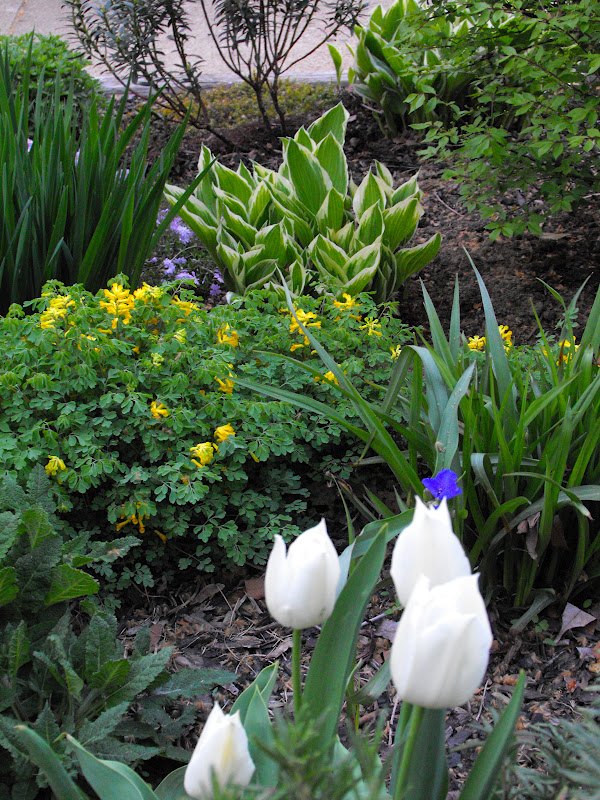
Corydalis lutea, in a sort of women's lib protest, inserted herself in the axis of white in the entrance sun garden, 


while reds of the most alluring sort provide stimulation in an otherwise calming front garden-scape dominated as it is this time of year by whites, blues, pale greens, and a few accompanying splashes of yellow. Here, the vibrancy of the red tulips (which, to remind my reader, were labeled Tulipa Triumph Deep Blue) is pulled through to the other side of the garden in the delicate chartreuse flowers of Rudold Waleuphrud Euphorbia.


Looked at from another angle, reds appear in deeper, regal hues (in the guise of the Ben Franklin Double Red Peony) and the ruddy legs of Rudolf Waleuphrud. Yes, dear reader, his carpet matches the drapes.


In the gardening world, "repetition" is the equivalent of the slogo-sound-byte. Repetition of color or particular plant "draws the eye" around and through the garden, and provides some continuity that lends coherence to the whole. In the East Side Shade Bed I use the rather pedestrian Diamond Tiara Hosta as a a visual avenue linking the whole bed. Diamond Tiara also finds limited homes in other parts of the rear garden, thereby providing a continuity of flow and a respite for one's eyes.

Diamond Tiara Hosta is good-natured, for it knows that its presence--really only spectacular in the early spring before other plants emerge--allows the spotlight to always shine upon others: whether Kirengeshoma palmata Yellow Waxbells, Kerria japonica, the late spring blooming fuchsia Astilbes, or the Nikko Blue Hydrangea.
 

In the rear garden, yellows and whites provide the visual axes. But this is a special time of year, for deep blues make a pronounced appearance. Kerria japonica put on quite the show this year with its brilliant, luteous flowers. For a brief spell, golds and yellows dominated; whites, notably on the margins of the Diamond Tiara but also in the stands of bell-like flowers of Pieris japonica and now in the Leatherleaf Viburnum which overhangs the Buddha bed, help alleviate the visual stress. Now, streams of blue thread through the garden, rather explosive in their appearance, yet always, simultaneously, exuding a sense of respite. 

Lysimachia (Creeping Jenny) accentuates the margins of Golden Tiara Hosta, set as they are against a backdrop of black mulch. The drama in the lantern bed is provided by jessamy axis, which begins with the Golden Tiaras, extends through the Lemon Drop Hostas (one of which is seen at the top of the above photo), accented only at this time of year by June Plantain Hosta, and filtered out through the pale-yellow white (ochroleucous) of the Ghost Fern at the far end of the bed, situated at the base of Nandina.

All of the visual axes, and all of these insertions, remind us of the sheer ephemerality of the construction, whether that construction be the garden or the slogo-sound-byte. For blooming times pass, and politicians go. Tweets flutter away with alarming alacrity, making a mockery of the person we are and the things we do, just as the status update demands not stagnation but contemporization. But in the end something remains: the principle remains...the principle that gives our lives and our myriad of activities meaning, the principle that evidences our desire to be in this world, remains. And so we have Vita's Sissinghurst and Johnston's Hidcote, Jeckyll's Munstead Wood and Lloyd's Great Dixter, and for you mid-Atlantic folk, the DuPonts' Winterthur and Longwood, and Bartram's garden to join all of those slogo-sound-bytes that are now the residue of history. 


Saturday, March 10, 2012

The Desert of One's Own Emptiness


For the last three days I've battled my writing demons: those nasty little voices that demean one's abilities, disparage the sentences one has crafted after endless hours that veer between joy and mental exasperation, and question the very fiber of the life that one has come to cultivate.

Gardening is the one arena, the one vocation in my life (and gardening is a vocation) in which the demons remain well at bay, defeated as it were only because they have not found a conceptual hook on which to gain a foothold (even if the late winter fiery reds of Rudolph Waleuphrud Euphorbia evoke a demonic presence). I have ancestral callings as my foundation, and a first prize winning garden as my demon-proof structure.

Yet on these brisk late winter days, sandwiched between unseasonably warm ones that coax many a plant from their underground lairs, when gardening seems improbably suspended between a nearly forgotten past and an ostensibly distant future, one must face the demands of work that beckon.


Feeling defeated, I decided this morning to slay the demons, to go all Buffy on their asses; the run and workout were just what I needed. But then a curious thing happened while driving home from the gym.

I tuned in midway through an interview on NPR. There was some brief talk about classical music and then some childhood reminiscing about the time the interviewee asked Richard Burton, a fellow Welshman, for his autograph, at which point I began to listen with trance-like rapture since my father lives near one of Elizabeth Taylor's daughters, and Elizabeth Taylor was once married to Richard Burton.

And then the statement that hit me resonated from the radio:  "I wanted to escape from the desert of my own mental emptiness..." Scott Simon, incredulous, asked "to escape the desert of your own emptiness? Really?"

Being naive at these sorts of things, I didn't recognize the voice until Scott Simon thanked Sir Anthony for his time at the end of the interview.

Sir Anthony as in Sir Anthony Hopkins, the actor famous for, coincidentally, his Academy Award-winning portrayal of a demon of another sort--a cannibalistic serial killer, in addition to my favorite Hopkins' roles as the repressed butler, Mr. Stevens, in the cinematic rendition of Kazuo Ishiguro's The Remains of the Day, or as Henry Wilcox in Howards End, as well as a vast list of other critically acclaimed performances.

The moment was not lost on me. We all have our demons, don't we? Even the famed and fortuned, the talented and celebrated: but we knew that, already, for celebrity deaths related to poisons of pleasure indicate lives gone awry, vanquished by formidable adversaries we might call demons.

But we slay our demons in so many ways. Sir Anthony, by the way, further escapes the desert of his emptiness by adding another credit to his astonishing career, for he has finally fulfilled a lifelong dream by composing his own classical music, a recording of which by the City of Birmingham Orchestra was recently released on CD and which has apparently catapulted to the top of the list in classical music sales.
 
Looking around this sunny, breezy, if chilly day (our last in the forecasted 7-day future, when daytime highs will spike into the low 70s), I see a desert of another sort: the late winter garden, slowly beginning to rejuvenate, more torpid than teeming.

Robert Frost told us so long ago that "nature's first green is gold," no doubt a reference to the iconic coloration of New England willow buds, mere gossamer threads that seem to belie the profound transformation that is about to occur in the landscape.

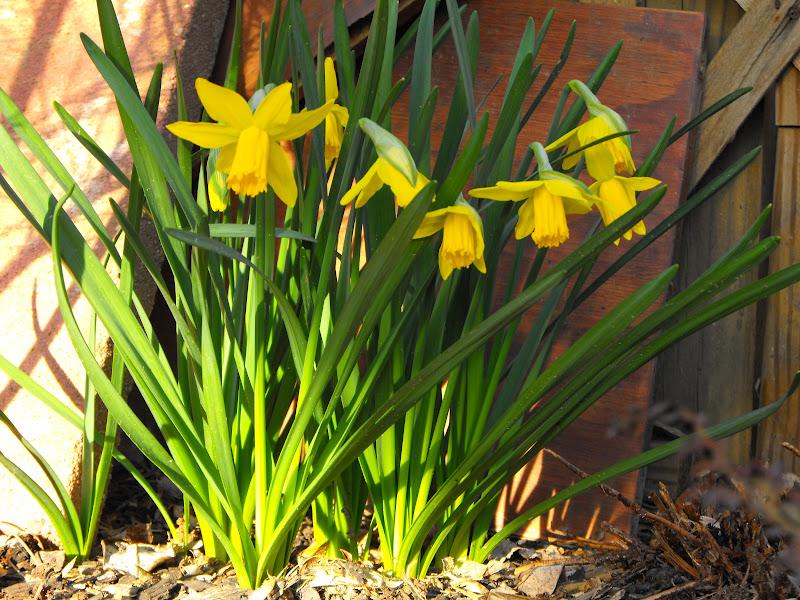
Having no room for willows, I recreate a golden landscape with Aucuba japonica Mr. Goldstrike crowning the Buddha, Aureomarginata Euonymous japonica (Golden Euonymous; above left), Citronelle Heuchera (above, foreground), and, lest we forget that heir of spring, the daffodil.

I'm fortunate for that coincidence, and for Sir Anthony's eloquent articulation of the content of his condition. For I went into the desert that is my late winter garden and saw those bright, cheery yellows and golds which exude such promise and hope.

Gold: the color that slays the mighty demons.


Saturday, November 12, 2011

Subduction


Subduction is an odd word.

It sounds like the bastard child of abduction and seduction.
 
But it is not. In fact, it is the opposite of what my dirty thoughts suggest: that is, not reproduction and thus the addition of something else, but rather a subtraction, a withdrawal, a removal.

Subducere, from which subduction derives, conjoins the prefix sub- (under, below, beneath, secondary, less than) with the root ducere, meaning to lead. Ducere makes me think immediately, of course, of Il Duce himself, with his corpse hanging upside down and all that that implies: secondary leadership, attempted escape, execution, withdrawal.


Yet the term has lost its ordinary meaning, having been adopted by geologists who will, no doubt, be puzzled by my application of a technical term of science to gardening. In plate tectonics, subduction refers to the process by which the edge of one crustal plate descends below another. Nine of the ten most powerful earthquakes to occur in the last century were subduction zone events, including the 2004 Indian Ocean and the 2011 Tohoku (Japan) earthquakes, both of which produced devastating tsunamis.

My autumnal world, it seems, is undergoing a process of subduction. A withdrawal. Sure, that is the cycle of seasons, yet there is something else going on: a subduction of color.

If subduction in the rear garden assumes various shades of yellow--a veritable pot of gold into which all colors are absorbed, made more spectacular by the golden canopy of the maple tree, then the front garden experiences a subduction dominated by hues of red and purple.

The Orange Marmalade hosta, having turned a brilliant shade of gold, begins the East Side Shade bed's autumnal glory,


and is joined by the Big Blue Angel hosta, which has turned  this brilliant shade of amber, accented by the leathery greens of East India Holly Fern.


Gramsci looks veritably pleased that the world has capitulated to his omnipotent handsomeness by turning his golden-boy shade of glory, though I surmise he may also feel a tad bit overwhelmed by the ubiquity of  "the color of him."


In the front garden, the burning bush takes center stage, and is complemented by the single petaled daisy-like chrysanthemum and the now denuded burgundy stems of Rose Mallow, and offset by the creamy variegation of the Siberian Iris.


Rudolph Waleuphrud Euphorbia begins to come into his own, his tips deepening their ruddy display in preparation for his Christmas pageantry. He's a one man show at that time of year, and he simply must shine.


In the meantime, Gramsci searches for the fresh green grass on which he likes to graze--grass that will no doubt in a few weeks experience its own subduction by winter white.


Saturday, December 11, 2010

Adult Pleasures VI: Boozing it up

Oh baby! (We've not had some dirty thoughts in such a long time...so be forewarned! After all, wasnt Santa looking out for nice and naughty?! And isn't that hoary frost on my Euphorbia?!)


It’s that time of year when we’re all rockin’ around the Christmas Tree (or the Hanukkah Bush), having a little egg nog with our Bourbon, and sipping on (more than) a few Pomegranate Martinis. Sip on too many and maybe you might just see that bright red nosed reindeer that Johnny Marks, Jewish-American songwriter, so affectionately called Rudolph, high in the sky!

Or are those red-tips from something else entirely?

Why don’t you just save yourself a not-so-merry little hangover and come on over to my garden instead! Euphorbia x martini Rudolph Waleuphrud is gradually succeeding the Asteraceae family on his way to becoming the star of the winterizing front sun garden—and what a specimen he is! How could he not be?! With Martini in his name and sporty red-tips his game, he offers something for everyone: with circular bracts of joyful apple and lime green florets surrounding stunningly red star-shaped centers in the spring; clumping upright habit of dark green with reddish undertoned evergreen (that is, non-herbaceous) leaves; and red rosettes (like Rudolph's fabled nose!) throughout winter that offer just that dose of holiday cheer we so desperately need during the monotonous pre-snow brown-season, Rudolph adds unexpected joy (unexpected for me, since I fixated on the term “Martini” and conveniently glossed over all other relevant information … “what a lush!” my dear reader must be uttering!).

Rudolph, with your bracts so bright, won’t you guide my garden tonight (and until spring)? [Keep singing...]

Oh how the gardeners love him,
As they shout his name with glee,
Rudolph the red-tipped Euphorbia,
You’ll go down ever so easy!

Uh, yeah, that last line had more to do with my Pomegranate martini than my dear Rudolph…You certainly wouldn’t want to drink him because he is, like all Euphorbias, poisonous—so poisonous in fact that his milky-white liquid on your skin will produce quite the nasty rash!

Ah, Rudolph Waleuphrud… he’s so dreamy.

If he loves you, he’ll do wondrous things before your eyes… like send up this lone and quite unseasonal spike of florets, tempting me towards spring which feels at the moment ever so far away. Any man who brings me cut flowers...well, now... he must be hot for me. (But then again, his red leafed rosettes are not quite as red as the garden guides indicate. True, these things take time, and the process of reddening has only just begun.)

Regardless: I blush with excitement.

(Or perhaps that’s the Pomegranate Martini I drink in his honor.)


Thursday, July 29, 2010

Reunions

Viet and I met several Americans (all "young" women--twenties and thirties) on our return flight home, all traveling alone save for two friends who took advantage of cheap airfare to visit Denmark for 5 days, and I was struck by a comment each of them made on separate occasions: they were all very happy to be returning home.

Traveling when young(er) is easy: having few if any attachments liberates the self in so many senses, and enables one to pick up and leave unencumbered, bound only by a plane ticket, perhaps a hotel reservation, and whatever preconceptions one may have developed of a place. Many of my students readily take advantage of the university's multiple study abroad programs; they leave with abandon, armed with energy, excitement, desire to see the world, and a healthy dose of idealism.

But as one grows older, attachments come in many forms: children, pets, homes, jobs, gardens. Traveling becomes a bit more psychically difficult, and the return home is looked forward to, joyous, even sweet. Our roots urge us, nay, pull us back from our jaunts.

True, I was ready to come home days before our departure. I turned to Viet and announced my readiness. I had, in the language of my sage friend Jim, truly vacated.

Most of us have obligations to which we become accustomed and which compel us always to return. Many of us are fortunate enough to create a life, thereby making the return bearable if not enjoyable. A few of us actually grow into life, and thus the return is as important as the time away. The house and gardens at 410 have offered me both the opportunity to create a life and to grow into life--and seeing Rose Mallow, now reaching to my nose, and her single glowing red flower, even in the darkness of night, painted my return in most illustrious of colors.

Armed with my camera, I emerged from the house the next morning to photograph this beauty, only to find her only flower dropped to the ground. Welcome home. But she is rife with buds, and I look forward to her amorous display of seduction.

I scanned the gardens and was surprised by what survived and flourished in the extreme heat and humidity, and also by what died. One purple day lily, which had a blossom when I departed, had two single mini-leaves; clearly it died back at some point but with recent heavy rains it began to grow again. Gaura died; or perhaps is merely aestivating. Several of the hostas in the rear garden baked, as did many of the ferns.  Ligularia flowered, but now the flower stalk stands burned, dried, cracked, and several of the leaves have fallen to the ground unable to withstand the heat.

But the Rudolph Waleuphrud Euphorbia doubled in size, while Tall Purpletop Verbena looks like it tripled. The Provence lavender has produced another round of blooms, the Catmint is now quite tall albeit leggy, and the Feverfew has rejuvenated after what I assume to have been long weeks of crispy edginess. The Lemongrass, which had 12 stalks when I departed, now has 25. The potted mint is flourishing finally, while of two patches of mint in the garden one struggles for existence while the other seems to have vanished. My friend Kathy mailed me a clump of Siberian irises earlier this season, and it had struggled since I planted it. Now it flourishes. 

So many changes, and so much work to be done.

A praying mantis greeted me this morning, coming up and out from within the chrysthanthemum, probably wondering when I was going to start my chores. In due time, in due time. 

Welcome home, indeed. It feels rather good.