Twenty-nine degrees this morning brought with it the second appreciable frost of the season--but not a frost frigid enough to destroy many of the hardier perennials or even affect the shade garden, still protected as it were by the now-decimated golden canopy of the maple tree.
The front garden, exposed, bore the brunt of the frost, which visibly extended its icy grips across my miniature botanical garden.
If frost claimed the vestiges of this hosta, already ravaged by the first (light) frost several weeks ago,
then it proved an ancestral accoutrement for this Sedum ellacombanium, native to northern Japan and the Kamchatka Peninsula, which, flowering well into the chill of November, looks dazzling draped in frosty white.
The Siberian Iris, bespeckled with gelid diamonds, appeared to reminisce, never so close to its indigenous Asian steppe as on the morning of the first frost which clings to its elongated fingers.
The frost surprised me, but not for the expected shock of its arrival, its veritable message that the gardening season has ended. After all, my insomniac self counted not sheep but the number of times the heating system turned on since 1:48 a.m.; I was very much aware of the consuming chill of the night, constrained also by 3 cats eager to capture every kilowatt of heat emanating from my body.
No. The frost surprised me by what it instigated and what it claimed.
It instigated an unexpected if disturbing sense of release: a release from obligation, a release from care, a release from service.
How positively strange. I love gardening. It is my escape. And yet, like the gym and this blog and my research and my house cleaning, my gardening life has been hijacked. Frost announced that all is virtually over, and that the mess that I call a garden, once first prize winning but for weeks an overgrown mass of mess, no longer needed my attention. Frost proved my absolution for the paralyzing guilt that had been building up for weeks, caught up in the pressure cooker that has become the metaphor for my life. Frost proved its release. Frost saved me from my self.
As is my nature, I lapsed into brooding (as unbecoming as brooding may be). That sense of release has consumed me, commanded my attention all morning. In my brooding I have come to realize what the frost must also claim: my sense of abandonment, my hijacking. These must end.
We are not hedonists when we care for the self, whether care assumes the form of gardening, or shopping, or blogging, or working out. No. We are tenders of the soul.
And now I come to realize the importance of advice given to me several months ago: I need to learn how to ignore and to prioritize. To prioritize is not to put others always above and ahead of the self. To prioritize is to recognize that others must learn to tend to their own selves and to take responsibility for the choices they make.
Amazing: if frost is usually denigrated for that which it takes away, today I celebrate frost for what it has brought (back) to me.
Showing posts with label Sedum ellacombanium. Show all posts
Saturday, November 19, 2011
Monday, May 30, 2011
Divisions: The Thin Blue Line
Gardeners often speak of divisions. This is not to suggest that gardeners like mathematics, or speak in a private language framed by numerology. No, though I do surmise it may have to do with dollar signs and being "cheap." After all, garden centers (not Lowes or Home Depot, but those local specialty garden shops and nurseries) charge premium prices (albeit for very fine, very robust, generally disease resistant plants),and in these times we may feel the need to "economize."
"Division" refers to the act of digging up a plant and breaking it up (dividing) into smaller plants, each new plant equipped with foliage and roots (click here to see a brief video on how to divide perennials, or to read this article). The gardener can share these with others; keep the plants in one's gardens manageable by controlling plants' tendency to overcrowd; and expand one's gardens themselves by getting more plants for one's money.
Yesterday, restless, I ventured outside at dusk--at the fleeting moment of time when blues, especially, glow in the not quite daylight/not quite darkness. And there I saw a different kind of division: my own thin blue line.
I seem to recall the UN peacekeeping presence in Cyprus described as a "thin blue line" separating the Turkish occupied north from the Greek south. The description is apt: blue helmeted UN peacekeeping forces occupy a swath of land stretching across the island country, a buffer between the parties, both a symbol of the de facto division of the country and a symbol of the inability of the parties to come to a final agreement.
[Side note: A search for "thin blue line" yielded no direct application of the term to Cyprus, though it did produce references to police forces as the "thin blue line" between law abiding civilians and criminal elements and non-law abiding citizens.]
My thin blue line does not separate combatants, but rather the warmer yellows (Corydalis Lutea and the now blooming Sedum ellacombanium) from the calming, meditative whites (of the Siberian Iris, the Diamond Tiara Hosta, Husker Red Penstemon, and Feverfew).
It begins with the Blue Fescue (or Festuca glauca) Grass, extends to the Maynight Salvia, Spiderwort, and the other Blue Fescue Grass, onwards to Blue Star Lithodora (difficult to see in the photo, and at the very end of its flowering season), the Variegated Siberian and Purple Siberian Iris (now both out of bloom), and, on the other side of the garden, the Provence Lavender (though it is neither blue nor in bloom, but it does echo the color).
But no garden deserves to be divided along such stalwart, impenetrable lines. Colors must flow. The eye must be allowed to wander with ease. And so the gardener must visualize in the language of politics infiltrations, spies, and irregular combatants, and place them strategically in the garden to unite the parts and create flow. The red berries of Hypericum (St. John's Wort) and the chartreuse of Lysimachia on the "white side" are my irregulars, and converse with the warm colors on the other side of the thin blue line. The blues themselves, later in the gardening season, will begin to melt into the lower bed as the blue/purple day lily blooms and the Tall Purpletop Verbena rewards us with its July 4th fireworks-quality flowers.
And when the recently relocated Rose Mallow blooms later this summer--right in the middle of the thin blue line--well, then, the blast will no doubt resonate and the effect of the thin blue line will be lost.

For now, though, I enjoy seeing my little blue headed flowers march not in formation, but staggered, through my garden, drawing my eye and my mind into the future, imagining how the garden changes.
"Division" refers to the act of digging up a plant and breaking it up (dividing) into smaller plants, each new plant equipped with foliage and roots (click here to see a brief video on how to divide perennials, or to read this article). The gardener can share these with others; keep the plants in one's gardens manageable by controlling plants' tendency to overcrowd; and expand one's gardens themselves by getting more plants for one's money.
Yesterday, restless, I ventured outside at dusk--at the fleeting moment of time when blues, especially, glow in the not quite daylight/not quite darkness. And there I saw a different kind of division: my own thin blue line.
I seem to recall the UN peacekeeping presence in Cyprus described as a "thin blue line" separating the Turkish occupied north from the Greek south. The description is apt: blue helmeted UN peacekeeping forces occupy a swath of land stretching across the island country, a buffer between the parties, both a symbol of the de facto division of the country and a symbol of the inability of the parties to come to a final agreement.
[Side note: A search for "thin blue line" yielded no direct application of the term to Cyprus, though it did produce references to police forces as the "thin blue line" between law abiding civilians and criminal elements and non-law abiding citizens.]
It begins with the Blue Fescue (or Festuca glauca) Grass, extends to the Maynight Salvia, Spiderwort, and the other Blue Fescue Grass, onwards to Blue Star Lithodora (difficult to see in the photo, and at the very end of its flowering season), the Variegated Siberian and Purple Siberian Iris (now both out of bloom), and, on the other side of the garden, the Provence Lavender (though it is neither blue nor in bloom, but it does echo the color).
And when the recently relocated Rose Mallow blooms later this summer--right in the middle of the thin blue line--well, then, the blast will no doubt resonate and the effect of the thin blue line will be lost.
For now, though, I enjoy seeing my little blue headed flowers march not in formation, but staggered, through my garden, drawing my eye and my mind into the future, imagining how the garden changes.
Wednesday, April 27, 2011
Leap Year
Yes, this is a leap year folks!
There is no 29 February on your calendar?! The next leap year is 2012?! (One extra day to prolong the misery of February, one extra day before one gets paid: what is there to actually love about leap year day?!)
Forget what conventional wisdom tells you.
No, folks. This is my leap year (though I admit, this may not be your leap year).
On what basis do I argue this?
There is an old gardening adage when it comes to the plant kingdom: the first year they sleep, the second year they creep, and the third year they leap!
Now, forget what I just told you about conventional wisdom. This adage is right. It is no longer a hypothesis, but a veritable nugget of wisdom cultivated in fields of black gold.
(I agree: the metaphors were mixed, the image idiotic, and the sentence just plain stupid.)
But the proof is in the pudding (ha! gotcha with another metaphor!). Try it.
While dating my garden is difficult to do--one always adds and subtracts, things die over the winter, etc.--the entire front sun garden dates to 2008, as does the East Side Shade Bed which I renovated late last fall. And the two beds that run along the backyard deck also date to 2008. The newly-dubbed Lantern bed was planted in 2009. So for much of my garden (construed as a whole, not simply as the aggregate of its many parts), this marks the 3rd year of existence.
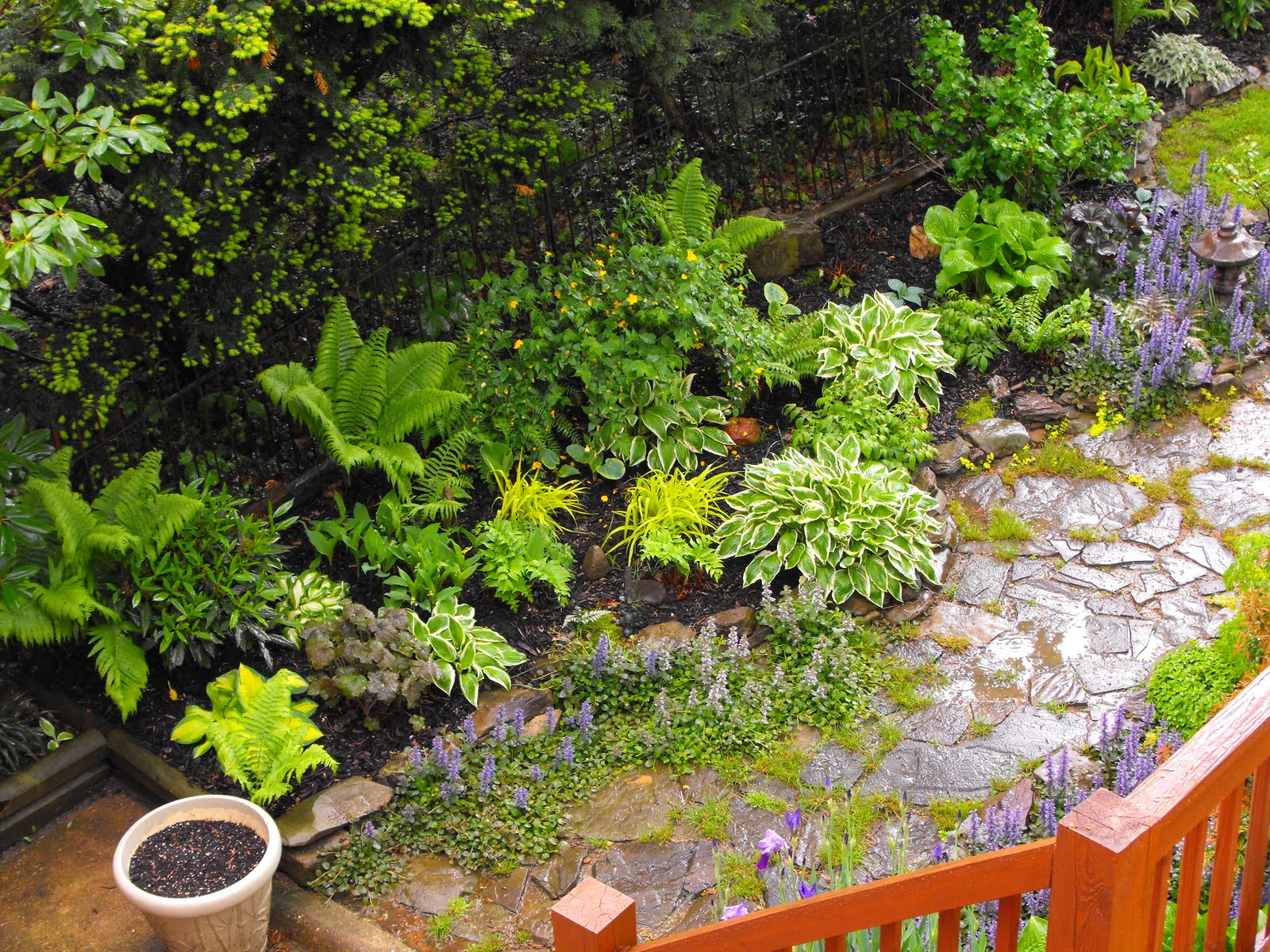
And already I see signs of lots of "leaping!" (I haven't space to showcase particular plants, so I've opted to provide "aerial" shots of the back shade garden, some taken in the rain.)
Keep in mind that some plants--especially those in the deep shade of the extension of the Buddha Bed, the autumn ferns, and the blue based hostas--have only recently emerged. Keep in mind that though we've had some rather unseasonable heat, the temperatures have wildly fluctuated over the last 6 weeks (indeed, just late last week did we experience temperatures in the 30s with a threat of frost last Thursday evening).
Despite those caveats, the many specimens are flourishing thus far!
The Lantern Bed (of 2009; so this would be the year of creep)
My blue bed: a veritable sea lashing against the shores of Sedum ellacombanium, with the towering red mountains of Pieris japonica and Sum and Substance Hosta presiding...
The renovated East Side Shade Bed, with Kerria japonica now past its prime flowering, with color being provided by the flowering blue spikes of ajuga and the yellow-oranges of Orange Marmalade Hosta and the Golden Kate Spiderwort
More of the ESSB and the Buddha bed, with the neighbors fragrant Viburnum towering above
The Lantern Bed looking back at the newly renovated rear corner, with Ostrich ferns proudly dominating over the new addition to the garden, Leatherleaf Mahonia
There is no 29 February on your calendar?! The next leap year is 2012?! (One extra day to prolong the misery of February, one extra day before one gets paid: what is there to actually love about leap year day?!)
Forget what conventional wisdom tells you.
No, folks. This is my leap year (though I admit, this may not be your leap year).
On what basis do I argue this?
There is an old gardening adage when it comes to the plant kingdom: the first year they sleep, the second year they creep, and the third year they leap!
Now, forget what I just told you about conventional wisdom. This adage is right. It is no longer a hypothesis, but a veritable nugget of wisdom cultivated in fields of black gold.
(I agree: the metaphors were mixed, the image idiotic, and the sentence just plain stupid.)
But the proof is in the pudding (ha! gotcha with another metaphor!). Try it.
While dating my garden is difficult to do--one always adds and subtracts, things die over the winter, etc.--the entire front sun garden dates to 2008, as does the East Side Shade Bed which I renovated late last fall. And the two beds that run along the backyard deck also date to 2008. The newly-dubbed Lantern bed was planted in 2009. So for much of my garden (construed as a whole, not simply as the aggregate of its many parts), this marks the 3rd year of existence.
And already I see signs of lots of "leaping!" (I haven't space to showcase particular plants, so I've opted to provide "aerial" shots of the back shade garden, some taken in the rain.)
Keep in mind that some plants--especially those in the deep shade of the extension of the Buddha Bed, the autumn ferns, and the blue based hostas--have only recently emerged. Keep in mind that though we've had some rather unseasonable heat, the temperatures have wildly fluctuated over the last 6 weeks (indeed, just late last week did we experience temperatures in the 30s with a threat of frost last Thursday evening).
Despite those caveats, the many specimens are flourishing thus far!
The Lantern Bed (of 2009; so this would be the year of creep)
My blue bed: a veritable sea lashing against the shores of Sedum ellacombanium, with the towering red mountains of Pieris japonica and Sum and Substance Hosta presiding...
The renovated East Side Shade Bed, with Kerria japonica now past its prime flowering, with color being provided by the flowering blue spikes of ajuga and the yellow-oranges of Orange Marmalade Hosta and the Golden Kate Spiderwort
More of the ESSB and the Buddha bed, with the neighbors fragrant Viburnum towering above
The Lantern Bed looking back at the newly renovated rear corner, with Ostrich ferns proudly dominating over the new addition to the garden, Leatherleaf Mahonia
Saturday, May 15, 2010
It's Electric
One afternoon in mid-August 2008, two months after I planted the east shade bed with the bounty bestowed upon me by Phyllis (see earlier entry), a ferocious thunderstorm wreaked havoc on Wilmington. Several inches of marble size hail fell. High winds uprooted a massive old tree in Brandywine Park. Our street turned into a massive, raging ice flow, garbage and recycling bins carried away for several blocks. Needless to say, very few plants and trees retained their leaves after such a devastating storm, and the garden never did recover that season. The optimist might say that the storm excused me from having to do my late autumn garden chores and readying the bed for its winter respite.
And our thunderstorm brought with it a bolt of divine lightning, as the first of at least 14 white Siberian irises bloomed overnight, its bit of yellow nicely echoed by the yellow tubular flowers of the Corydalis, reminding us that the divine is human and the human is divine.
Standing up, I am brought back to reality, perhaps because of the click of the knee or the twang in my lower back, or perhaps because my eye spies a little weed, or perhaps the sounds of the birds and the breeze on my face, or perhaps because of the sight of peeling paint on the porch deck, or perhaps the realization and the assuredness that this garden is my creation.
The effect is electric.
Subscribe to:
Posts (Atom)