Showing posts with label Tiarella Dark Star Foam Flower. Show all posts

Thursday, April 19, 2012

Water, Water Everywhere, But Not a Drop to Drink

If you live in the mid-Atlantic region, you might be puzzled by the title of today's post.

We haven't had rain in weeks.  Early summer-like temperatures add to the misery (misery for plants, parched as they are).

I recently adjoined two flower beds: the lantern bed and the crescent bed bordering the stone patio. Even 14 inches down, the soil is arid. With merely traceable snow this winter, above-average temperatures for months, and limited spring rains, we face a considerable problem moving into the summer.

So when I see my Tiarella Dark Star Foam Flower, rather neighborly with Brunnera and its sky blue flowers (or might that be sea blue?), I think of the sea foam that forms on (some) beaches--and I feel refreshed.

Tiarella, some websites inform us, like consistently moist soil.

However, I purchased it at Mt. Cuba in Delaware (one of the several DuPont estates and gardens), and was told it tolerated well dry soil, being a native of woodlands (where tree roots presumably absorb all available moisture).

And mine is doing extraordinarily well in its raised bed underneath a Norwegian maple tree (the most notorious moisture thief transplanted to North America)!

Despite her nomenclature, she is a good natured gal.

(Some may take offense at that statement.)

But really, with her name, what can you expect?

Tiarella, as in from the Greek tiara. Think princess. Stuck-up. Bossy. Demanding. Some prissy prima donna, first lady of the stage, a Maria Callas refusing to sing because of some pretense or intuited offense.


If you think her given name is any indication of her personality, well, then, meet her family: Saxifragaceae.

Yes, Sax.

How about this spelling: Saks (as in Fifth Avenue)?

Our darling little princess, it seems, has expensive taste, or is from a family of expensive tastes!

But, alas, she is quite modest--so modest that she has rewarded my virtual neglect of her with masses of foam flowers (even during Mother Nature's desertification of Delaware).

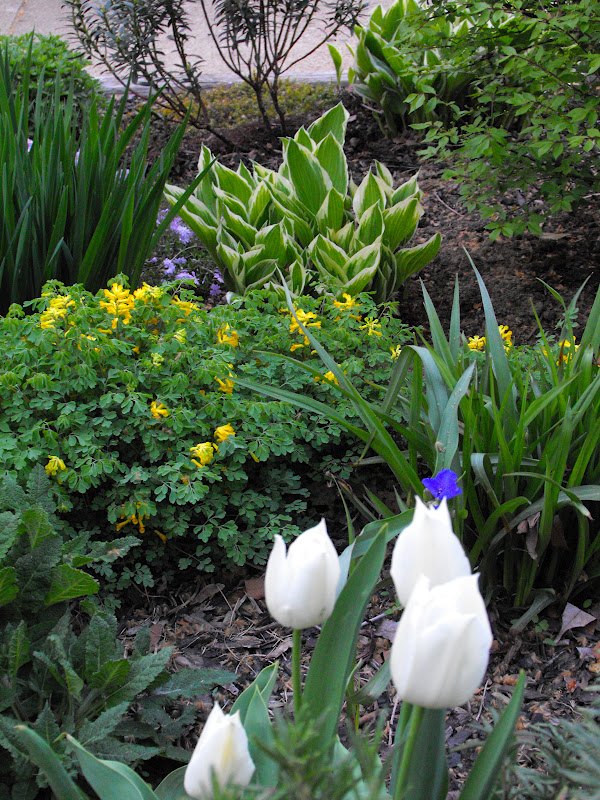
Corydalis, the harlot of my garden, accents Tiarella's bright yellow anthers (a bit of seduction, eh?! I hear her whisper: "come, burst forth my darling, give me your seed..."),


while the blue of Brunnera communes so nicely with Tiarella's lavender-colored unopened buds. They are intimate friends; you can see that in the way they delicately reach out to each other, comforted by the other's presence.


In the distance, Solomon's Seal shamelessly offers himself to her: unburdened by undergarments, his flowers dangle from his stems. One wonders if they know that their displays of purity white belie their highly sexualized presence.


So we wait. We wait for sexual contact, made possible through the few honey bees I've seen and massive sized bumble bees (so large they don't have stingers but carry switchblades). 

We wait for rain.

Yet here we have a collection of drought-tolerant plants: Brunnera (macrophylla), Corydalis, Solomon's Seal, and of course, Tiarella, the star of the garden. How do we know? Her leaves tell us so...


Sunday, March 25, 2012

Axis of Evil, and all that...

Politicians wed a while ago that contemporary communication malaise called the "sound-byte." Of course, we might attribute this unholy alliance to Twitter and Tweets and Feeds and Status Updates, but really, the sound-byte has a protracted, though not necessarily venerable, history.

"Tippecanoe and Tyler Too."

"A Day that will Live in Infamy."

"The Buck Stops Here."

"Labour is not Working" (for you Anglophiles and those on that side of the pond).

There are certainly more colorful ones, such as the unwittingly sexualized "We Polked You in '44,We Shall Pierce You in '45" (boy did that one work!) and more ominous ones, such as "Arbeit Macht Frei."

The Sound-byte, the slogan, is supposed to capture an essence, a Weltanschauung, through rhythm or metaphor or some form of word play. For the most part, it does that even if ones from times past may have lost resonance to contemporary ears.

Of course, there are inadvertent slogans, such as "Read My Lips" or "It's the Economy Stupid" or "Where's the Beef?!" that assume the de facto status of slogo-sound-byte. These are perhaps the best ones, in part because they are so ostensibly off-the-cuff, though I can't help but find geekish infatuation in the devised "Labour is not Working."

In 2002, George W. most famously gave us the "axis of evil" in reference to that unholy trinity of Iraq, Iran, and North Korea, to which John Bolton added Cuba, Libya, and Syria as a "beyond the axis" category. Not to be outdone, Condoleezza Rice constructed an "outposts of tyranny" label for Belarus, Zimbabwe, and Myanmar. That's the thing about slogo-sound-bytes: they demand one-up-(wo)manship, such that "Four More Years" became "Four More Wars."

The garden is not immune to the creation of axes, and even to one-up-manship.

Corydalis lutea, in a sort of women's lib protest, inserted herself in the axis of white in the entrance sun garden, 


while reds of the most alluring sort provide stimulation in an otherwise calming front garden-scape dominated as it is this time of year by whites, blues, pale greens, and a few accompanying splashes of yellow. Here, the vibrancy of the red tulips (which, to remind my reader, were labeled Tulipa Triumph Deep Blue) is pulled through to the other side of the garden in the delicate chartreuse flowers of Rudold Waleuphrud Euphorbia.


Looked at from another angle, reds appear in deeper, regal hues (in the guise of the Ben Franklin Double Red Peony) and the ruddy legs of Rudolf Waleuphrud. Yes, dear reader, his carpet matches the drapes.


In the gardening world, "repetition" is the equivalent of the slogo-sound-byte. Repetition of color or particular plant "draws the eye" around and through the garden, and provides some continuity that lends coherence to the whole. In the East Side Shade Bed I use the rather pedestrian Diamond Tiara Hosta as a a visual avenue linking the whole bed. Diamond Tiara also finds limited homes in other parts of the rear garden, thereby providing a continuity of flow and a respite for one's eyes.

Diamond Tiara Hosta is good-natured, for it knows that its presence--really only spectacular in the early spring before other plants emerge--allows the spotlight to always shine upon others: whether Kirengeshoma palmata Yellow Waxbells, Kerria japonica, the late spring blooming fuchsia Astilbes, or the Nikko Blue Hydrangea.
 

In the rear garden, yellows and whites provide the visual axes. But this is a special time of year, for deep blues make a pronounced appearance. Kerria japonica put on quite the show this year with its brilliant, luteous flowers. For a brief spell, golds and yellows dominated; whites, notably on the margins of the Diamond Tiara but also in the stands of bell-like flowers of Pieris japonica and now in the Leatherleaf Viburnum which overhangs the Buddha bed, help alleviate the visual stress. Now, streams of blue thread through the garden, rather explosive in their appearance, yet always, simultaneously, exuding a sense of respite. 

Lysimachia (Creeping Jenny) accentuates the margins of Golden Tiara Hosta, set as they are against a backdrop of black mulch. The drama in the lantern bed is provided by jessamy axis, which begins with the Golden Tiaras, extends through the Lemon Drop Hostas (one of which is seen at the top of the above photo), accented only at this time of year by June Plantain Hosta, and filtered out through the pale-yellow white (ochroleucous) of the Ghost Fern at the far end of the bed, situated at the base of Nandina.

All of the visual axes, and all of these insertions, remind us of the sheer ephemerality of the construction, whether that construction be the garden or the slogo-sound-byte. For blooming times pass, and politicians go. Tweets flutter away with alarming alacrity, making a mockery of the person we are and the things we do, just as the status update demands not stagnation but contemporization. But in the end something remains: the principle remains...the principle that gives our lives and our myriad of activities meaning, the principle that evidences our desire to be in this world, remains. And so we have Vita's Sissinghurst and Johnston's Hidcote, Jeckyll's Munstead Wood and Lloyd's Great Dixter, and for you mid-Atlantic folk, the DuPonts' Winterthur and Longwood, and Bartram's garden to join all of those slogo-sound-bytes that are now the residue of history. 


Friday, May 6, 2011

The Best Little Whore House in Delaware

Let's face it: sex sells.

Take The Best Little Whorehouse in Texas Broadway production, for example. It ran for 1,584 performances. So successful it was that Universal Pictures adapted it for an eponymous film starring Dolly Parton and Burt Reynolds, with supporting roles by Jim Nabors and Dom DeLuise. But films take license, and if in the stage production Sheriff Ed Earl and Miss Mona had a one-night stand, the on-screen version placed them in an ongoing affair.

Ah, yes. Sex in all its guises, licit and illicit, vanilla or more "exotically" flavored, stimulates all kinds of attention.

And so we contemporize the story and situate it, like any good plot, in a variety of contexts across time. It seems we have a quaint little whorehouse right here in Delaware.

In Wilmington.

At 410.

Gasp.

Really, people, don;t be too surprised. After all, I've already admitted my--how shall we say?--"easiness." And we've already encountered certain "characters" in the whorehouse, er, I mean garden, such as Corydalis who add a generous dose of cavalier sexuality to the garden.

But every good whorehouse needs, I presume, a really good madame, and I have (inadvertently?) assumed that role. Yet to be exact about it, I think Viet is the madame and I the Burt Reynolds husky sheriff who frequents said establishment. After all, he instructs me on how much money to bring (last year, $100, this year, an undisclosed amount though in the end I exceeded my allowance as any self-respecting gigolo would do being confronted by such....um....seducing beauties). Just sayin'....

In any case, this whorehouse just got larger. For the sun garden:

A new double red "Benjamin Franklin" Peony (again, what's with the freakish or cutesy or seemingly irrelevant names?!) to complement last year's find of a double white Chinese Solange peony; and a (white flowering) Carolina Moonlight Baptisia (False Indigo);

and for the shade garden:

a ghost fern; dwarf Crested Iris, Tiarella Dark Star "Foam Flower," and Hosta elegans for the in-progress blue and white bed; a ghost fern; and Kirengeshoma palmata "Yellow Waxbells."

What orgasmic finds!