Showing posts with label June Plantain hosta. Show all posts

Sunday, January 1, 2012

Color in the Garden: On Color


In a season festooned with vibrant reds and jovial greens, glistening whites and royal blues, sparkling silvers and gleaming golds, the hit television show Glee opted to forgo some of the more eye-catching spectacles in its 2011 Christmas offering. Bathed in black and white and peppered with suave banter, the episode was a show within a show: an homage to a 1963 Judy Garland Christmas show (mixed with, in my narrow view, ridiculous references to a 1978 Star Wars holiday special).

In our color saturated world, black and white stands out: it is construed either as the antithesis of color or the absence of color. Black and white (taken in the singular) is the "there-ness" of that which is simultaneously "there" and "not there." The mandala riot of color of our everyday lived lives becomes, in the black-and-white rendition, a monochromatic subduction. The interplay of light and shadow rendered as variations of gray, not a panoply of color, expresses mood and emotion, and manifests an artistic, yet no less realistic, version of life. Black and white: subject matter in stark relief.

Yet we live our lives in color: we cannot escape it, save for in (some) photography or cinema. By comparison, the use of black and white seems almost indulgent--indulgent not in the contemporary sense of self-gratification (always immediate and always perpetual) yet in the ecclesiastical sense: a remission of punishment, a forgiveness, an act of reconciliation.

Viewed through that prism, black and white dons an ethereal character: a "there-ness" of the seemingly improbable that otherwise would go unnoticed.

And it is this fleetingness of our exposure to the black and white image, the flirtation with the "there-ness" that is simultaneously "there" and "not there," an almost mystical experience with rawness that I find a parallel to the appearance of COLOR in the garden: not color in an ordinary sense, but those pops of preternatural colors that elicit certain responses of wonderment. These are the rich colors of sunrises and sunsets, but also of unexpected juxtapositions of color that, by virtue of the juxtaposition, make a particular color seem more other-worldly than it really is.

If color writ large is merely a vehicle to help us view the world, it is those preternatural pops of color or the unexpected juxtapositions or the black and white moment that really teach us how to see that world.

Perhaps that is the underlying, enduring significance of the garden: not only are they spaces of pleasure, not only are they places of escape, but they serve the wider function of helping us--whether gardener and doer, or visitor and viewer--to see, to understand, to interpret, and to Be.

And so on this New Year's morning, I was fortunate to catch this fleeting glimpse of the first sunrise of 2012 from my third floor:

The sight reminded me of a photo I took of a sunset on 19 November, yet this morning's coloration scheme differed.

The cool intellectual blues of the morning give way to the burning promise of the dawn. The coloration represents a day unadulterated, a calmness of spirit and mind, a readiness.

But compare this to the burnt sky in the November sunset: this is a day in decline, a day spent and readying for its respite.


And then I thought of the cerulean blue of the Hardy Geranium Rozanne (a.k.a. Cranesbill), an unexpected late autumnal appearance in a world dominated by a warm/hot palette of simultaneously fiery yet subdued hues of ochres, red, oranges, yellows and rusts.


And that starkness reminded me of a seemingly distant spring, and the creaminess of White Feather Hosta that soon gave way to a snowy white, complemented as it were by Hakuro-nishiki Dappled Willow (which died during this summer): an unexpected color if only because it appeared not as flower but as foliage.


Those blues....yes, those blues arrest me. The blue-purple of the Ajuga proves a stunning sea in early spring, and thus makes an exquisite addition to any garden. Yet it relinquishes some of its singular drama when paired with this June Plantain Hosta, the blues of each complementing and accentuating the virtues of the other,


while Ajuga properly fades into the background when the gardener needs it to do so, as when paired with this Lemon Drop hosta. 


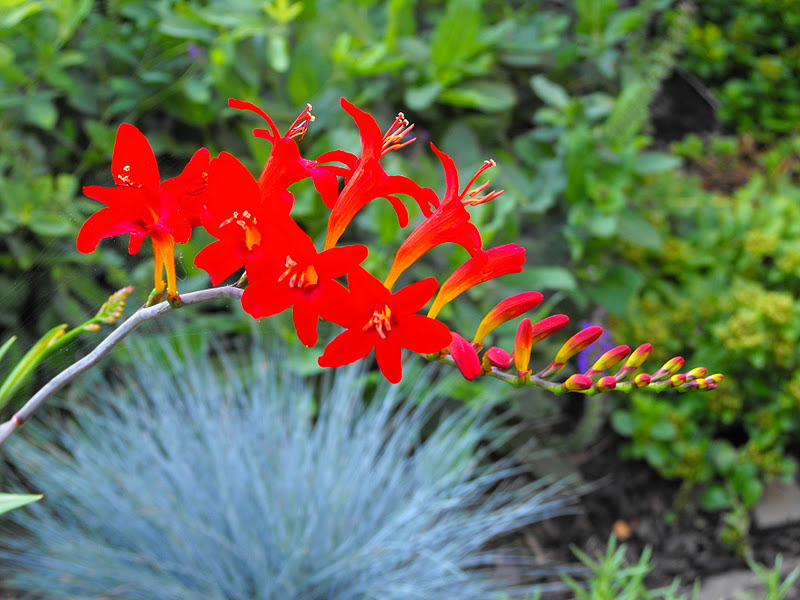
Blue Fescue Grass proves a diaphanous companion to Crocosmia Lucifer. Far from dousing the devilish heat of Lucifer, Blue Fescue spurs it on to extravagant license, all the while Crocosmia urges Blue Fescue into hypnotic decadence.

Likewise, red makes otherwise pedestrian greens burst in improbable ways. This blood-red geranium (no, the photos do not capture this) accentuates the dappled texture of the otherwise ordinary green of the Sum and Substance Hosta, while making the blue/gray greens of the Iris' sword-like leaves sharper, crisper. Of what did these swords prick or penetrate to make the blood run so red?


At the same time, the black pansies appear as spent embers of a blazing fire, each flower both a backdrop and a centerpiece.


A blanket of gold created by fallen gingko leaves does enliven the otherwise drab landscape. But notice what else it does: it allows the greens to self-distinguish to sublime effect,


just as the bronzing leaves and burgundy legs of Rose Mallow in the mid-autumn garden allow the varying greens of Blue Star Lithodora, the sheaths of Spiderwort, and the gossamers of (a now faded) Blue Fescue to announce their differences in ways they otherwise could not.


But I leave the final word to red, not because it is my favorite color (it is not), but because of the harbinger of spring the photo represents. The quintessential vernal flower--the tulip, in this case, Corona kaufmanniana tulip (the earliest blooming varietal, which I brought back from the Netherlands)--converses with Euphorbia x martinii Rudolph Waleuphrud.

They speak, by virtue of the coloration they share, the same language. Yet like the old year that has passed, Rudolph Waleuphrud appears aged and speaks in hushed, measured tones, while Corona, adorned in vibrant attire, speaks with alacrity and a brightness appropriate for youth. The conversation, though, would hardly be complete without the other, and in this briefest of moments we intuit the "there-ness" we otherwise miss, experience the subduction of all that occupies and seduces, and revel in the majesty that is.


Happy New Year to all!!!


Wednesday, August 25, 2010

Turn, Turn, Turn...


The Byrds had it right (though to be fair they did adopt and rearrange the words from Ecclesiastes 3:1):

“To Everything (Turn, Turn, Turn)
There is a season (Turn, Turn, Turn)
And a time to every purpose under Heaven
A time to be born, a time to die
A time to plant, a time to reap
A time to kill, a time to heal
A time to laugh, a time to weep…”

And the song goes on….

I had pondered an entry on “the August garden,” usually a time of repose when plants seem suspended in time, weighted down by sultry days, the air thick with humidity and the sounds of the cicadas. But, as I wrote in my journal, we’ve had “August heat in June and since” and, despite my long absence and the unrelenting early spring – late July drought, my garden in August is offering quite a show.

Until now.

I have noticed that since my return 3 particular plants (one in the sun garden, two in the shade garden) have not been performing well. I did lose my lovely white Gaura (Whirling Butterfly) in my absence, and next to it Carpathian Harebells (Campanula carpatica Blue Clips) finally died yesterday (it, too, required additional care during its first year of transplant, and the heat and parched conditions in my absence clearly took their toll, as did the fact that I dropped a bag of mulch onto it in early July, effectively splitting Campanula in half). But the rest: spectacular! The dahlias launched into overdrive the other day, probably to compensate for Rudbeckia’s waning display. I am quite pleased, as are my neighbors!

In the rear shade garden, two of my prized hostas—Lemon Drop and June Plantain (about which I wrote in “On Metamorphosis”)—looked to be suffering a bit, and I quickly diagnosed their woes: drought. The enormous maple tree acts as an umbrella to both, and dry conditions are further exacerbated by the canopy provided by Nandina and the Oakleaf Hydrangea in the case of the Lemon Drop hosta, and the Oakleaf in the case of June Plantain. In the height of summer, both do receive a few hours of mid to late morning sun—and both can tolerate it—but not without moisture.

Careful watering only marginally improved Lemon Drop’s situation (its leaves were baked a crispy brown), and noticeably June Plantain’s. But then by late last week June Plantain sported one yellow leaf after another, and I discovered yesterday that she was succumbing to the always fatal Sclerotium rolfsii, a soil-based fungus that is, according to the many horticultural sources I’ve consulted, impossible to eradicate but able to be managed if caught early.

If the previous week was a week of coincidences, then this is the week of infection and rot: eggs and salmonella, Viet’s computer and an internal rot (not a virus), and now, a few of my prized hostas and Sclerotium rolfsii.

The bad news is that Sclerotium rolfsii, as mentioned, cannot be eradicated. Not even harsh winters of prolonged below-zero temperatures can kill the Sclerota, small white then, as they mature, brown-red protective spheres the size of mustard seeds that have allowed this fungus to survive since before the dinosaurs ruled the earth. Hostas, peonies, ajuga, Aquilegia (columbine), Campanula, day lilies, foxgloves, wood ferns, and 192 other plants both sun and shade tolerant succumb to the disease.

There isn’t much good news. One can plant hostas such that the crown (the area where the leaf petioles emerge from the root base) rests above the soil, in hopes of minimizing petiole contact with the soil (this is an effective method, though nearly an impossible condition to ensure as rain almost inevitably splatters the Sclerota onto the plant, which actually is the chief method of fungal spread). One can spray a 10% bleach solution on infected areas, which will not kill the fungus but will slow its advance and thus may save whatever remains of your prized specimens. Fungicides such as flutolanil (marketed as Contrast), and products containing PCNB, including Terraclor, Defend, Pennstar, and (all formal names are registered trademarks) have proven effective, but care must be taken with these as phytotoxic reactions (from yellowing to death) may occur. One can remove all of the soil from the infected area (be sure to dig down at least 8 inches), and replace it with uninfected dirt.

The good news, in the end, may reside in the fact that, despite the loss, the mourning, the frustration, and the unsightly bare spots in the garden, one can look beyond. For everything there is a season: a time to plant, a time to die, and a time to plan for the future.

Friday, May 28, 2010

A Formal Declaration of War


The age of Obama was supposed to usher in an era of cooperation and hope, a repudiation of Bush Administration policies and assertive (aggressive?) policy. And yet my inner Bush has formally declared war on the vile little slug.

For weeks, I’ve been conducting a low intensity battle on the slimy creature, but a stroll at dusk the other evening to survey (and dust off) the ramparts shocked this reigning monarch (please, folks, keep the “queen” comments to a minimum!) into launching a massive offensive to save his kingdom. (My inner Realist and my inner Liberal rejoice: for in battle I affirm an instinct of self-defense, enact that putative law “the strong do what they can, while the weak do what they must,” and manifest my predilection for a particular kind of rule—and do all that I can do to ensure my preferred governance remains unmolested.) Sprinkling pounds of poisoned food pellets between rainfalls (especially around the hostas) has been effective at killing off the first assault of springtime slugs; ground warfare has been of a guerilla sort, and while a few slugs manage to resist the temptation of delicious “mollusk-cidal” caviar, most have fortunately succumbed to the law of delicious desire.

Yet the other evening the second, massive wave of astonishingly plump slugs slimed their ways across the leaves of the Sum and Substance hosta—the largest, tallest, and thus perhaps most visible of the hostas. I panicked. With my bare hands I plucked tens and tens of slugs from the leaves, deposited them on the stone walls, and smeared them with my sandals. Smearing the slug is necessary because slugs can self-amputate and survive a predator’s assault. Killing must be swift, and it must be totalizing; nothing but a smudge must remain.

As further evidence of my brutality, I’ve decided not to dignify the slug’s existence by posting a photograph of it. Instead, I opt to exhibit some of the slug’s damage: I under-planted the June Plantain hosta with this Dead Spotted Nettle, the leaves of which show some slug damage (notice the [thankfully minor] hail damage on the hosta leaves). A former, now deceased, acquaintance from Houston, Wynn, possessed a peculiar fascination with the slug, and even painted at least one mammoth portrait of it. Clearly, he did not have a garden, nor did he ever garden—else he wouldn’t celebrate this destructive creature. Wynn would no doubt protest my cruelty, and actively campaign against my methods.

But deploy various, sometimes lethal methods we must, else the fruits of our labors vanish with exacting precision, rendering once lush leaves to lacey Swiss cheese appearance. If groundcover, as I previously concluded, is "the perfect proxy for measuring the certitude of one's will," then decimating the slug population (decimation is about all we can hope for given their hermaphroditic orgies and, consequently, exponential reproduction rates) is the first major test of our established certitude. 

I am happy to report that I annihilate without regret, and indeed find satisfaction in every slug I smear across the walkway.  


Saturday, May 8, 2010

Metamorphosis


Not many of us wake up to discover that our bodies have undergone a most unusual transformation while we slept, such as from human to insect. But such is imagination, and such is metaphor.

The other morning I awoke to an unexpected, dramatic, and decidedly non-metaphoric metamorphosis: the June Plantain hosta, the leaves of which previously had bright chartreuse centers framed by vibrant, deep lime green borders, suddenly appeared as pale yellow-green centers framed by gray-blue edging. I stood mesmerized by unexpected shades of blue, for the borders perfectly harmonized with the blue of "Blue Angel" hosta, and together, this team of venerable hostas accentuated a particular bluish hue in the Obisidian heuchera that is otherwise, to my eyes, not visible.
But these may be June Plantain’s true colors—and indeed they are, as this particular hosta is known for its pigmentary variation throughout the season. The vivacity of its lime and chartreuse proved the flaunting of youthful spring revelry; with adolescence nearly over, the plant settles into a more mature display of aesthetic restraint. Time in the botanical world is at once compressed and accelerated.

We humans, however, live more measured lives, and we tend to mark time not by colorful refashioning (at least not of the sort about which I’ve been writing) but by wrinkles and increments of ten. Adages like “fifty is the new forty” and “forty is the new thirty” appear in the lexicon of my peers (and slight elders) with increasing frequency; these seem but trifling grasps at passing youth, futile attempts to conceal a fear of reaching another milestone birthday and coming ever closer to the inevitable moment when we shall pass from this earthly plane.

As an educator, I am exposed each day to a curious, sometimes humorous, sometimes painful mix of the tempestuousness of youth and the moderation of age, and to developing selves prepossessed of the need to achieve a balance between the two. And this helps keep me young in a way that disabuses me of resorting to euphemisms and cliché—though fret I continue to do.

These selves require a patience that I often do not think I possess, but in the end learn that I do (if only because my sympathies overwhelm my rational yearnings for discipline and punish, order and responsibility). Like my plants, developing selves require a forbearance and attunement to their particular needs; helping them negotiate those needs with others’ in a preexisting context is part of the metamorphosis from child to adult. And so it is with plants. 

Gardening offers the world to me in microcosm—but not in a controlled laboratory sense, since my plants metamorphose and protest, flourish and proliferate, seemingly without regard to me though perhaps always in reference to something I have or have not done. Instead, my gardens offer me the certitude of my own Being, existing as it does within a context broader and deeper than my individual self. And thus my gardens come to teach me how to allow others to be selves in ways that ensure their continual metamorphosis.