Showing posts with label White Feather Hosta. Show all posts

Sunday, January 1, 2012

Color in the Garden: On Color


In a season festooned with vibrant reds and jovial greens, glistening whites and royal blues, sparkling silvers and gleaming golds, the hit television show Glee opted to forgo some of the more eye-catching spectacles in its 2011 Christmas offering. Bathed in black and white and peppered with suave banter, the episode was a show within a show: an homage to a 1963 Judy Garland Christmas show (mixed with, in my narrow view, ridiculous references to a 1978 Star Wars holiday special).

In our color saturated world, black and white stands out: it is construed either as the antithesis of color or the absence of color. Black and white (taken in the singular) is the "there-ness" of that which is simultaneously "there" and "not there." The mandala riot of color of our everyday lived lives becomes, in the black-and-white rendition, a monochromatic subduction. The interplay of light and shadow rendered as variations of gray, not a panoply of color, expresses mood and emotion, and manifests an artistic, yet no less realistic, version of life. Black and white: subject matter in stark relief.

Yet we live our lives in color: we cannot escape it, save for in (some) photography or cinema. By comparison, the use of black and white seems almost indulgent--indulgent not in the contemporary sense of self-gratification (always immediate and always perpetual) yet in the ecclesiastical sense: a remission of punishment, a forgiveness, an act of reconciliation.

Viewed through that prism, black and white dons an ethereal character: a "there-ness" of the seemingly improbable that otherwise would go unnoticed.

And it is this fleetingness of our exposure to the black and white image, the flirtation with the "there-ness" that is simultaneously "there" and "not there," an almost mystical experience with rawness that I find a parallel to the appearance of COLOR in the garden: not color in an ordinary sense, but those pops of preternatural colors that elicit certain responses of wonderment. These are the rich colors of sunrises and sunsets, but also of unexpected juxtapositions of color that, by virtue of the juxtaposition, make a particular color seem more other-worldly than it really is.

If color writ large is merely a vehicle to help us view the world, it is those preternatural pops of color or the unexpected juxtapositions or the black and white moment that really teach us how to see that world.

Perhaps that is the underlying, enduring significance of the garden: not only are they spaces of pleasure, not only are they places of escape, but they serve the wider function of helping us--whether gardener and doer, or visitor and viewer--to see, to understand, to interpret, and to Be.

And so on this New Year's morning, I was fortunate to catch this fleeting glimpse of the first sunrise of 2012 from my third floor:

The sight reminded me of a photo I took of a sunset on 19 November, yet this morning's coloration scheme differed.

The cool intellectual blues of the morning give way to the burning promise of the dawn. The coloration represents a day unadulterated, a calmness of spirit and mind, a readiness.

But compare this to the burnt sky in the November sunset: this is a day in decline, a day spent and readying for its respite.


And then I thought of the cerulean blue of the Hardy Geranium Rozanne (a.k.a. Cranesbill), an unexpected late autumnal appearance in a world dominated by a warm/hot palette of simultaneously fiery yet subdued hues of ochres, red, oranges, yellows and rusts.


And that starkness reminded me of a seemingly distant spring, and the creaminess of White Feather Hosta that soon gave way to a snowy white, complemented as it were by Hakuro-nishiki Dappled Willow (which died during this summer): an unexpected color if only because it appeared not as flower but as foliage.


Those blues....yes, those blues arrest me. The blue-purple of the Ajuga proves a stunning sea in early spring, and thus makes an exquisite addition to any garden. Yet it relinquishes some of its singular drama when paired with this June Plantain Hosta, the blues of each complementing and accentuating the virtues of the other,


while Ajuga properly fades into the background when the gardener needs it to do so, as when paired with this Lemon Drop hosta. 


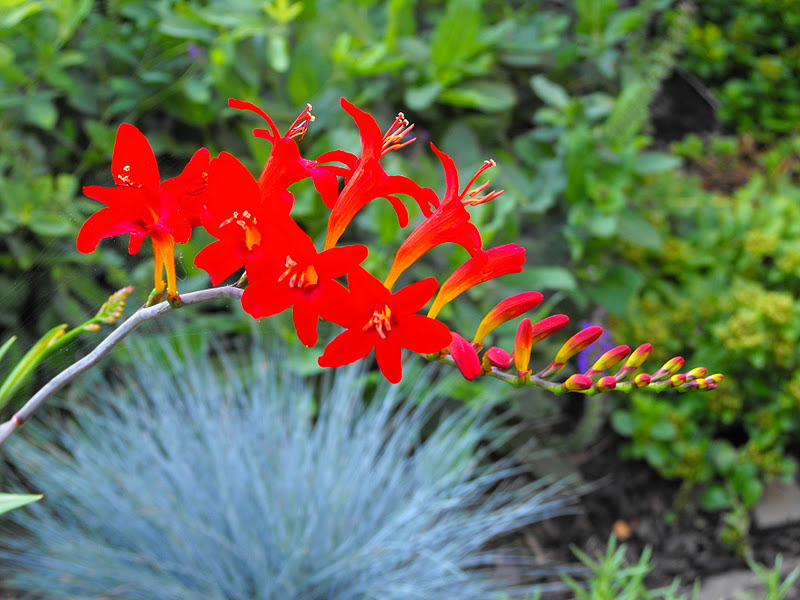
Blue Fescue Grass proves a diaphanous companion to Crocosmia Lucifer. Far from dousing the devilish heat of Lucifer, Blue Fescue spurs it on to extravagant license, all the while Crocosmia urges Blue Fescue into hypnotic decadence.

Likewise, red makes otherwise pedestrian greens burst in improbable ways. This blood-red geranium (no, the photos do not capture this) accentuates the dappled texture of the otherwise ordinary green of the Sum and Substance Hosta, while making the blue/gray greens of the Iris' sword-like leaves sharper, crisper. Of what did these swords prick or penetrate to make the blood run so red?


At the same time, the black pansies appear as spent embers of a blazing fire, each flower both a backdrop and a centerpiece.


A blanket of gold created by fallen gingko leaves does enliven the otherwise drab landscape. But notice what else it does: it allows the greens to self-distinguish to sublime effect,


just as the bronzing leaves and burgundy legs of Rose Mallow in the mid-autumn garden allow the varying greens of Blue Star Lithodora, the sheaths of Spiderwort, and the gossamers of (a now faded) Blue Fescue to announce their differences in ways they otherwise could not.


But I leave the final word to red, not because it is my favorite color (it is not), but because of the harbinger of spring the photo represents. The quintessential vernal flower--the tulip, in this case, Corona kaufmanniana tulip (the earliest blooming varietal, which I brought back from the Netherlands)--converses with Euphorbia x martinii Rudolph Waleuphrud.

They speak, by virtue of the coloration they share, the same language. Yet like the old year that has passed, Rudolph Waleuphrud appears aged and speaks in hushed, measured tones, while Corona, adorned in vibrant attire, speaks with alacrity and a brightness appropriate for youth. The conversation, though, would hardly be complete without the other, and in this briefest of moments we intuit the "there-ness" we otherwise miss, experience the subduction of all that occupies and seduces, and revel in the majesty that is.


Happy New Year to all!!!


Tuesday, April 13, 2010

Color in the Garden: White


I am often struck by the infusion of color in the high drama that is international relations: white papers, green parties, orange revolutions, and purple slates reside next to less attractive invocations of color such as red scares, blue ants, black lists, and yellow peril. To wit, in my previous entry, I may have identified an entirely new kind of “yellow peril”—the kind that compels us to do naughty things (like steal a tulip or, argue that “really, officer, the light was yellow when I entered the intersection,” which prompts the response, “So, would you rather have me write you up for speeding through the intersection, which you did, or running a red light, which it was when you left the intersection?”). Yeah, yellow is the color of contradiction: caution, slow down; or speed up and hope you don’t get caught.


I also mused that divinity itself must be responsible for reintroducing every spring the loveliness of yellow. Yet yellow is not the color of the divine; it is but a product of the divine. We just need to learn how to negotiate our uses of and responses to yellow. If yellow is the color of contradiction, the color of human frailty, then white is the uber-color, the untouchable (guys: wear a white suit to a fancy soiree and you’ll understand what I mean). White symbolizes not royalty, whose color is purple, but, by cultural association, divinity itself (whether white represents purity, or serves as the color of mourning, the divine and the afterlife are neatly, crisply, encapsulated into the breathtaking magnitude of this color and, by extension, even the most limited appearance of white in the garden).


Immediately, we conjure images, perhaps even blankets, of white flowers: snowdrops, crocuses, paper whites, alyssum, phlox, lilies, and sundry other lovely flowers. This white Siberian iris stands alone in my garden, a valiant beacon in a luxurious sea of green, a peace offering, a lone beauty, a stunning reminder that above all human frailty, beyond all the reach of all impropriety, stands perfection. Whether perfection is divine, or divinity is perfection I’ll leave to the reader; suffice to note that the triangulations of my iris (“my iris;” how haughty! How human!) could not have been produced by anything less than the divine exaltations of nature herself.


And then there is the brief spell of the white feather hosta, whose white gradually turns to a soft cream and then a diluted pale green. We often associate color with flowers—a natural association to be sure, but a somewhat narrow one given the various hues of leaves, not to mention their diverse textures and shapes. Perhaps more a function of my indecision rather than my intellectual predispositions or aesthetic principles, some of my garden beds are more experimental: working hypotheses of aesthetic design and the consequence of impulsive seductions and random flirtations in the garden shop. This white feather hosta has thus far served me well; she glows. All visitors to my gardens immediately look at her; not even the serenity of the Buddha elicits a first glance, for her fluorescence immediately arrests the eyes.


I accept that commandment: start with me, the white feather hosta demands, then look around. For divinity makes only brief appearances in my garden: the paper-whites (which somehow, for some reason, do not to me speak in the vernacular of the divine); the white Siberian iris (thank you, Aunt Annie); the white feather hosta; and, much later in the season, a few white chrysanthemums. I opt not to infuse my garden with white, but rather with brief experiences with it, and with anticipations of the divine in the form of foliage: White Christmas hosta (in front of the garden Buddha) and Liberty hostas, among some others. The lemon scented white flowers of the Sum-and-Substance hosta evoke divinity in mid-summer, and positively glow at dusk and dawn.


But I have opted to keep the divine at bay. Perhaps this is a function of my aborted blue theme and subsequent inability to fully embrace a mix of colors in my garden. Or, perhaps more philosophically, my decision reflects my imperfectability, my inability to imitate, to approach, divinity. As I write this, I feel a sense a wabi, and I am sadly happy, comforted by my perfect imperfectability.

Wednesday, April 7, 2010

On Perfection


How utterly perfect is this Diamond Tiara Hosta? Fresh from the soil (last week’s hefty rain followed by our unseasonable Delaware warmth—90˚ (30.5̊ C) in early April?!—have made for increasingly and rapidly lush beds), Diamond Tiara’s tight clumping habit and pristine leaves (still unaffected by my arch enemy, the slug; celebrated survivor of Gramsci-style moisturizing and fertilizing) invites smiles and admiration.

And the early spring performance of this White Feather Hosta—new offshoots lining up in perfect sentinel formation in front of Pennsylvania red shale (this picture doesn’t quite capture the deep reddish hue of the stone), first pale green, then turning a bright white, and, as the season progresses, returning to delicate shades of green—strike me as a delightful coincidence of “plant agency” (thank you, Bob, for the terminology) with garden order and structure. By the way, I only planted two bare roots last spring, and now have 4 distinct plants; their linear arrangement perplexes, yet pleases. Perfection. Telos. Aristotle lives in my garden; surely these photos are proof.

But perfection is a double-edged sword. On the one hand, we avidly consume images of perfection, perhaps to assuage our fears that our struggles for perfection are not in vain and that yes, perfection is attainable (sure, my garden can look exactly like that magazine, picture-perfect flower bed). We thus labor and nurture and tend, all in that quest to mimic, whether our ideal assumes the form of the cacophony that is English cottage gardening, rich in its diverse tapestry, appealing to every sense; or relates to the more austere, manicured geometry of French and English aristocratic gardens, or evokes the serenity of the raked stones and meticulously situated plants and rocks of Zen gardening.

On the other hand, not achieving those picture-perfect flower beds and the pristine, weed-free lawn (for those so inclined) can be a frustrating affair. Blame, guilt, and perhaps even anger rear their ugly little heads, even as we confront the cheerful daffodil, clad in her bright, welcoming yellows. And then come the accusations and the litanies of verbal assaults on our gardens, nay, on our very Being: we do not devote enough time to the project; we lack skills or knowledge or money; we lack vision; we lack energy and verve. Or we improperly direct blame elsewhere: do-it-your-selfers scoff at those who hire others to do their dirty work. Of course if I had the money or desire to hire a professional, or if I had staff to work my gardens and fluff my pillows, my X, Y, or Z would like just like theirs. Dirty thoughts indeed!

And so my image of perfection was assaulted yet again this morning, as I caught Gramsci watering, then fertilizing, a poor innocent Japanese Painted fern that had JUST emerged from the soil. In the act of covering his naughtiness, he destroyed most of the tendrils. I was furious. I fumed. I called him names. I made a spectacle of myself (no wonder my neighbors stood by the window, staring down upon this pitiful soul—um, me, not Gramsci—getting upset over something ever so trivial).

Perfection is indeed dirty business, in part because interruptions of our obsessive toils may compel us to do or say dirty things. But perfection ultimately motivates. It offers us a goal, even if unattainable by some measure, a destination, even if unreachable at certain times and in certain respects.

Perfection becomes especially dirty business when we equate it primarily or solely with control—a common equation, I think. I cannot control where Gramsci urinates or defecates any more than I can control the weather. But I can control my reaction, and recognize that perfection relates more to my efforts and less to externalities.

In that vein, plants for the gardener are not trivial (nor, apparently, are they trivial for those who seek to make a political statement; see this article on planting trees as an act of Palestinian non-violent resistance). Plants offer a spectacle of perfection, a retreat from an imperfect world. To be sure, gardening is about some degree of control. But the element of chance remains despite our best efforts and intentions. In the end, what we find perfect, others will not, for perfection resides in many respects in the eye of the beholder. Thus our efforts should be directed not at necessarily pleasing others, but pleasing ourselves. Whether we put forth our best efforts, whether we made a serious, concerted attempt to do our best, ought to be the measure of perfection. All the rest is secondary, and perhaps even eye-candy. My Diamond Tiara and White Feather Hostas prove that (to me at least).