What is life but a continual exercise in revision?
We think about that email we sent or the response we gave in a work meeting and mentally revise how (both procedurally and substantively) we will respond in a similar, future situation. Always, we wonder: do we show all our cards in an effort to make a statement, or are we more circumspect, leaving subtlety and subtext to assume the burden of our messages to others?
We rewind a thousand times the memories of our conversations, lectures, and work presentations because we perceive some flaw in our communication. We aim to isolate those errors and disturbances, and remedy them so our embarrassment is curtailed in the future.
We rewrite our prose to clarify our thoughts.
We remind ourselves of the kind of person we wish to be.
We rejuvenate with yoga, while aspiring to not let the world trample on our spirits so much.
We rewind, relive, rejoin, remand, remind, remonstrate, redirect, resurrect, recalculate, redistribute, readjust, repair, recycle, reassign, reexamine, and review.
Much of our life activity, it seems, revolves around words with prefixes, all in an attempt to improve and Become.
But if we are not careful, the aspirational trajectory of our lives may become overwhelmed by our hyperactive superegos which continually remind us of our failings and foibles.
And so it is easy to understand why the Germans so efficiently (always efficiently) compressed a big emotional experience into (for German) a not so long word: Schadenfreude. For here we have the encapsulation of an experience whereby the emphasis shifts away from our self-induced purges to concentrating on the misfortunes and mistakes of others. For once, we can silence the incessant inner nagging and see that others, too, make and receive their folly.
Ah, yes, Schadenfreude. We know it well, even if we hesitate to admit it.
But sometimes the misfortunes and mistakes of others present us with opportunities--and that is something to really celebrate.
For instance, I brought home this Foxglove--a plant I otherwise would not willingly situate in my garden (they are pretty, but, as my dear reader knows, I am a garden snob and I have peculiar, if fluctuating, tastes). But, it was a gift from a gardening friend, an extra, and gardeners cannot willingly send plants to their deaths if they can help it (hence the generosity of gardeners: "please, come and take these plants." "OF COURSE you can have these; I am dividing and removing." "No, no, you aren't imposing; I offered, silly!")
It was labeled creamy yellow, and I thought it would look smashing in the yellow and blue bed.
Well, look at it. What idiot switched the tag?
What an eyesore.
(Though I hear my cousin Arianna now: "Pink: you always need pink." (Can one discern her favorite color?)
She would be thrilled to see how pink, a color I tried to banish from my garden, has made deep intrusions into my garden--always unconscious, always startling and denounced, yet always welcomed with a murmur, "gosh, that's so beautiful."
Her Schadenfreude--"Ha! Pink Prevails! The ban collapses!"--becomes, curiously, my delight too!
As I stared at this eyesore, I had a thought: move it. (Ahem. yes, dear reader, I am a bit slow.)
How perfect an accompaniment to the blues and purples of the East Side Shade Bed!
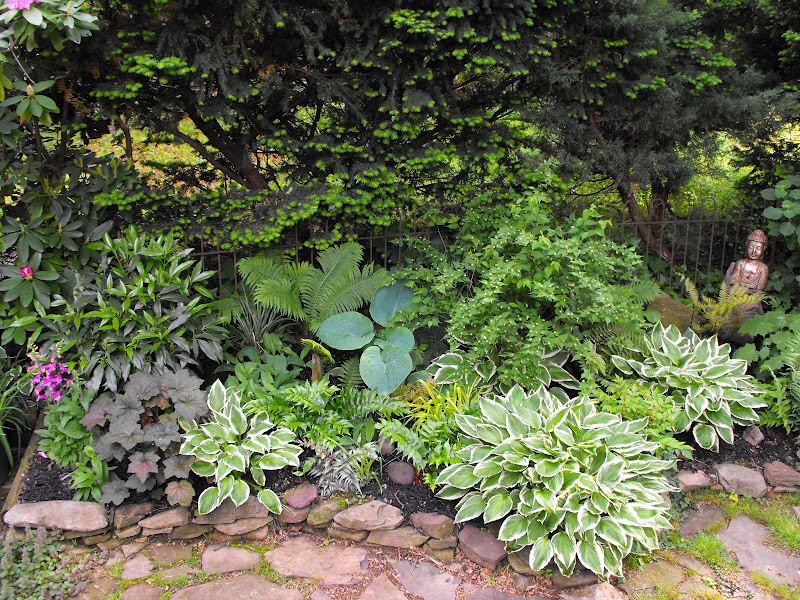
How perfect an accompaniment to the neighbor's rhododendron!
Transplanting the Foxglove thus gave me an opportunity to revise and amend, which for all intents and purposes translated into a visit to my favorite garden center.
A Thunderbolt Hosta took the place of the Foxglove, its blues a perfect contrast to the oranges and yellows of Lena Scotch Broom, which is now underplanted with Orange Marmalade Hosta, and Citronelle Heuchera.
Schadenfreude: it gives us pleasure in so many ways.
Showing posts with label Orange Marmalade Hosta. Show all posts
Sunday, May 13, 2012
Saturday, November 12, 2011
Subduction
Subduction is an odd word.
It sounds like the bastard child of abduction and seduction.
But it is not. In fact, it is the opposite of what my dirty thoughts suggest: that is, not reproduction and thus the addition of something else, but rather a subtraction, a withdrawal, a removal.
My autumnal world, it seems, is undergoing a process of subduction. A withdrawal. Sure, that is the cycle of seasons, yet there is something else going on: a subduction of color.
If subduction in the rear garden assumes various shades of yellow--a veritable pot of gold into which all colors are absorbed, made more spectacular by the golden canopy of the maple tree, then the front garden experiences a subduction dominated by hues of red and purple.
The Orange Marmalade hosta, having turned a brilliant shade of gold, begins the East Side Shade bed's autumnal glory,
and is joined by the Big Blue Angel hosta, which has turned this brilliant shade of amber, accented by the leathery greens of East India Holly Fern.
Gramsci looks veritably pleased that the world has capitulated to his omnipotent handsomeness by turning his golden-boy shade of glory, though I surmise he may also feel a tad bit overwhelmed by the ubiquity of "the color of him."
In the front garden, the burning bush takes center stage, and is complemented by the single petaled daisy-like chrysanthemum and the now denuded burgundy stems of Rose Mallow, and offset by the creamy variegation of the Siberian Iris.
Rudolph Waleuphrud Euphorbia begins to come into his own, his tips deepening their ruddy display in preparation for his Christmas pageantry. He's a one man show at that time of year, and he simply must shine.
In the meantime, Gramsci searches for the fresh green grass on which he likes to graze--grass that will no doubt in a few weeks experience its own subduction by winter white.
Wednesday, June 9, 2010
Color in the Garden: Orange
In my estimation, orange is an other-worldly color, which may explain its sparse, fleeting appearance in my gardens. Growing up, unlike so many other young boys I presume, I was cognizant that things could have ended up quite differently (and indeed I wanted them to be). We could be speaking Dutch.
But, like many imaginations, it could not have been that way. The Dutch, led by the House of Orange-Nassau, faced more pressing realities, being at first embroiled in an eight decade revolt against Spanish rule. The English, feeling threatened by Dutch domination of the seas and its respectable, far-flung collection of colonial and trading outposts, challenged the United Provinces in a series of wars, and took New Amsterdam in 1664, christening it New York. Having briefly retaken New York (1673-1674) and renamed in New Orange, the Dutch were obviously seduced more by nutmeg than by beaver, and decided Suriname represented that orgiastic future it so imagined and thus relinquished, by the Treaty of Westminster, New Orange to the English. The rest, as they say, is history.
One might muse, then, that orange is paradoxically the color of victory and the color of defeat, the color of imagination and the color of reality. Orange bedecks, indeed cloaks itself in an aura of unexpected juxtaposition; orange challenges us to reconcile the vision with the fact, the ought with the is, just as the color itself reconciles the vibrancy and intensity of red with the seductiveness and cheeriness of yellow.
My youthful imaginations, however, were of no match for reality (or perhaps reality was no match for my imaginations) and into those imaginations I increasingly retreated until living there became quite untenable.
And so I find vestiges of a life once lived in orange and with its associations. I do not wish to return to that imaginary life, yet I welcome reminders of parts of it (I refer not to ancestral callings but, for the reader, more obliquely to a peculiar lived history, which each of us has, and some of us wish were not so). Thus I retain my Dutch language tapes, disused and tucked away as they are in a dusty corner of a closet. I reacted with impassioned levity as I read Russell Shorto’s riveting The Island at the Center of the World, for it transported me back in time to the place in which I wanted to Be, free of my factual burdens and liberated from my fictions, and actualized the imaginary world I desperately tried to create in my own New Netherland. Lena Scotch Broom makes her dramatic spring appearance—her orange deeply rooted in this world—and the orange day lilies, now in full bloom, follow several weeks later, pairing nicely in an echo of the former Dutch flag with my fireworks-quality Verbena.
And Orange Marmalade hosta: there it is, not quite orange, but nominally connecting me throughout the gardening season to the brighter shades of that haunting color that constituted my past.
One might muse, then, that orange is paradoxically the color of victory and the color of defeat, the color of imagination and the color of reality. Orange bedecks, indeed cloaks itself in an aura of unexpected juxtaposition; orange challenges us to reconcile the vision with the fact, the ought with the is, just as the color itself reconciles the vibrancy and intensity of red with the seductiveness and cheeriness of yellow.
Subscribe to:
Posts (Atom)