Wednesday, April 25, 2012

Color in the Garden: Indigo

Surprisingly, I haven't yet written on indigo in the garden. I've mused on blue and violet and purple, but not indigo, which is more prevalent in my garden than any of those other colors.

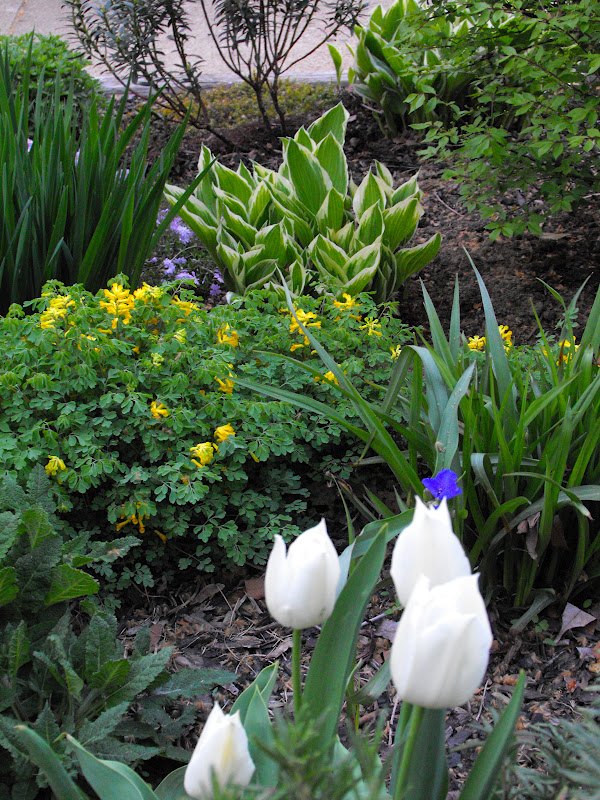
And I'm not talking about False Indigo (Baptisia), and my first miserably insulting experience with it!  (Though now I relish in the fact that my Carolina Moonlight Baptisia, seen here in communion with Corydalis lutea, situated between Blue Fescue Grass and May Night Salvia, with spikes of about-to-burst creamy white/pale yellow flowers, is performing remarkably well in my front garden!)

Indigo, from the Greek ινδικόν (indikon) meaning simultaneously "dye" and "from India," silently screams its substance. Not mere color, but transformational experience (turning something into something else). Not merely from somewhere else, but transoceanic, trans-spatial journeys.

Indigo is, in the Vedic chakra system, the third eye or brow chakra. Ajna. The center of spiritual understanding. The portal for sight in both its physical and intuitive senses. Clarity in the brow chakra--which is code for clarity of mind--allows us to "see things anew," "to see the big picture."

The symbol for the brow or indgo chakra is the pyramid, much like the Iris with its 3 sepals.

I wonder, then, if the expression "out of the blue" really speaks more to the Vedic (indigo) rather than the Western tradition. The idiom is, etymologically, an adaptation of a line from Thomas Carlyle's 1837 The French Revolution: "Arrestment, sudden really as a bolt out of the Blue, has hit strange victims."  

"Out of the blue" speaks to the unforeseen, the unplanned, the jolt of clarity as one thinks and writes. 

It is a bolt of indigo Iris 'gainst a backdrop of Citronelle Heuchera sunshine.

Yet in the Western tradition writ large, this democratic meaning of indigo/blue is countered by an elitist strand.

Sumptuary laws--laws designed to restrain the display of luxury or extravagance--in Elizabethan England regulated use of the color indigo. Associated with wealth and power, indigo (a.k.a. Royal Blue) could only adorn the fashionable, and fashionable was code for royalty and the landed aristocracy. 

This all seems so Hegelian now...for there is a power inherent in indigo: at once democratic and royal, accessible yet reserved. And therein the two traditions, if I may cal them that, converge.  (To what synthesis I have not yet been struck out of the blue to indicate...)

Clarity of sight--literal and figurative, physical and spiritual--is open to us all. That is the democratic element.

Yet there are forces, internal and external, that hamper our vision. That is the elite element.

I'm not so convinced that the choice--to be democratic or to be defeated by elitism--is always up to us.

Perhaps that is the synthesis: the out of the blue moment when democratic and elite combine to forge an inestimable moment of perfect vision.


Thursday, April 19, 2012

Water, Water Everywhere, But Not a Drop to Drink

If you live in the mid-Atlantic region, you might be puzzled by the title of today's post.

We haven't had rain in weeks.  Early summer-like temperatures add to the misery (misery for plants, parched as they are).

I recently adjoined two flower beds: the lantern bed and the crescent bed bordering the stone patio. Even 14 inches down, the soil is arid. With merely traceable snow this winter, above-average temperatures for months, and limited spring rains, we face a considerable problem moving into the summer.

So when I see my Tiarella Dark Star Foam Flower, rather neighborly with Brunnera and its sky blue flowers (or might that be sea blue?), I think of the sea foam that forms on (some) beaches--and I feel refreshed.

Tiarella, some websites inform us, like consistently moist soil.

However, I purchased it at Mt. Cuba in Delaware (one of the several DuPont estates and gardens), and was told it tolerated well dry soil, being a native of woodlands (where tree roots presumably absorb all available moisture).

And mine is doing extraordinarily well in its raised bed underneath a Norwegian maple tree (the most notorious moisture thief transplanted to North America)!

Despite her nomenclature, she is a good natured gal.

(Some may take offense at that statement.)

But really, with her name, what can you expect?

Tiarella, as in from the Greek tiara. Think princess. Stuck-up. Bossy. Demanding. Some prissy prima donna, first lady of the stage, a Maria Callas refusing to sing because of some pretense or intuited offense.


If you think her given name is any indication of her personality, well, then, meet her family: Saxifragaceae.

Yes, Sax.

How about this spelling: Saks (as in Fifth Avenue)?

Our darling little princess, it seems, has expensive taste, or is from a family of expensive tastes!

But, alas, she is quite modest--so modest that she has rewarded my virtual neglect of her with masses of foam flowers (even during Mother Nature's desertification of Delaware).

Corydalis, the harlot of my garden, accents Tiarella's bright yellow anthers (a bit of seduction, eh?! I hear her whisper: "come, burst forth my darling, give me your seed..."),


while the blue of Brunnera communes so nicely with Tiarella's lavender-colored unopened buds. They are intimate friends; you can see that in the way they delicately reach out to each other, comforted by the other's presence.


In the distance, Solomon's Seal shamelessly offers himself to her: unburdened by undergarments, his flowers dangle from his stems. One wonders if they know that their displays of purity white belie their highly sexualized presence.


So we wait. We wait for sexual contact, made possible through the few honey bees I've seen and massive sized bumble bees (so large they don't have stingers but carry switchblades). 

We wait for rain.

Yet here we have a collection of drought-tolerant plants: Brunnera (macrophylla), Corydalis, Solomon's Seal, and of course, Tiarella, the star of the garden. How do we know? Her leaves tell us so...


Tuesday, March 27, 2012

Meryl Streep in the Garden

If we think about it, our everyday lives are full of moral choices.

Should we violate the sign that says "This driveway is not a thru passage" and use it as such to avoid the backed up traffic at the signal light?

Should we cheat?

Should we tell the cashier that s/he gave us back $15 extra in change?

These are important decisions, yes, but rarely are we called upon to make exceptional decisions. Of course, exceptional begs definition. And here, in this limited instance, I define it in relation to life and death.

No: rarely are we called upon to make such exacting, portentous decisions.

And so when we are forced to make such decisions, we often act in unexpected ways. In the laboratory that is our mind, under constraints of endogenously designed hypotheticals, we decide one way and envision that we will act in particular kinds of ways to reflect the kind of person we would like to be.

But in the laboratory that is not the mind, that is, in the laboratory that is the so-called real world, faced with practical constraints and exogenously defined parameters, we most likely think and act differently--in ways that reflect the kind of person we actually are.

In Sophie's Choice, a commandant indicates that the Pole ranks slightly higher than the Jew in the Nazi racial hierarchy. That gives the Pole the privilege of choice: you may only keep one of your two children. You decide.

Meryl Streep's character resists, protests, refuses, and then, when the commandant orders both children to be removed, and the soldiers comply, a struggle results and she screams, "Take my little girl! Take my baby!"

The choice is one we cannot fathom.

The reader may balk--and rightly so--at the parallel I am about to make. But given the cinematic portrayal of a more than likely real world event, I have fictionalized precedent before me.

Last night's freeze warning (it was 31 degrees when I awoke) prompted me to make some hard decisions: which plants to protect, and which plants to leave exposed. I had one tarp, and several empty plant containers, and so could only save a few from likely frost.

Oddly, I did not think and was not sentimental. The tarp went over the bare root Japanese anemones that I planted several weeks ago. The emptiness in my bank account is still raw.

The containers were placed over a surprising assortment of plants: surprising because in the laboratory of the hypothetical, I would have chosen somewhat differently.

The Ben Franklin Double Red Peony received protection, while the more prized Chinese Double White Solange Peony did not. The former had begun to produce leaves, while the latter remains in gerkin-like form. Besides, the Double White failed to produce flowers last year. Perhaps I was subconsciously punishing it.

The Japanese Beech Ferns in front of the Buddha received protection (divine intervention?), and so did the European Ginger (hail to the imperialists?), but neither the American Ginger (Gramsci has watered it so much, that only a few little bits remain) nor my favorite blue hostas did not.

So too did two of the four the Toad Lilies, but not the more glamourous and substantially larger Toad Lily (practical constraints: I did not have a container large enough to contain it).

The list is not too much longer, but the point is not to recount those granted reprieve. The point is to underscore how differently we do act when the immediacy of a situation demands the immediacy of reaction. We rise to the occasion. We act in unforeseen ways. We surprise ourselves by the person we are, because aspects of that person don't always cohere with the person we think we may be.

But all the while I methodically placed my containers around selected plants, I could hear the voice of another Meryl Streep character, the Iron Lady herself, steely calling out in the garden, "Cowardice, Cowardice, Cowardice!" 


It seems the other plants were not enthused about being rejected.  

Or perhaps I was judging myself.


Sunday, March 25, 2012

Coronation

The looming War of the Scotch Broom Succession demanded drastic measures.

One might say they were of the divine intervention sort.

While Provence Lavender surveyed an invasion along the north-eastern flank, Kalmia latifolia Minuet (Minuet Mountain Laurel) wished not to be upstaged and so began planning a full frontal assault. The boxwoods--a privy council if I ever encountered one--gave no indication on whose side they offered clandestine support, thinking, I assume, that they would need to ingratiate themselves to whomever assumed the throne. Why get involved? (I could hear their whispering.)

In the meantime, it seems that ground forces of the Northern Sea Oats Grass had already made considerable headway into the Scotch Broom's promontory, making it seem highly likely a bloody battle for the succession would soon erupt. The gardening god frowned upon a mass invasion. Indeed, the gardening god ordained defeat.


But first, the funeral.

Lena Scotch Broom's corpse was quickly and nearly effortlessly disassembled and removed for interment elsewhere. The garden stood still as the dead was ceremoniously and neatly placed on the walkway, care taken to align her major limbs to make the final processional to the compost heap an efficient one.

But the ramparts, the gardening god discovered, were overtaken by mass reinforcements sent in by Northern Sea Oats Grass. Swift action had to be taken, even though said gardening god wore fairly nice clothes.

Yet the work of the divine is always a bit dirty, and so the clothes remained.

And in came the thunderbolts from heaven, delivered in the form of shovels and pruners!

The swarm of Northern Sea Oats Grass occupiers were undermined with a few maneuvers of the shovel.

A mass hole was created. The gardening god looked first to Provence, and then to Kalmia latifolia.

But a surprising development occurred. The garden subjects bowed down and hailed their new monarch. A soft wind drew the attention of the gardening god to said monarch.

Gardening god worked the shovel around the new leader, carried him over, planted and watered him, and there he was, anointed, proud, looking smart against a backdrop of Emerald and Green Ice Boxwoods, and itself a background for Tulipa kaufmanniana Corona, a veritable saint-cum-kind: St. John's Wort.

Yes: his regal burgundy colored garb gave him away, yet this gardening god, too preoccupied with other matters, failed to see the obvious choice.

The coronation is complete, and a new reign begins.


Long live Hypericum the saint!

Axis of Evil, and all that...

Politicians wed a while ago that contemporary communication malaise called the "sound-byte." Of course, we might attribute this unholy alliance to Twitter and Tweets and Feeds and Status Updates, but really, the sound-byte has a protracted, though not necessarily venerable, history.

"Tippecanoe and Tyler Too."

"A Day that will Live in Infamy."

"The Buck Stops Here."

"Labour is not Working" (for you Anglophiles and those on that side of the pond).

There are certainly more colorful ones, such as the unwittingly sexualized "We Polked You in '44,We Shall Pierce You in '45" (boy did that one work!) and more ominous ones, such as "Arbeit Macht Frei."

The Sound-byte, the slogan, is supposed to capture an essence, a Weltanschauung, through rhythm or metaphor or some form of word play. For the most part, it does that even if ones from times past may have lost resonance to contemporary ears.

Of course, there are inadvertent slogans, such as "Read My Lips" or "It's the Economy Stupid" or "Where's the Beef?!" that assume the de facto status of slogo-sound-byte. These are perhaps the best ones, in part because they are so ostensibly off-the-cuff, though I can't help but find geekish infatuation in the devised "Labour is not Working."

In 2002, George W. most famously gave us the "axis of evil" in reference to that unholy trinity of Iraq, Iran, and North Korea, to which John Bolton added Cuba, Libya, and Syria as a "beyond the axis" category. Not to be outdone, Condoleezza Rice constructed an "outposts of tyranny" label for Belarus, Zimbabwe, and Myanmar. That's the thing about slogo-sound-bytes: they demand one-up-(wo)manship, such that "Four More Years" became "Four More Wars."

The garden is not immune to the creation of axes, and even to one-up-manship.

Corydalis lutea, in a sort of women's lib protest, inserted herself in the axis of white in the entrance sun garden, 


while reds of the most alluring sort provide stimulation in an otherwise calming front garden-scape dominated as it is this time of year by whites, blues, pale greens, and a few accompanying splashes of yellow. Here, the vibrancy of the red tulips (which, to remind my reader, were labeled Tulipa Triumph Deep Blue) is pulled through to the other side of the garden in the delicate chartreuse flowers of Rudold Waleuphrud Euphorbia.


Looked at from another angle, reds appear in deeper, regal hues (in the guise of the Ben Franklin Double Red Peony) and the ruddy legs of Rudolf Waleuphrud. Yes, dear reader, his carpet matches the drapes.


In the gardening world, "repetition" is the equivalent of the slogo-sound-byte. Repetition of color or particular plant "draws the eye" around and through the garden, and provides some continuity that lends coherence to the whole. In the East Side Shade Bed I use the rather pedestrian Diamond Tiara Hosta as a a visual avenue linking the whole bed. Diamond Tiara also finds limited homes in other parts of the rear garden, thereby providing a continuity of flow and a respite for one's eyes.

Diamond Tiara Hosta is good-natured, for it knows that its presence--really only spectacular in the early spring before other plants emerge--allows the spotlight to always shine upon others: whether Kirengeshoma palmata Yellow Waxbells, Kerria japonica, the late spring blooming fuchsia Astilbes, or the Nikko Blue Hydrangea.
 

In the rear garden, yellows and whites provide the visual axes. But this is a special time of year, for deep blues make a pronounced appearance. Kerria japonica put on quite the show this year with its brilliant, luteous flowers. For a brief spell, golds and yellows dominated; whites, notably on the margins of the Diamond Tiara but also in the stands of bell-like flowers of Pieris japonica and now in the Leatherleaf Viburnum which overhangs the Buddha bed, help alleviate the visual stress. Now, streams of blue thread through the garden, rather explosive in their appearance, yet always, simultaneously, exuding a sense of respite. 

Lysimachia (Creeping Jenny) accentuates the margins of Golden Tiara Hosta, set as they are against a backdrop of black mulch. The drama in the lantern bed is provided by jessamy axis, which begins with the Golden Tiaras, extends through the Lemon Drop Hostas (one of which is seen at the top of the above photo), accented only at this time of year by June Plantain Hosta, and filtered out through the pale-yellow white (ochroleucous) of the Ghost Fern at the far end of the bed, situated at the base of Nandina.

All of the visual axes, and all of these insertions, remind us of the sheer ephemerality of the construction, whether that construction be the garden or the slogo-sound-byte. For blooming times pass, and politicians go. Tweets flutter away with alarming alacrity, making a mockery of the person we are and the things we do, just as the status update demands not stagnation but contemporization. But in the end something remains: the principle remains...the principle that gives our lives and our myriad of activities meaning, the principle that evidences our desire to be in this world, remains. And so we have Vita's Sissinghurst and Johnston's Hidcote, Jeckyll's Munstead Wood and Lloyd's Great Dixter, and for you mid-Atlantic folk, the DuPonts' Winterthur and Longwood, and Bartram's garden to join all of those slogo-sound-bytes that are now the residue of history. 


Monday, March 19, 2012

Successions


Being mortal and possessed of the ability to think of life well beyond our own existence, we humans have the potential of becoming obsessed with that which succeeds our presence on earth.

And so we constitute elaborate rules for the selection of successors. Primogeniture ensures passage of your worldly possessions and estates to your first born: in the Norman and English traditions, males only, or, in the French, the first born no matter the sex. British monarchs can't be Roman Catholic. The ulema in Saudi Arabia must approve all royal successions. North Korean leaders must be sons of the current leader. And so on and so forth.

And we invent indicators to publicize preliminary results (or non-results) along the decision making process. Black smoke from the Vatican signals failure to reach agreement on a papal successor, while white smoke signifies confirmation that the Council of Cardinals need not be fed a diet of water and bread to induce agreement, as happened in 1268. For nearly three years, willful cardinals apparently considered too many fallible potential successors to occupy the ostensibly infallible position of Pope. It wasn't until the roof was removed from the room in which they were sequestered that they came to agreement.

Lest that high political body charged with maintaining international peace and security be trumped by the cardinals' monochromatic scheme, the UN Security Council in 1991 introduced color-coded ballots (red for permanent members and white for the non-permanent) as indicators of the succession, er, I mean election process of that other most famous singular position in world consciousness, the UN Secretary-General, that takes place in the Council's New York chambers every 5 years 

And we constitute rituals to see us through succession: recitations of solemn oaths, consecrations, marches, processionals, coronations, speeches, interments, and all the pomp and circumstance we can muster. So ingrained is the ritual that even the creators of Star Trek felt inclined to include a Rite of Succession, a Klingon ritual, to govern the succession of leadership of the Empire.

And of course, when we can't agree or when the rules don't quite fit the circumstances, we revert to the next best thing: violence, as in wars of succession.

And many there have been: "The Anarchy" (a civil war in England and Normandy that erupted after the 1135 death of Henry I's only legitimate son and his attempt to install his only daughter; the conflict finally ended in 1153); those of Champagne (1216-1222) and of Flanders and Hainault (1244-1257); the first (1383-1385), the second (1580-1583), and the third (1828-1834) Wars of the Portuguese Successions; of Breton (1341-1364), Lithuania (1431-1435), and Stettin (1464-1472); the Incan (1529-1532) and the Mantuan (1628-1631); and the Spanish (1701-1713), the Polish (1733-1738), the Austrian (1740-1748), and the Bavarian (1778-1779).

Goodness.

Our battles over succession are, thankfully, now, usually, less violent.

And so now we come to treat succession as entertainment (so indicative of our psychology, no?): who shall succeed the current president, or become the next Politburo chief (a major question amongst Kremlinologists when there was a Soviet Union)? Who shall marry the prince? Do Will and Kate have sex? Will they produce an heir? Can we see her rounding belly just yet? Likewise, the media used to make a big deal over the Miss America and Miss Universe succession pageants, but now commentators (and fans) are content to squabble over the NCAA or World Series championships or some other such succession games, and games they are.

In the literary world, the issue is not without notice. Robert Silvers, 82, stands as the longest serving editor in chief of any major publication. He is the Kim Il Sung of the publishing world, though, thankfully, sans official lies, purges, and nuclear crises.

Yesterday, The New York Times speculated about a potential succession crisis in the halls of the famed  New York Review of Books. There are currently no identified successors, albeit rumored ones. Even after the death of his co-editor, Barbara Epstein, in 2006, no plans were made to insure the editorial succession of one of the great learned publications.

That article reminded me of my own looming succession battle: The War of the Scotch Broom Succession.

You see, the Lena Scotch Broom in my sun garden has reached the end of its 10-15 year life-span. It looks dead. Compared to the one in my backyard garden  (which at this time of year receives a full day of sun, but once the maple leafs out only gets morning to very early afternoon sun as is looking very fit), the front garden Broom appears brown and dessicated.

Of course, Lena grew too tall and thus overshadowed what was supposed to be her Boxwood backdrop. But I could not move her; no. She was too delicate (appearances are deceiving! She is one tough gal!), and too gorgeous to fiddle with. So I left her, ignoring the aesthetic blight she created.  Love really is blind.
 
But now that she is, I am convinced, dead, I see the shortcomings of her placement.  Yet until I decide something, I cannot remove her browned bones. Gone will be the sound of her maracas--unexpected musical instruments given her Scottish ancestry. But that's why I loved her so: she seduced by surprising.

Gone will be her citrus melon and yellow flowers.  Gone will be her smart accompaniment to the electric blues of Siberian Iris.


Perhaps indecision really is the insulator against violence: why battle, over what is there to battle, if one cannot make up one's mind?


All I know is that the succession will not be bloody, though it may be not pretty. Brown in the garden?  Not a color one really takes to celebrating. But celebrate I must--or prepare the ground for battle--until I decide something, anything.

UPDATE: Yes, battle lines are being drawn.  Might Provence Lavender, which actually is doing splendidly well in her current space, take over the seat once occupied by Lena?  (She has outgrown her location and thus may need to be resituated.) Might Kalmia latifolia Minuet (Mountain Laurel) make a lateral move: s/he (?) needs more sun. Or might a new interloper be introduced?

Stay tuned.

Saturday, March 17, 2012

Wearing of the Green?

Kermit the Frog's initial lamentations eventually morph into an acceptance and celebration of the extraordinary in the seemingly mundane. He teaches us how to look, not simply see, just as we should learn how to listen and not merely hear.

So it is not without a bit of irony that on this day of celebration of all things chlorochrous (perhaps the same irony that green robbed from blue, the color traditionally associated with St. Patrick) that I look to other colors that begin to permeate the landscape--colors that not just punctuate the monotony of omnipresent green, but really highlight its variations in ways that we can more appreciate its distinctiveness and peculiarities.

An early morning walk in the garden revealed an astonishing juxtaposition of the amaranthine ajuga against a field of prasinous moss.


Last year's struggle with the placement of Citronelle Heuchera, if I may, ended with the right decision:  the perfect accompaniment to the grey-green blades of Indigo Bearded Iris.


My Sexless, er, I mean Sawtooth Aucuba japonica Serratifolia displays its own sense of humor: a playful protrusion of chartreuse leaf encased florets against its leathery gray leaves that will soon open to reveal Imperial (Tyrian) Purple.


The flaming reds of the Japanese maple leaf buds herald a new season, a true vanguard of the revolution,


and the color is reflected elsewhere in the garden, closer to the ground, in the guise of the Britt Marie Crawford Ligularia


and, nearby, the (albeit differently colored) candy-cane like spikes of a Diamond Tiara Hosta.


Not to be outdone, blue must, too, make an appearance: a forced appearance, if you ask me. The Heart-Leaf Brunnera, which usually does not sport flowers until it is 5 times the size it is now (at least 6 inches tall), was compelled to bring the sky down, treated as it were with week-long temperatures in the 70s. Who can lament a cerulean blue in the garden, even if it is premature?