 For the last three days I've battled my writing demons: those nasty
little voices that demean one's abilities, disparage the sentences one
has crafted after endless hours that veer between joy and mental exasperation, and
question the very fiber of the life that one has come to
cultivate.
For the last three days I've battled my writing demons: those nasty
little voices that demean one's abilities, disparage the sentences one
has crafted after endless hours that veer between joy and mental exasperation, and
question the very fiber of the life that one has come to
cultivate.Gardening is the one arena, the one vocation in my life (and gardening is a vocation) in which the demons remain well at bay, defeated as it were only because they have not found a conceptual hook on which to gain a foothold (even if the late winter fiery reds of Rudolph Waleuphrud Euphorbia evoke a demonic presence). I have ancestral callings as my foundation, and a first prize winning garden as my demon-proof structure.
Yet on these brisk late winter days, sandwiched between unseasonably warm ones that coax many a plant from their underground lairs, when gardening seems improbably suspended between a nearly forgotten past and an ostensibly distant future, one must face the demands of work that beckon.
Feeling defeated, I decided this morning to slay the demons, to go all Buffy on their asses; the run and workout were just what I needed. But then a curious thing happened while driving home from the gym.
 I tuned in midway through an interview on NPR. There was some brief talk about classical music and then some childhood reminiscing about the time the interviewee asked Richard Burton, a fellow Welshman, for his autograph, at which point I began to listen with trance-like rapture since my father lives near one of Elizabeth Taylor's daughters, and Elizabeth Taylor was once married to Richard Burton.
And then the statement that hit me resonated from the radio: "I wanted to escape from the desert of my own mental emptiness..." Scott Simon, incredulous, asked "to escape the desert of your own emptiness? Really?"
Being naive at these sorts of things, I didn't recognize the voice until Scott Simon thanked Sir Anthony for his time at the end of the interview.
Sir Anthony as in Sir Anthony Hopkins, the actor famous for, coincidentally, his Academy Award-winning portrayal of a demon of another sort--a cannibalistic serial killer, in addition to my favorite Hopkins' roles as the repressed butler, Mr. Stevens, in the cinematic rendition of Kazuo Ishiguro's The Remains of the Day, or as Henry Wilcox in Howards End, as well as a vast list of other critically acclaimed performances.
The moment was not lost on me. We all have our demons, don't we? Even the famed and fortuned, the talented and celebrated: but we knew that, already, for celebrity deaths related to poisons of pleasure indicate lives gone awry, vanquished by formidable adversaries we might call demons.
But we slay our demons in so many ways. Sir Anthony, by the way, further escapes the desert of his emptiness by adding another credit to his astonishing career, for he has finally fulfilled a lifelong dream by composing his own classical music, a recording of which by the City of Birmingham Orchestra was recently released on CD and which has apparently catapulted to the top of the list in classical music sales.

Looking around this sunny, breezy, if chilly day (our last in the forecasted 7-day future, when daytime highs will spike into the low 70s), I see a desert of another sort: the late winter garden, slowly beginning to rejuvenate, more torpid than teeming.
Robert Frost told us so long ago that "nature's first green is gold," no doubt a reference to the iconic coloration of New England willow buds, mere gossamer threads that seem to belie the profound transformation that is about to occur in the landscape.
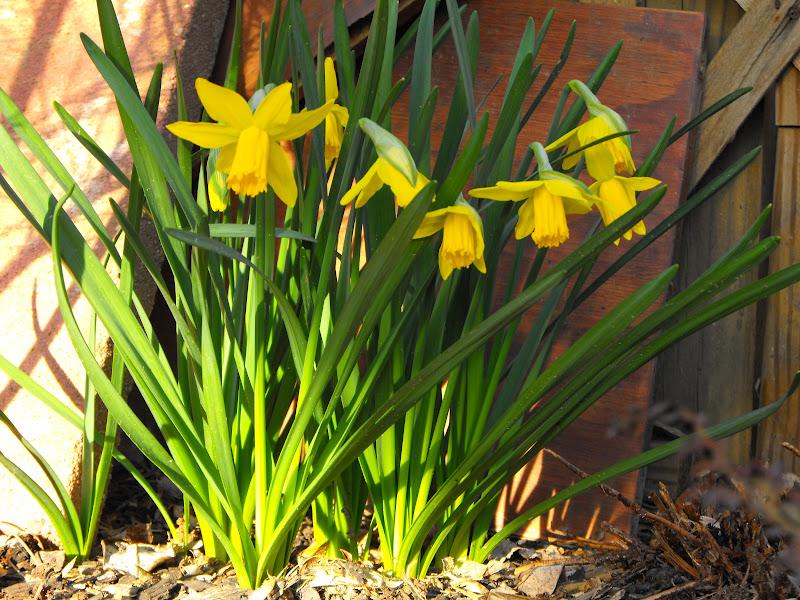
Having no room for willows, I recreate a golden landscape with Aucuba japonica Mr. Goldstrike crowning the Buddha, Aureomarginata Euonymous japonica (Golden Euonymous; above left), Citronelle Heuchera (above, foreground), and, lest we forget that heir of spring, the daffodil.
I'm fortunate for that coincidence, and for Sir Anthony's eloquent articulation of the content of his condition. For I went into the desert that is my late winter garden and saw those bright, cheery yellows and golds which exude such promise and hope.
Gold: the color that slays the mighty demons.


