Showing posts with label Kerria japonica 'Golden Guinea'. Show all posts

Tuesday, November 12, 2013

On Vocabulary

I pulled back the curtains in the study this morning (our "This Old House" exudes its charms this time of year in the form of drafts, and curtains are a handy way to block the more egregious of them) to discover a rear shade garden awash in shades of yellow--the populist color, as Christopher Lloyd dubbed it.

At this time of year, I can't imagine the eye NOT attuned to lighting and coloration which change daily. Yet our modern, busy lives increasingly orient us away from the spectacle of the world and towards the entrapped, elusive light of the screen.

But there it was: an overnight metamorphosis providing the bookend to the 2013 gardening season. If we began with spring yellows, we end with autumnal ochres.

The Solomon's Seal--comparatively, the least exuberant of the garden yellows at the moment--caught my attention, for its transfiguration has only just begun, its flavescent leaves suspended just for today in a curious interregnum as viridity yields to heraldic gold.

In less than a minute the following happened.

I wanted to jot a haiku in its honor, but Polygonatum just seemed, visually, too bulky a word, even if, syllabically, it conveniently satisfied first line requirements.

I then began to think of (or rather look up) the diversity of words we have to capture one color and its multiple hues and shades:

aurulent, chartruese, citreous, citrine, flavescent, gamboge, goldenrod, icteritious, isabelline (like graying-yellow hair we hope to avoid), jessamy, luteolous, luteous, lutescent, melichrous (like honey), meline, ochre, ochroleucous, or, primrose, sulphureous, tawny, tilleul, topaz, vittelary, and xanthic.

What language!

I spied a fulvous aging white port  in the lower leaves of Carolina Allspice, which reminded me of a nearly-forgotten bottle and my time in Porto in 2011.

There was a wheaten sunset supplied by a potted Sum and Substance Hosta at the base of Mount (Sawtooth) Aucuba, while on the other side, was a rising icterine sun in the form of Kerria japonica 'Golden Guinea'. A most pleasing microcosm of our world.


And then there was the white.

No: not the white from the errant flowers of the leatherleaf viburnum (Viburnun rhytidophyllum) or the few remaining chrysanthemums or even the Camellia sassanqua.

No.

This was the white of falling snow: one bookend overlapping with another.

This is our world: a panoply, a diversity, a richness, a mutability that we dismiss by calling it cyclical (as if to say, "if you miss it this year, it will happen again next"). How much of it goes increasingly unnoticed? 

Tuesday, August 20, 2013

On Discipline

When I began this blog, I freely admitted my promiscuity.

In fact, the confessional appeared in my second entry, Public Confession #1. Lena Scotch Broom, with her tantalizingly tangelo and lemon yellow flowers, was the Ariadne to my Theseus.

Of course, most gardeners are promiscuous. When allured by the brazen sexuality of a flower with an extended stamen or a fleshy pistil, or a flashy dress of petals; when seduced by color, whether bold or subtle, the hue of which captures light "just right" and brightens (and broadens) our perspectives; when enchanted by the elfin charm of an exotic or unusual varietal; when embraced by the brawn of a handsome plant, we gardeners genuflect before the pot or the price tag, our prurient desires satisfied--always thinking, "just one plant won't hurt."

And yet they usually do hurt, that is, if the garden is one of design and the paramour in question introduces yet another shade of desire. Otherwise, a riot of color in an unplanned garden may (a highly contingent "may," mind you) actually look quite good--an homage of sorts to the quintessential English cottage garden.

Recently, owing to changes on the other side of the fence, I've had to rethink the backyard shade garden (yesterday, more was removed, yet this time I was so gratefully consulted by the owner and tall, tanned, sandy-haired, and toned-muscular landscaper; my eye-candy must have thought my flirtations importunate yet, at the same time, flattering, because he repeatedly asked if his work and pruning satisfied me). But I digress...discipline...oh yes, right.

Knowing the predicament I faced, a friend, Rich, so thoughtfully introduced me to his gardener friend, Kevin, who faced the opposite situation: enlarged trees and shrubs created increasing shade for what was once a predominantly sun garden. We met and exchanged some plants, one of which was this Agastache (above and aside), the blooms of which are more diminutive than is customary whose Greek nomenclature directs us to its many tall spikes of purple flowers--but I did shock her by transplanting just prior to flowering. I paired it with Baby Blue hosta, which I think, once both become fuller next year, will look smashing together.


With the transplanted Heliopsis--also a gift from Kevin--and the spring-blooming Kerria (which is happily offering the occasional "Japanese rose" even now in waning summer), I was suddenly reminded of my original design scheme, at least for the front garden: blue and white. Confronted with the specter of the present--yellows, blues, purples, and whites--and reminded of the pleasures of the recent past--a sporadic sprinkling of pink to accent those colors--I felt the disciplinary compulsion to reign in the garden and realize a design that went beyond a generic and loose commitment to 'East meets West', 'Japanese meets English cottage garden aesthetic' principles. Panoptikon lives.

Any garden designer (or magazine article on garden design)--even those who specialize in cottage gardens, which appear to the untrained eye as a simple melange but which really are not--will in varying degrees recommend or downright insist on discipline, even if that discipline manifests itself only as a limitation of color combinations along a particular segment of the color wheel (say, the yellow-greens to the reds for a fiesta of heat and salsa, or the red-violets to the dark greens to achieve a cooler, more meditative atmosphere), or to an analogic color scheme (colors alongside a given color), or, more restrictive still, to a composition of complementary or opposite colors (say, green and red, or blue and orange). The gardener and visitor alike (nay, the eye) will be rewarded, so we are told, by the commitment to a scheme.

I think there is an added, often curiously unstated, benefit: the gardener becomes well versed in a particular array of plants and flowers. Surely, one can visit the local garden center and purchase what is available. But the garden becomes more special, and is elevated in stature and meaning, when the gardener invests some time and energy to research and seek out, though internet and catalog perusal, unusual specimens that conform to a selected palette (keeping in mind that color comes from both flower and foliage!). And for garden snobs--surely, a Lady Mary lives in each of us!--there is no greater pleasure in showing off our finds and artistry. 

Of course, the $64,000 question (or the $1 million question when adjusted for inflation!) is whether I have enough discipline to realize and maintain my garden coloration scheme.


Saturday, August 18, 2012

Micro-climates


Every gardener is aware of the micro-climate phenomenon: that space alongside a southerly facing brick wall in which you can grow a plant 2 zones beyond the designated USDA hardiness zone; or that desertified space under your maple tree in which Solomon Seal flourishes while your astilbe does not, though it may several feet away; or even that spot of shade in your full sun garden in which a tender hosta, sheltered as it were, defies logic and thrives.

Smallness.

Our human lives, too, occupy micro-climates: infinitesimal spaces in a nearly unfathomable macrocosm.


Celestial objects, majestic mountains, dinosaur fossils, even (human-made) technology which becomes grander than the minds that gave birth to the machine (and the bomb): no wonder we should occasionally experience smallness as an existential condition.

It seems to me we humans have spent the entire history of existence trying to overcome nature, to control and subdue it. Even we gardeners, who I like to think are appreciative of the natural world, do our part towards subduing and controlling nature by nurturing and directing aspects of it. We weed. We prune. We divide. We eradicate. We expand our borders by cutting into the forest or field that abuts our property. We supplant native species with ornamentals from abroad.

The whole experience--our interaction with nature--is humbling from my point of view (though I know a number of people who will scoff at the notion, and find no moral element in our presumably G-d-given right to dominate). After all, G-d granted Adam the right to name things (perhaps there was no right granted; it was simply a perceived opportunity...I need to check this). By naming, we appropriate and exert a form of intellectual control (and a concomitant sense of ownership).

Hence, as awful as it sounds, the hurricane, the tornado, the earthquake produce a kind of melancholic satisfaction: that we are not masters of everything for we cannot control these forces of nature. We cannot even predict them. We are, in all of our naked humanness, in all of our fallibility, objects of nature, exposed in our hubristic fantasy that we dominate nature. We become, if for a moment of time in the face of these forces, infinitesimally small. You'd think we'd have learned some humility by now.

But many don't. No wonder some continue to think humans have negligible impact on the environment: because we are objects enacted upon by nature. We are the objects of disease and drought, heat waves and deep freezes, not to mention nature's more spontaneous, headline-grabbing forms of violence.

But just as we may get lost in our bigness, we may also get lost in our smallness. We hang by proverbial threads. We intuit our irrelevance or, more appropriately stated, our relevance but in the most miniscule and limited of (geographic, social, intellectual) ways. There are, to be sure, personalities that shift the course of history. There are "larger-than-life" figures. But most of us are not in any grand historical sense, even if we may be to those who intimately know us.

Several days ago, while engaged in my own inner drama, feeling infinitely small and gripped by inability (to write, to think, to be the professional I was trained to be) I took a garden stroll. This wasn't the best idea: I was confronted everywhere by evidence of my own failures. I've been too preoccupied this summer trying to finish the book I was contracted to write, and hence have spent little time gardening. I had just been away for eight days, with another brief jaunt unexpectedly appended to it. And drought, Gramsci "fertilization" and "watering," and a fatal fungus have taken heavy tolls on the garden; many of my prized ornamental hostas (Golden Tiarra, June Plantain) have succumbed to that wicked Scerlototium rolfsii that, once confined to southern tropical climates, has eased its way north (global warming?). The rear shade garden looks quite the mess.

And then I spied this gossamer thread: that delicate filament with improbable tensile strength comparable to high-grade alloy steel.


And not only the gossamer thread, but this bud on the early spring-blooming Kerria japonica.

And not only a bud, but a flower.


And I felt that smallness melt away. The tenacity of the spider, the toughness of the filament, paired with the fluorescence of Japanese Rose: these were little victories in this annus horribilis of gardening. And along that gossamer thread, I found the insignificance of my research, the irrelevance of my self, and the frustration with gardening inadvertently and unexpectedly projected away, spun out upwards into the universe and thus out of my existence.

Later, perhaps in an act of penance for the destruction he has caused, I witnessed Gramsci communing with Buddha. Or perhaps he was just contemplating what needed additional watering. One little cat (okay...not so little), one big impact. 

Never underestimate smallness: its effects are anything but.


Tuesday, September 6, 2011

Delayed Pleasure

"Late" or its usual variant of "delayed" must be the most hated word in the language of travel.

Some might take issue with that position and think cancellation is the worst. But I maintain that at least with cancellation one knows one must make alternative arrangements. The certainty of the situation mitigates its problematic and inconveniencing aspects.

Tardiness, instead, simply prolongs a misery that is born from expectation, and the frustration born of the sense of "wasted time," and the fear that yes, if you step outside to smoke that cigarette, or sit down at the only airport restaurant that offers waitstaff service, you may miss your flight.

We hardly welcome tardiness in many areas of our lives, which makes me wonder how I ended up with Viet who, well, put diplomatically, enjoys the elasticity of time. I have come to realize over the last 3-weeks-short-of-13-years learned his behavior from his family. Dinner at 8 p.m. means one begins eating oh, perhaps 9:15. In my upbringing, dinner at 8 means you show up, unless otherwise directed to attend a preceding cocktail hour or have hors d'oeuvres, to arrive by 7:50, for dinner will be served at precisely 8. After many years of living in quiet--and sometimes not so quiet--frustration, I've learned to accommodate myself, which, in the realm of dinner, translates as "eat a little something beforehand, because you may be waiting several hours."

Dear Reader must be exasperated, but let me tell you: for someone who eats breakfast before the roosters crow, and who eats a very light lunch if at all (I usually skip lunch), waiting to eat for 15 or 16 hours is quite the ordeal.

Yeah, yeah, I know exactly what dear reader is saying... so let's move on with the story.

Some late arrivals we celebrate:

like this spring blooming Kerria japonica which reared this single astonishing blossom this past weekend,


or this Carolina Allspice (Calycanthus floridus), also spring blooming, which decided to engage in a bit of late summer impishness after my return from Europe in late August.


Both remind (read: mock) me that being obstinately wed to inflexible schedules makes one a frustrated soul, especially since the vast majority of the world seems to be, well, differently scheduled.

But sometimes, as Viet has demonstrated countless times over the years, for the sake of sanity time itself must be arrested and disposed of, for, in Viet's street-savvy wisdom, "if you wait until the last minute, it only takes a minute."


I haven't gotten to that point, nor will I ever, but I am learning to appreciate the unexpected pleasures that sometimes come with delays.

Saturday, April 16, 2011

"You Don't Bring me Flowers, Anymore"


Romance may not always begin with flowers, but it must include flowers.

Paramours, husbands, wives, and lovers: take note.

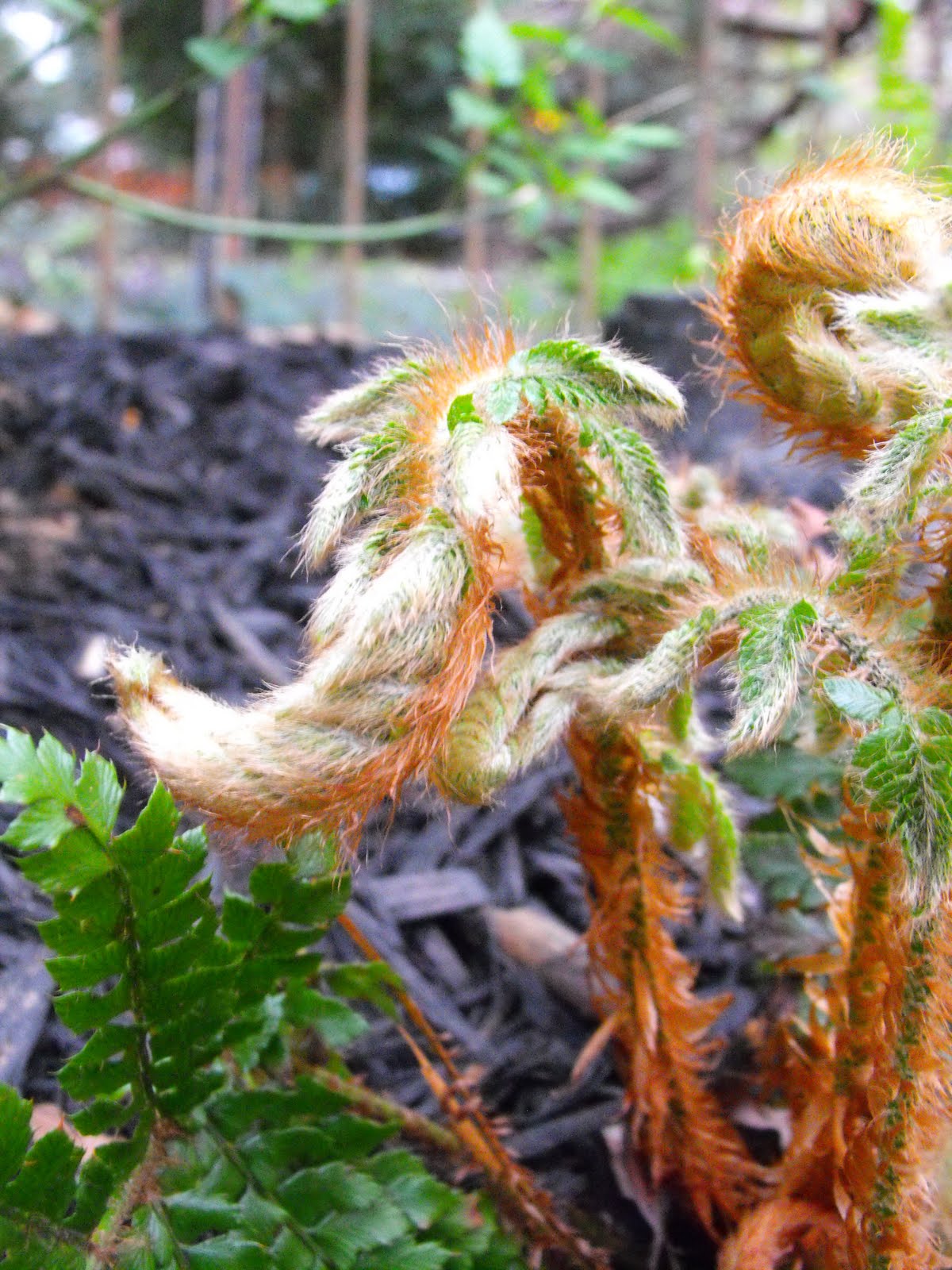
Look at how Kerria stoops down to offer the outstretching, sinewy, furry arms of Tassel Fern a bouquet of its own vibrant, golden yellow flowers. The two meet, barely touching, until the slightest breeze compels the connection. Electric.

The scene is reminiscent of Neil Diamond and Barbara Streisand's performance of the 1978 hit, You Don't Bring Me Flowers. But in this scenario, we don't have the impression that Kerria and Tassel Fern lament a love lost, or a love eroded, as it were. Rather, we feel a distinctive romance, a connection, borne out of the pangs of winter barrenness. This is a joyous reunion.

Romance harbors many expectations. Indeed, one might even muse that romance is expectation (of a certain sort). We engage the objects of our affections with hair tossing or coy smiles. We laugh at even the most inane comment, simply because it emerged from the lips of the beloved. We expect touches and kisses; we expect, perhaps, a candlelight dinner or a concert. We expect a phone call or, as must be prevalent in the younger generation, a text message (email must seem so antiquated). We expect attention. It doesn't have to be lavish attention, though I suspect in the beginning stages of romance, lavishness may indeed be welcome as the definitive antidote to dreaded nonchalance.

In time, romance may grow into love, and love, as Alan and Marilyn Bergman, composers of You Don't Bring Me Flowers, warn us, may atrophy: for love enacts its own kind of stabilizing force to tame the tempestuousness of romance. Love, to remain alive, demands an occasional revolution, a romantic paroxysm. Without it, love becomes inertia itself. Perhaps that is the real reason why the song reached the top of the Billboard Hot 100 in 1978: all of the flower children of the 1960s, having bent to conformity, married, and had children, began to lament not necessarily the love lost in their lives but the loss of freedom and blitheness. The song captured for them the passage of time, and what a better way to conceal underlying irritation and disconnect than by singing along with Barbara. But even Barbara cannot stave off the blues or save marriages, and so the divorce rate skyrocketed.


Flowers may fare no better than Barbara, but flowers may be that occasional paroxysm, the stimulator (pun intended) that is romance's rejuvenation that permits love to grow.


** Source of graph: OECD Index of Statistical Variables--Population, Marriage and Divorce**

Saturday, February 19, 2011

Flamboyant Revolutionary Reinforcements

I’ve been slogging through mounds of paperwork and happened upon the oddest phrase in a rather revealing statement of purpose. Someone described himself as “flamboyantly heterosexual.” Flamboyantly heterosexual? Really?! I’ve heard of metrosexuals, and flamboyant homosexuals, but never flamboyant heterosexuals. What might that mean? Does he dress like a lumberjack, or a plumber with the omnipresent visual of…well, let’s say, the beginning of the torso’s division at the rear of the spine? Does he communicate in monosyllabic grunts? Bottle up his emotions? Crush beer cans with his bare hands when his favorite team scores a touchdown, or a homerun, or a hole in one?

Unless the author of the statement deliberately wished to convey the message that he is a walking stereotype (perhaps outdated ones at that!), wouldn’t “metrosexual” have proven a more apt descriptor?

I remained puzzled until I spent time in the garden yesterday (in our glorious 70 degree February day!).  And then I saw it: flamboyant heterosexuality at its best!

Kerria japonica began to leaf out yesterday (or, given the maturity of one leaf, the previous day).

Aerial reinforcements to advance the revolutionary cause have arrived!

I do masculinize Kerria, and I’m not sure why. Regardless, he, like Petasites, uses his masculinity (their flamboyant heterosexuality?) in the spring garden to tremendous, rousing effect! His lithe chartreuse stems, populated by red, bulging buds, seem otherworldly. One would think his gangly self could not endure; his lankiness, though, belies his brawniness. He is a star.

Perhaps, then, there is more than horticultural coincidence—perhaps there is deep significance—that Star of Bethlehem too emerges from the cold, soggy soil, sporting her slender spring green leaves with narrow white medians. Each compliments the other and reinforce their avant-gardism.

This is flamboyancy at its best!

Monday, December 20, 2010

At One with the Garden in Winter


For nearly three-quarters of the year, we commune with the garden. Those are blissful times: times of activity and growth, experimentation and familiarity, rejuvenation and repose.

Late autumn to early spring bring quieter times: times of lamentation, times of a different sort of repose, and times of planning (with all those garden and seed catalogues coming our way, how could one resist the urge to chart and plan the spring and summer garden?).

But winter brings with it a different kind of opportunity—an opportunity that all gardeners must heed. It is the opportunity to study the architecture of space.
 
Winter lays bare the beds, the garden rooms, the hedges, the walkways, and the walls. But so exposed are the parts that makeup each. Take this walkway, for instance. This dusting of snow accentuates the shapes of the stones. Here I see a shrunken Egypt and an elongated Sinai. Two stones below or toward the foreground we see undulations caused by millennia of successive waves—a reminder of a past so alien and almost unimaginable.

I see the stone walls that outline my beds have sunk into the ground by at least 4 inches. Height recedes. Verticality morphs into an unwelcome horizontality.

Frost-induced reduction of the ajuga makes stark the sinuous walls. My fetishistic collection of rocks once again appear, their herbaceous screens having retreated in the wake of winter’s onset. And the redesign of the east side shade garden bed becomes more apparent as only the anchor specimen plants—the Sawtooth Aucuba japonica Serratifolia (Serrated Japanese Laurel), Kerria japonica (which I moved from the heavily shaded southwest corner), and the Nikko Blue Hydrangea—are left to inhabit the winter garden, accented only by the improbable, preternatural greens of the Autumn, Christmas, and Holly ferns.

And today, indoors, despite the cold and the frozen ground, I live in the garden and commune with it. The window wells are being insulated, and the windows reinstalled (which means I shall live for the next few days sans windows in particular parts of the house). Nothing separates me from the garden, and I feel the same cold the plants feel. Even for me, this is too close for comfort in the winter garden. 


Wednesday, April 28, 2010

Color Me Happy


And so he’s mine: Kerria japonica Golden Guinea five-petal cultivar, not the double-flowered, less hardy Pleniflora cultivar! Victory!

To wit, I’ve been lusting after him ever since I saw Kerria at the garden center many weeks ago (the garden center only sold Pleniflora, and at a hefty price). Last weekend, I just happened upon him by accident (or was it fate?) at the UD Botanical Garden Society sale while scouting for a dwarf witch hazel, all of which were reportedly sold out, though I secretly hoped someone had stashed one away behind some bush for me to find, purchase, and steal away to 410.

I also purchased Carolina Allspice (Calycanthus floridus) Athens cultivar, and a “Waterfall” Japanese maple. Who knew happiness came in so many colors and shapes?!

Why I masculinze Kerria I do not know. His flower —such a vibrant, arresting yellow— is delicate, yet his stems are strong. He sits back in the corner, of 410's shade gardens, his foliage unassuming, his flowers drawing attention to this presence. In the winter, his stems stripped bare, he displays an inspiring fortitude of chartreuse stems—green (a non-evergreen green!) in the dead of winter! How robust! How daring!

Kerria and Nandina (Heavenly Bamboo or False Bamboo) shall look divine together during the barren winter months, I am sure; his green will offset her green and red foliage, as well as the intensity of her crimson fruit.