Showing posts with label Blaze Starr Rose Mallow. Show all posts

Monday, July 29, 2013

My Rose of Sharon, One Year Later


You will hear thunder and remember me,
And think: she wanted storms. The rim
Of the sky will be the colour of hard crimson,
And your heart, as it was then, will be on fire.

That day in Moscow, it will all come true,
when, for the last time, I take my leave,
And hasten to the heights that I have longed for,
Leaving my shadow still to be with you.


Sometimes we must genuflect before the poignant confluence of art and life. 


A crimson sky bathed the rear garden in an ethereal glow moments before darkness shrouded this part of the world--yet it was not at the time conceived of as a prelude to the dramatic storms that would follow several hours later. 

Torrents of wind-driven rain produced a turbulent river down the street, carrying the detritus of human life and the limbs and leaves of trees with it; rolling crescendos peaked into the denouement of piercing claps of thunder; and razor-sharp streaks of lighting slashed the skies while illuminating black, angry clouds.

I did hear thunder and I did remember her: our beloved Sharon who left this world one year ago today.

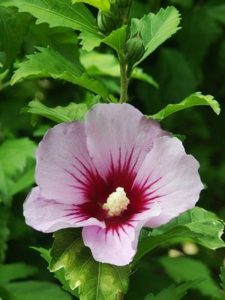
And this morning she appeared to me in different form: an exuberant display of her favorite flower in my garden: Blaze Starr Rose Mallow, which last year in commemoration of her brief life and indescribably humbling relationship with her cancer, I dubbed my Rose of Sharon.

Not to be overly metaphysical about it. 

But Sharon identified with the flower: for her, looking across the street every morning for weeks during summer's midpoint and decrescendo, she absorbed its beauty, mused on it.  It was often the opening salvo of our daily morning conversations, her sitting on her stoop having coffee, me, emerging to feed the outdoor cats.

But the sunset, the storms, the Akhmatova poem (a particular favorite of mine), Rose Mallow's first display of more than 6 flowers at a time: their junction struck me as a sign.

But the cancer...

But it was her cancer. She took ownership of it in order to accept it. She did not fight in the way we normally attribute "struggles" or "battles" with cancer; in this way, she lived Susan Sontag's exegesis, Illness as Metaphor. And her ownership of this virulent, fast-consuming thing, we think, helped her move forward and live "normally" for months with few ostensible effects. And then suddenly, one morning she awoke, and she appeared different, for the cancer, overnight, transformed the physicality of our beloved Sharon. And such began the rapid descent...

We may find and derive meaning in and from the lives of others: what they do and how they are helps us intuit their Being. And Sharon did ever so much, welcoming us into a predominantly African-American neighborhood, when many looked down upon us with disgust and suspicion, and warding off the vitriol sent our way. And over the years, we cultivated a harmony and camaraderie because, as she occasionally said, we are all in this together. That's what Sharon brought to this world. And what she left us.

And so today I see signs of her, and celebrate her life, even if the celebration is marked by tears and pangs of pain, much like the fuchsia droppings of Rose Mallow as she discards those magnificent blossoms daily, during the evening, as if exhausted from serving as a vanguard of beauty.

Such is the residue of a powerful life lived that all of us must bear.


Saturday, July 20, 2013

The Social Event of the Season


Every community seems to have its "social event of the season:" Baron's Balls, black tie dinners, silent auctions, banquets, garden parties, regattas, casino royales, art galas, opera first nights, opera-under-the-stars--all organized for some philanthropic endeavor. These are events not simply for the social mavens, doyens, debutantes, and more aged afficionados to display their finest attire and jewelry, but for others to be welcomed not merely to the charitable circle of donors, but to the hierarchy of society itself. Simply stated, one obtains social standing.

Today, social events of the season seem not to be a thing of the past, but certainly a vestige of the past. In an age of Facebook and Twitter, video and instantaneous communication, almost any event ascends to the hierarchy of attention given proper dissemination. Wrapped in hyperbole, nearly every event arrives at the pinnacle of importance which, of course, only demands that the next be characterized more effusively.

Somehow, these events seem to have lost their privilege and with it, their meaning. At least in my warped vision of the past and the present. But it need not be that way.

For instance, let's consider the following. Bill Cunningham of the famed fashion pages of The New York Times delivers weekly to a worldwide audience a display of (usually) New York fashion, such that you would think this week's 'Baked Apple' play on the 'Big Apple' was the social event of the summer fashion scene. Perhaps it is.

Please dear reader: I emphatically plead with you not to misinterpret. I love Bill and crave his weekly insights. He rises above the din and places his finger, effortlessly, perspicaciously, on the pulse of life. Or at least of an aspect of life. I would not have it any other way. It's the way he sees beyond and through people and their superficialities and captures a moment's essence that has, seemingly, arisen and presented itself organically, unconsciously, and only constitutes a trend--and this is critical--because Bill has observed and decreed it as such. Therein lies the power of a social event of the season.

But here is where, somehow, most of our social events of the season part company with Bill Cunningham and seem less peculiar and special moments in time for which we prepare weeks if not months than an instance among many on a streaming calendar of life. We are all Twitter and Instagram and Facebook and status updates and tweets: we are moments vying for attention. And somehow we lose our way.

Perhaps indicative of the poverty of my social life, one event does appear on my calendar: the appearance of Blaze Starr Rose Mallow, which today offered her first dazzling spectacle. It is the summer solstice of gardening.

Like any social event of the season, she is larger than life. Well, now, that surely is an exaggeration, but seriously: the flower is enormous. Here, for scale, I photographed it from across the street against the backdrop of No. 410.  And she dazzles. Her fiery fuchsia and morphing lavender-to-magenta-and-plum colored stems, along with those palmate leaves: well now, that is one chic gown she sports!

Like any social event of the season, she lasts for a brief period of time, her moment on this earth infused with a curious mix of frivolity and seriousness that defines it. More properly stated, each flower lasts one day, though she blooms from mid-to late July into well into September.

And, like any social event of the season, she heightens one's sense of anticipation such that when she arrives, one feels relief and satisfaction, and somehow more alive having experienced it.


Saturday, September 22, 2012

Editing


Writing is not easy.

Reading, I suspect, alters our perception.

We pick up a book and relish the prose, yet think not of the craft. We consume, yet think not of the production.

Gifted writers entice and captivate with rivulets and torrents of words which, in their very juxtaposition, generate images, evoke feelings, signify a mood, set a scene. Good writing belies the labor of the craft, for it impresses upon the reader an eloquence, a rhythm, a flow, an economy of words that, in its precision, exemplifies efficiency.

The activity of writing is much, much messier.
 
Nay, writing is brutal: brutal only because good writing entails not simply composition but editing, or a curious, objective, unsentimental, unforgiving approach to one's work. Editing demands disposal of the product, excision of text; reconstruction of prose; revision of ideas. It demands we confront our best work and declare it ineffective, in need of improvement.

Nature proves an apt model. I've complained this summer of my Sclerotium rolfsii which has killed ever so much in my garden. I've complained of drought. And now I complain about all of the empty spaces.


But as I walked around this morning, I was struck by how effective an editor nature really is.

What remains is an essence: a prominence of elegant burgundies and purples, as supplied by the vibrant ethereal hues of Tall Purpletop Verbena against those svelte limbs of Rose Mallow, which deepen in intensity as the days grow shorter,

which contrast so perfectly with the silvery hues of Helene von Stein Lamb's Ear when set against a backdrop of the Happy Single Flame dahlia (which has produced hundreds of buds and few flowers owing to a parasite that eats the buds from the inside out). 


On the lower level in the front garden, Helene von Stein finds company with Eupatorium 'Chocolate' Snakeroot, which itself is paired (deliberately) with Lavatera Red Rum so as to accentuate the latter's burgundy stems.


The effect is, if I may, one of Teutonic efficiency, and militaristic precision.


Monday, July 30, 2012

"The Rose of Sharon"

National Flower of South Korea Mugunghwa

I had always thought that the Rose of Sharon was a type of Hibiscus (Hibiscus syriacus, to be exact). A visit to most garden centers will confirm this, though the hibiscus in question eponymously, and quite erroneously, attributes its origins to Syria when in fact it hails from East Asia (and is in fact the national flower of South Korea).


But Rose of Sharon, I have learned, also refers to Hypericum calycinum, better known as St. John's Wort, which of course bears no resemblance or filial relation to the hibiscus. 

So we have two different plants with the same common name. Curious, isn't it?

Sort of, but not really, because Rose of Sharon also has come to be attached to a crocus (this is confirmed as a mistranslation of the Hebrew  כרכום, karkōm, which grew on the plains of Sharon along the Mediterranean Sea in what is today northern Israel). Confusion may have stemmed from the fact that the crocus bears some resemblance to a previously unidentified, onion-like flowering bulb, Chavatzelet HaSharon, חבצלת השרון, which has been authoritatively identified as Pancratium maritimum, a.k.a. Sand Lily or Sand Daffodil, pictured below.


And the name has been attached to a type of tulip.

And to a type of lily.

Confusion is nothing new.

This is why I try to learn the formal botanical (Latin) names for plants: because their common names mislead.

But then so too do the Latin names, as knowledge becomes more precise, and as knowledge is created.

I do not have the Rose of Sharon, but I do have Rose Mallow in my garden. I've written about her several times; she is a stunning addition to any garden, and responds well to being accorded a place of prominence where she is permitted to be the belle of the ball.

(For comparison: I spied a Rose Mallow in the Chanticleer Pond Garden [toward the upper left of the photograph], but it rather gets lost. This is not a point of criticism, for Chanticleer is designed as an Impressionistic tapestry, each plant prominent only for its placement in and contribution to a wider order, a punctuation of color and texture; in the small garden, plants must be selected that both contribute to a wider order and that stand alone as exemplars of a moment or a vision.)

My friend and neighbor, Sharon, loved my Rose Mallow. In fact, she wanted it after we began her garden.

For a moment, I choked. How could I tell her that while Rose Mallow is surprisingly unfussy, she is the botanical equivalent of a bibber, our summer drinks on the porch notwithstanding? And my Sharon made it quite clear she needed low maintenance plants because she had a self-professed "black thumb."

I responded that I'd be happy to divide her once she became acclimated, but that she needed copious amounts of water.

And out came classic Sharon: "Girrrrlllllll.....you'd best keep her over there so I can look at her pretty!  You be bothered, but I can't be.  Just as well: I can look out at her everyday, so keep her growing. I get all the pretty and you all the work!"

And we laughed.

Last year, Rose Mallow reached approximately 12 feet with five stalks.  This year, she sports seven stalks, at approximately the same height. And oh, the flowers she produces!


Our Sharon, our beautiful Sharon, took her leave late yesterday from this earthly existence. She...died. (Take note: how powerful are our words, but more so the tenses of our verbs.) She took her enormous heart, and her infinite goodness, out into other worlds.

And so my Rose Mallow becomes my inadvertent Rose of Sharon. Perhaps this is how these common names come to refer to a wide variety of plants: our proclivities and personal experiences, our understandings and our misunderstandings, shape our perceptions and we locate, create, linkages between otherwise disparate items. These common names create order where there was none, provide comfort and assurance in a world of uncertainty and confusion.

Genesis: the beginning. A beginning. Naming: Adam's contribution to that beginning. And where there are no names, or when names are altered at will for self-benefit, or when names lose their meaning...well, we need only think of Thucydides' account of the stasis at Corcyra to understand the peril the befalls us.

We all felt bereft last night, huddled together, remembering and laughing and sharing stories: our mortal way to grasp onto ethereal meaning. We have to reiterate names, name names, ascribe meaning and importance to them all over again...lest we lose them too.  That is what we humans do: we attempt to regularize and stabilize; some might call this an exercise of proprietorship, but that misses the mark. We are all mortal in an immortal world. We seek a continuity otherwise lost to us ephemeral beings.

For me, Sharon--the woman, the name--will always be synonymous with strength and fortitude, not just of physicality, but of character and spirit. She did not tolerate intolerance or bigotry, rudeness or shenanigans. She rose above the fray and taught all of us, in her no-nonsense, genuine, and always sassy kind of way, how to be human.

She was a beacon of light, just as Rose Mallow is a mid- to late-summer floral beacon on our block. 


Now, Rose Mallow stands alone, bereft of that other rose in our lives.

Rose Mallow extends into the sky, stretching forth, always there, a beacon, to guide the spirit of Sharon back to the place of her earthly life.

 
** In memory of our beloved Sharon Thompson **  


Tuesday, June 5, 2012

Reaching New Heights


Several weeks ago, news media outlets paid homage to, or downright celebrated, the eclipsing of the Empire State Building as New York City's tallest skyscraper (a status it regained after that horrific day in September 2001) as the new World Trade Center Tower No. One (once dubbed the tacky, pretentious, and rather nativistic "Freedom Tower") rose to 1,271 feet above Manhattan streets.

The architectural world has long been preoccupied with heights and bigness--which in my base view is but a shameless intellectual version of men's locker room antics and furtive glances.

Bigger is better, right?  One would think so if one glanced at the seemingly never-ending quest to build higher and higher, not to mention more angular (really Libeskind? Another angular, jagged design? Oh my, how very original), or more arcing (oh, Calatrava, I thought I just saw that design...perhaps because I have?), or more twisted. Sigh. (Yes: I really can be an opinionated bitch. There, I said it.)

Burj Khalifa (2010 at 2,716 feet), Taipei 101 (2004 at 1,667 feet), the Petronas Towers (1998 at 1,483 feet), and the Sears Tower (1974 at 1,451 feet) have become (almost) household names, monuments to architectural and engineering prowess, if not hubris.

Recently, I've reached new heights. No, no, I haven't been climbing the tree, though I did perch an extension ladder a few weeks back against the maple to remove many of the lower branches and hence raise the canopy to allow more light (and rain) to access the beds below. Being scared of heights, I couldn't get beyond a few meager feet above the ground. Sigh.

No. My story of height and eclipse has really nothing to do with me.


Today, among the perennials in the front sun garden, Rose Mallow surpassed the Northern Sea Oats Grass in terms of height.

One just wonders: how will Rose outdo herself this year?

It's a question worth asking.

After all, she has to keep up with some famous architects.


Saturday, November 19, 2011

Color in the Garden: Amber

Amber is not a color that we plant in the garden.

Amber is the color that becomes the garden, for November (in these parts, never October) signifies what is both the garden's final retreat, and its inexorable march towards its annual, ritualistic demise.

Amber mutates, morphs, appears in various strains,

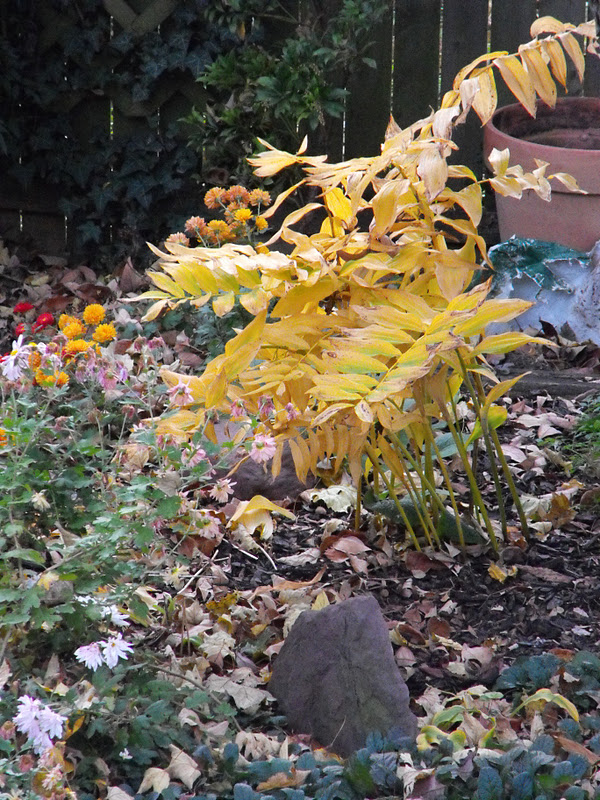
from the more translucent golden yellows of Solomon's Seal (Polygonatum commutatum)


and the deeper yellow-golds of the Gingko Biloba tree which has painted the field beneath it bright (a stark contrast to its now darkened skeleton),


to the rich brown-yellows of Orange Marmalade hosta,


from the orange hues of Rose Mallow's palmated leaves,


to the rich brown-ambers of the Big Blue Hosta,


the Blue Angel Hosta (the photo was taken early in its coloric metamorphosis, hence the lighter tones which quickly gave way to the deep amber visible at its tip),


and the Carolina Allspice,


to the the rare (in the gem world at least) red-ambers as seen in this Bald Cypress allee.


Amber is the official notice: the color of automobile turn signals (the industry has, I've learned, named the color of those yellow-brown plastic casings "Automotive Amber"), the alert when a child is missing, the last flash of brilliance before autumnal barren becomes the norm.

Amber is the color of absolution: a reward for our gardening follies (gardening is a persistent education, after all, a learning from our mistakes).
 
Amber is the preservative of garden memories, a golden dusk that arrests the moment and the season just as we awake and realize we've lost our grip.


Amber is the apogee of splendor, the final color before moribund, dessicated brown envelops, and winter white purifies.


Sunday, August 28, 2011

Hot Pink, Beyond the Storm

Irene has passed, leaving us with only occasional gusts of wind this morning here in northern Delaware.

The wind-driven torrential rain last night transformed the street into a rivulet, washing all of the storm's debris down the hill with it. Thus, there really isn't much to clean up, at least in the front garden.

In the rear shade garden, I needn't fall back on that law of succession as I mused yesterday, for time continues. A Pieris japonica did suffer some severed limbs as a dead tree branch fell upon it, and a few hostas and ferns were crumpled by clumps of leaves clinging to small branches. But the garden fared well.

And as a sign of wellness (we need such significations, don't we?), Rose Mallow, nearly prostrate at the height of the storm but now managing to upright herself, issued a proud, vibrant flower this morning: a flash of color in an otherwise grey landscape.

Saturday, April 30, 2011

Adult Pleasures X: Being Fashionably Late

Yesterday, those who cared to partake in the experience via television were treated to a royal wedding spectacle. Guests arrived at the Abbey and photographers were all too happy to indulge them by capturing their glam and fabulous-ness. The men looked dashing, and some downright scrumptious, in their morning suits, but the event went, as events do, to the women.

Each tried, it seemed from an outsider's perspective, to outdo others. But that, I am not convinced, is the ultimate reason for the über-sense of fashion that pervaded the assemblage. To be fashionable is socially expected. Aside from the Queen and La Reina Sophia, and perhaps other seasoned royals, whose mostly unadorned attire embodied understated elegance, others treated the body as a showcase for the spectacle. And what a spectacle it was (click there to see a slideshow): from the black (lacecap hydrangea?) flower and twisted sticks on Victoria Beckham's hat, to what can only be described as a post-structural conception of a bow towering into the sky from Princess Beatrice's hat; from Miriam Gonzalez-Durante's stunning dress that evoked the artistry of the flamenco (she is Deputy Prime Minister Nick Clegg's wife) to the dramatic canopy worn by Lord Frederick's wife Sophie Winkleman. One was not disappointed. British women do love their hats.

Which reminds me...on Christmas Day, 2005 in London, Viet's cousin Lan treated us to high tea in the Ritz Carlton's famed Palm Room. To describe the experience would be an injustice. Suffice to note that upon departure, an elderly British woman, who was just as "made-up" as any one of the royal wedding guests, caught Viet sizing up a French woman who wore what looked like a deconstructed Eiffel Tower on her head. After the woman left, the British woman winked and, like an overly affectionate grandmother, gently scolded Viet though, if I recall correctly, she also made some veiled remark about the outlandishness of French fashion.

Of course, arriving late, even fashionably late, to a wedding--any kind of wedding, not simply royal ones--is an insult.

But to any other kind of party, save perhaps for a royal one, we take pleasure in arriving late. Indeed, in some circles it is considered gauche to arrive on time.

And so the mind games begin: calculating the earliest possible moment one can arrive without being the first to arrive. Calculate incorrectly, you arrive too late and seem nonchalantly rude, as if you could not be bothered.

The garden party is another matter entirely. Plants arrive (and always bloom) on their own preferred schedule. Springtime weather fluctuations dramatically alter arrivals; one can never plan. Last year, for instance, my pale yellow bearded irises didn't begin blooming until mid-May; this year, several bulging buds about to open already appear. As I await to host a garden party for my class in 2 weeks, I begin to stress: will there be anything left of my mid- to late- spring flowers for them to see?

Yes, during spring the gardener becomes somewhat schizophrenic, as if a servant at one of those grand British country houses, moving into a frenzy when the guests do appear, either early or late, never on time.

But at a certain point in time, especially when the beds have filled after days of torrential rains punctuated by unseasonable heat, the gardener--who really is a servant in the specific sense of one who tends to others--examines the several bare spots in the garden, and realizes that winter took its annual, unforgiving toll. We count the dead, lament their losses, and turn to filling the spaces--especially when there is a garden party (for humans!) to plan.

Rose Mallow, I determined, died. I wasn't convinced that the Autumn Ferns had died, having seen the little black bulges from the crown, just above the soil line. But still, even with last week's tryst with temperatures in the 80s, nothing happened.

On Friday evening, I went outside to trim the spent daffodil and tulip stems and to gather some Boxwood clippings that evaded my cleanup after their Monday haircut. And there, nestled between the stumps of her 3 legs, were two little shoots of Rose.

With her glamorous sense of fashion, I decided her exceedingly late arrival is most welcome.

And, as if to outdo Rose, the shade garden Autumn Ferns decided to coincide their arrival just after hers. Their rose colored "gloves" and cinnamon colored stipes exude understated elegance. If Rose Mallow is Victoria Beckham, then Autumn Fern is the Queen herself.


All I can say is "welcome back."

Tuesday, September 14, 2010

The Waning Days of Summer

If summer is the full throttle of gardening life, then autumn is not many a gardeners’ friend. Crops are harvested, seeds begin to set, plants gradually fade, and the incandescence of summer gives way to the muted hues of burnt, subdued rusts and ochres, pumpkins and burgundies, umbers and persimmons.


Autumn: that other book end of the gardening season.

If spring inflates, autumn deflates. If spring vitalizes, autumn devitalizes. If spring is celebrated for renewal and rebirth, esteemed for deliverance from the depths of winter, revered for buds and pastel flowers, then autumn is appreciated for the maturation of that which will soon pass.

Autumn signifies the decline of that which we have labored over for several months. Autumn compels us to face the passage of time—and the passage of time, in the linearity of human life, can only mean decline and decay. No wonder so many become glum in the elongating shadows of the midday sun, a melancholy punctuated only by the burning landscape of autumn color.

The Greeks had two words for life: zoē and bios. If the former referred to mere biological life in the sense of birth, maturation, decline, death, and decay, then the latter captured the very essence that makes us human: the projects and identities that make us idiosyncratic individuals and that give zoē meaning. We might learn something valuable from the Greek. Our melancholy at the passing of time is but a manifestation of our natural selves. But to be melancholy is to privilege the biological and to arrest that other form of life.

So, in these waning days of summer when the effects of autumn already appear, I look around and delight in the myriad of changes that begin to pepper the garden. Seemingly overnight, Rose Mallow shed her vibrant summer dress of green and chartreuse for her understatedly elegant burgundy gown. The one seed pod I allowed to remain on her stalks has turned a rich caramel (I do want her babies, but not so many of them!) The oat-like panicles of the Northern Sea Oats Grass have begun to redden on their way to a bronze finish, and I am warmed by his chromatic complement to Rose’s autumnal beauty.

And of course the season for pumpkins is rapidly approaching.

But in my garden, I just never know where “the pumpkin” will appear.


Friday, August 6, 2010

On the Ephemeral

Peace bells toll, recall
the flash of light that erased
traces of being.

Flowers, like life itself, have a way of escaping us. Their ephemeral beauty unfurls before our eyes, captivates the passer-by, and in an instant disappears.

I refer not to seasonal displays of a continual succession of blooms, a veritable florid parade, that all gardeners strive to create (save for those who are most easily seduced when creating their gardens and just happen, by accident of exuberance, to purchase plants that flower at that particular time). From the early spring bloomers—the tulips, daffodils, hyacinths, paper white—to the mid to late spring rhododendrons, peonies, and irises; from the unfolding of the myriad summer blooms, to the autumnal delights of the asters, chrysanthemums, camellias, and Sedum Autumn Joy (though mine, exemplary of 2010’s acceleration of time—August heat in June!—is already in full bloom), we delight in the ephemeral displays as the mutable palette of the garden (spring pastels give way to the intensity of summer flowers and soon to the more muted, autumnal burnt colors) offers new vistas, captures seasonal light in peculiar sorts of ways, and permits us to feel the existence and passing of each season (something we really no longer do in our air conditioned cars and offices, carried away by the rhythms of a non-agrarian work life).

Rather, I refer to the more specific, technical sense of ephemeral as captured by the word’s Greek origins: epi (on) and hemera (day).

I have two plants whose ephemerality arrests: Golden Kate Spiderwort (Tradescantia x andersoniana) in the partial sun section of my shade garden, and Blaze Starr Rose Mallow (Hibiscus coccineus) in the sun garden.

Golden Kate is a lovely, delicate, yet hardy addition to the garden. Her tri-petaled purple flowers with bright yellow stamens are set off by chartreuse flowing leaves that positively glow in the sunlight (though be warned: she does not like much sun).

I've written on several occasions about Rose Mallow, but never about her flowers as she has only recently begin to expose herself fully to the world. Her large, palm-sized plus flowers spend the early morning emerging from their paper-thin green sheaves; by mid-morning, they appear as fuschia teacups with deep-red waxy interiors; and by late afternoon they fully unfurl such that their green sheaves look like exploding five point stars set behind deep red petals which invariably accentuate the burgundy colored stalks.      

This is not to say they only bloom on one day of the year and, should you happen to be on vacation or at the store, you miss their spectacular showing and are all the poorer for it. No. Each flower lasts one day, but the plant rewards or compensates as it were by producing a succession of blossoms.

Though a garden is ephemeral in the generic sense, a garden needs ephemeral plants in the technical sense. Somehow, they heighten our anticipation, awaken our senses of the unexpected, and allow us to appreciate the simple yet profound joys of nature.

Written in memory of all those whose lives vanished with, and whose lives were irreversibly affected by, that ephemeral flash of light on 6 August 1945, and again on 9 August 1945