Saturday, November 19, 2011

Color in the Garden: Amber

Amber is not a color that we plant in the garden.

Amber is the color that becomes the garden, for November (in these parts, never October) signifies what is both the garden's final retreat, and its inexorable march towards its annual, ritualistic demise.

Amber mutates, morphs, appears in various strains,

from the more translucent golden yellows of Solomon's Seal (Polygonatum commutatum)
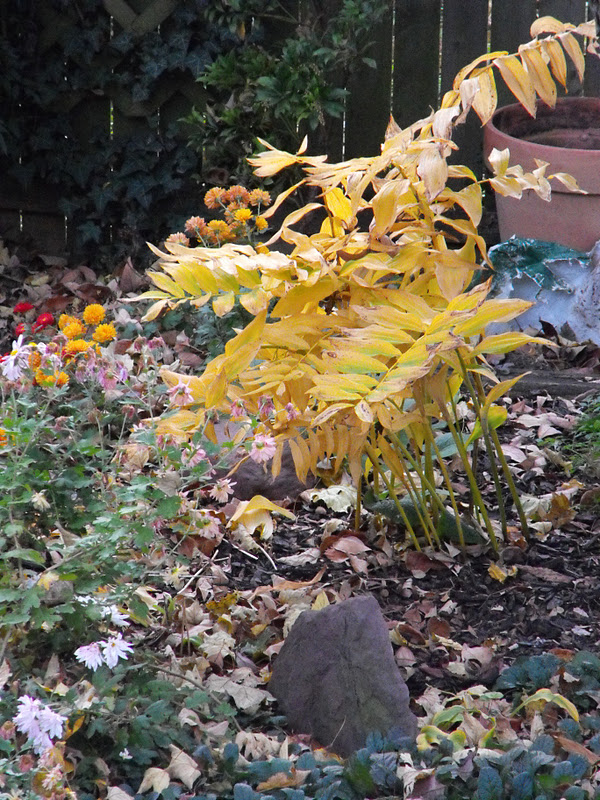

and the deeper yellow-golds of the Gingko Biloba tree which has painted the field beneath it bright (a stark contrast to its now darkened skeleton),


to the rich brown-yellows of Orange Marmalade hosta,


from the orange hues of Rose Mallow's palmated leaves,


to the rich brown-ambers of the Big Blue Hosta,


the Blue Angel Hosta (the photo was taken early in its coloric metamorphosis, hence the lighter tones which quickly gave way to the deep amber visible at its tip),


and the Carolina Allspice,


to the the rare (in the gem world at least) red-ambers as seen in this Bald Cypress allee.


Amber is the official notice: the color of automobile turn signals (the industry has, I've learned, named the color of those yellow-brown plastic casings "Automotive Amber"), the alert when a child is missing, the last flash of brilliance before autumnal barren becomes the norm.

Amber is the color of absolution: a reward for our gardening follies (gardening is a persistent education, after all, a learning from our mistakes).
 
Amber is the preservative of garden memories, a golden dusk that arrests the moment and the season just as we awake and realize we've lost our grip.


Amber is the apogee of splendor, the final color before moribund, dessicated brown envelops, and winter white purifies.


The Frost that Giveth...

Twenty-nine degrees this morning brought with it the second appreciable frost of the season--but not a frost frigid enough to destroy many of the hardier perennials or even affect the shade garden, still protected as it were by the now-decimated golden canopy of the maple tree.

The front garden, exposed, bore the brunt of the frost, which visibly extended its icy grips across my miniature botanical garden.

If frost claimed the vestiges of this hosta, already ravaged by the first (light) frost several weeks ago,


then it proved an ancestral accoutrement for this Sedum ellacombanium, native to northern Japan and the Kamchatka Peninsula, which, flowering well into the chill of November, looks dazzling draped in frosty white.


The Siberian Iris, bespeckled with gelid diamonds, appeared to reminisce, never so close to its indigenous Asian steppe as on the morning of the first frost which clings to its elongated fingers.


The frost surprised me, but not for the expected shock of its arrival, its veritable message that the gardening season has ended. After all, my insomniac self counted not sheep but the number of times the heating system turned on since 1:48 a.m.; I was very much aware of the consuming chill of the night, constrained also by 3 cats eager to capture every kilowatt of heat emanating from my body.

No. The frost surprised me by what it instigated and what it claimed.

It instigated an unexpected if disturbing sense of release: a release from obligation, a release from care, a release from service.

How positively strange. I love gardening. It is my escape. And yet, like the gym and this blog and my research and my house cleaning, my gardening life has been hijacked. Frost announced that all is virtually over, and that the mess that I call a garden, once first prize winning but for weeks an overgrown mass of mess, no longer needed my attention. Frost proved my absolution for the paralyzing guilt that had been building up for weeks, caught up in the pressure cooker that has become the metaphor for my life. Frost proved its release. Frost saved me from my self.

As is my nature, I lapsed into brooding (as unbecoming as brooding may be). That sense of release has consumed me, commanded my attention all morning. In my brooding I have come to realize what the frost must also claim: my sense of abandonment, my hijacking. These must end.

We are not hedonists when we care for the self, whether care assumes the form of gardening, or shopping, or blogging, or working out. No. We are tenders of the soul.

And now I come to realize the importance of advice given to me several months ago: I need to learn how to ignore and to prioritize. To prioritize is not to put others always above and ahead of the self. To prioritize is to recognize that others must learn to tend to their own selves and to take responsibility for the choices they make.

Amazing: if frost is usually denigrated for that which it takes away, today I celebrate frost for what it has brought (back) to me.

Saturday, November 12, 2011

Subduction


Subduction is an odd word.

It sounds like the bastard child of abduction and seduction.
 
But it is not. In fact, it is the opposite of what my dirty thoughts suggest: that is, not reproduction and thus the addition of something else, but rather a subtraction, a withdrawal, a removal.

Subducere, from which subduction derives, conjoins the prefix sub- (under, below, beneath, secondary, less than) with the root ducere, meaning to lead. Ducere makes me think immediately, of course, of Il Duce himself, with his corpse hanging upside down and all that that implies: secondary leadership, attempted escape, execution, withdrawal.


Yet the term has lost its ordinary meaning, having been adopted by geologists who will, no doubt, be puzzled by my application of a technical term of science to gardening. In plate tectonics, subduction refers to the process by which the edge of one crustal plate descends below another. Nine of the ten most powerful earthquakes to occur in the last century were subduction zone events, including the 2004 Indian Ocean and the 2011 Tohoku (Japan) earthquakes, both of which produced devastating tsunamis.

My autumnal world, it seems, is undergoing a process of subduction. A withdrawal. Sure, that is the cycle of seasons, yet there is something else going on: a subduction of color.

If subduction in the rear garden assumes various shades of yellow--a veritable pot of gold into which all colors are absorbed, made more spectacular by the golden canopy of the maple tree, then the front garden experiences a subduction dominated by hues of red and purple.

The Orange Marmalade hosta, having turned a brilliant shade of gold, begins the East Side Shade bed's autumnal glory,


and is joined by the Big Blue Angel hosta, which has turned  this brilliant shade of amber, accented by the leathery greens of East India Holly Fern.


Gramsci looks veritably pleased that the world has capitulated to his omnipotent handsomeness by turning his golden-boy shade of glory, though I surmise he may also feel a tad bit overwhelmed by the ubiquity of  "the color of him."


In the front garden, the burning bush takes center stage, and is complemented by the single petaled daisy-like chrysanthemum and the now denuded burgundy stems of Rose Mallow, and offset by the creamy variegation of the Siberian Iris.


Rudolph Waleuphrud Euphorbia begins to come into his own, his tips deepening their ruddy display in preparation for his Christmas pageantry. He's a one man show at that time of year, and he simply must shine.


In the meantime, Gramsci searches for the fresh green grass on which he likes to graze--grass that will no doubt in a few weeks experience its own subduction by winter white.


Friday, November 11, 2011

On Delicacy

I know someone who professes to be "delicate."

For instance, Viet (oops! Apparently very little is sacred in this blog, dare we rename it gossip column!) characterizes his palate as delicate. Cilantro used to overpower his senses, and he could not consume it. Perhaps those early sensitivities trained him to develop what has come to be an exceptionally sophisticated sense of taste.

"That's perfection: that hint of amaretto allows the caramelization of the fig not to dominate, but to add just the right amount of flavor."

"Uh, yeah, exactly," I murmur, as I look down at my now empty plate (the effect of vacuuming up, as opposed to savoring, my food) and peer over at his: one dainty bite gone while his entire dessert remains.

Moreover, his palate--much to my chagrin, chagrin because mine is exceptionally unsophisticated in comparison--seems possessive of its own memory, able to recall combinations of spices or flavors consumed years ago ("Do you remember that dish we had X number of years ago in which the saffron imparted an ethereality that arrested us?"  Um... no.... because unless saffron was the only ingredient in the dish, I can't taste it.)

We are beauty and the beast when it comes to food, though I try to learn. Our friend Alice, another "foodie" with whom we occasionally enjoy culinary delights, must, too, look upon me with disgust in the specific, Latin sense of the word.

All in the name of delicacy.

Delicacy, it seems, is not one-dimensional. Delicacy does not, it seems, mean what we think it means.

Delicacy does not only reference the dainty, the alluring, or after the 1603s, so my etymological dictionary tells me, the effeminate.

Delicacy appears also to be code for resilience (often) in the face of adversity.

Look at this Camellia.

Here we are in mid November, temperatures oscillating wildly between 70 and 32, and the Camellia just began to bloom. I think the first, almost inconsequential frost compelled one of its buds to open, the others just now pregnant and readying to deliver their indulgences.

Its perceived delicacy belies its actual fortitude.

Unless, of course, we rethink the meaning of delicacy, which we must.

Delicate is derivative from the Latin delicatus, meaning alluring or dainty, which is in turn derivative from the verb delicare, meaning to allure or to entice. That verb, in turn, may be deconstructed: its prefix, de, meaning away, is attached to the root which is a variation of lacere, meaning to lure or to deceive.
 
Yes: delicacy. It very root signifies deception. Supposed fragility fails empirical testing: for the Camellia prevails in inclement conditions, and Viet's palate disaggregates culinary complexities. To be delicate, it seems, is to possess an unparalleled potency, alluring most likely because it deceives.


Sunday, October 30, 2011

...and the Short of It

If autumn is the long season, then it also remains positioned on the precipice of disaster: and this we must not forget.

At this time of year, when the F-word begins to violate the gardener's consciousness, we come to appreciate the fragility of botanical existence even as we mentally fast-forward a few months to the promises of spring.

Yesterday, for many in the mid-Atlantic and Northeast, autumn came to a screeching halt. The Long Season, it appears, was merely a rump.

Not as a matter of bragging--certainly not, dear reader, as I will eventually lament the passing of my own gardening world, and will feel the pain of it as I am left to face the reality from which gardening permits me an escape--but we here in Wilmington were spared.

Yes, we received snow and sleet and some ice and a very steely, wind-driven rain throughout the day and night (3 and 3/8 inches, to be exact), but there was no accumulation of which to speak.

 
The Cassia didymobotrya (a.k.a. Popcorn Plant), a native of southern Africa and hardy only to Zone 10 (that is, subtropical conditions at worst), was clearly shocked (especially as I ripped it--roots and all--from the garden (don't mind the unpainted banister which my neighbor replaced but did not yet paint). I do not know how I shall keep it alive this winter, as it demands sun and warmth--both of which my old house lacks.


Carolina Moonlight Baptisia, in a display indicative of its southern cognomen, turned this rich shade of black; so clearly it has gone into winter mourning.

The chrysanthemums have flattened, and the leaves of Lavatera 'Red Rum', at least the leaves which were not protected by the collapsing single petaled lavender chrysanthemum (at the very bottom of the photo below), are, this morning rather frosty-crunchy.

Ah, yes: the long and the short of it.

But still, autumn, at least at this point of latitude and longitude, marches inexorably on, towards its inevitable end.


The Long...

Hobbes wrote of the Long Parliament (in Behemoth).

Vita Sackville-West and her husband, the diplomat Harold Nicolson, once lived at Long Barn, Sevenoaks Weald, Kent, parts of which date to the 14th century. (Incidentally, Charles Lindbergh and Anne Morrow rented the house from Vita and Harold after their son had been abducted.)

I heard a lecture a few days ago that reflected on narratives that frame the "long civil rights movement."

Long Island needs no introduction, nor does one of my summer favorites, Long Island Ice Tea.

But there is another famous "long," but one about which we hear very little: the long season, as in the long season of autumn.

Its temperate days and cool nights offer a preservative to autumnal blooms; at no other time are we treated to such longevity of blossom or profusion of color. Spring's riot of color comes a close second. But spring's fickleness appears as daffodils or tulips that relinquish their petals within a week; these are some of the vanguard that offer themselves to the stubborn throes of winter, sacrificial lambs intent on heralding a new dawn. If the rapid succession of blooms is spring's assertion of its own existence, then the longevity of blooms and the gradualist, measured expression of autonomy is autumn's.

If spring is a marked struggle between warmth and chill, a perilous balance between exuberance and destruction, then autumn...well, autumn remains special, sui generis. Its vanguard is hardly a vanguard, for it remains. But neither is it an ancien regime, facing inevitable erasure by the austerity of winter.


When many lament the passing of a "year," I am arrested by autumnal brilliance--a brilliance that simply remains. This is the long season. In late August the chrysanthemums and asters, the Toad Lilies and the Corydalis (again) appear: and even into late October and early to mid November, at least in these parts, they remain, gently expressing the certitude of their own existence.    

Thursday, October 27, 2011

Extensions


New Yorkers are a curious, fickle, unpredictable lot. One never quite knows where they might stand on any particular issue, in part because the element of surprise constitutes the supreme fiber of their being.What those outside the city think fabulous, New Yorkers declare a flop; what New Yorkers anoint fabulous others scratch their heads in bewilderment.

To think that New Yorkers might get excited about a refurbished elevated rail line might strike some as odd. To hear New Yorkers explain how delightful the view is "from up there" (a mere 30 feet above ground) is a peculiar iteration in a city known for its skyscrapers, both present and sadly past.

And yet to be present amidst the child-like enthusiasm amongst the throngs of patrons of the latest garden project in Manhattan--The High Line--is an other worldly, almost mystical experience.

Technically, The High Line is the latest addition to New York City parklands, yet I frame it as a garden: an intimate if elongated space, removed from a world yet constitutive of it. It is an effectuated imagination, an engineered design, a liberated vision--liberated precisely because it has been realized. The planting list is long; the design ingenious. At times one is funneled along narrow paths through groves of trees (the woodland flyover around W. 25th is a personal favorite). In other places, one enjoys open vistas afforded by lounge-worthy lawns or by prairie grasslands populated by just the right amount of blossom amidst undulating masses of sedges and panicums.

Last week, the Friends of the High Line received a $20 million gift to complete this botanical wonder from 30th Street (its current endpoint, or beginning, depending on your perspective) to 34th Street. The New York Times reported that "'a large number of staff burst into tears'" upon learning of the generous gift.

Yes: New Yorkers, saddled with the reputation of being hardened souls, burst into tears. Not over a tragedy, over which we expect tears, but over the salvation of a deteriorating rail line, an urban blight, the very affront to sanitized urban and cosmopolitan sensibilities. Rudolph Giuliani couldn't wait to tear it down. Fortunately, neighborhood preservationists saw beyond that once ugly deadweight, looked far into the future, and offered it an extension--one curiously rooted in the vegetative past that was once the wilds of Manhattan.