Tuesday, September 28, 2010

Mum’s NOT the Word: On the Not-So-Secret Life of Plants


Legend has it that the Danes decided to sack Scotland—and did so in a most un-chivalrous manner: by attacking under the cover of darkness. One barefooted Danish soldier allegedly stepped on a thistle and yelped out in pain, thereby alerting the Scots of the impending invasion. Soon thereafter the grateful and victorious Scots adopted the thistle as their national symbol. As an additional act of gratitude, the Most Ancient and Most Noble Order of the Thistle, Scotland’s very own knighthood, was founded in 809 (and is today headed by the Queen of England herself).


Speaking of that country south of Scotland, the rose—the Tudor or Union Rose to be exact—has served as the heraldic emblem of England since the War of the Roses (1455 – 1485). The Tudor Rose conjoins the White Rose of the House of York and the Red Rose of the House of Lancaster, and thus symbolizes the union of the feuding families. For 117 years, the House of Tudor reigned until all of its descendants died and one Scottish king, James VI, inherited all of the lands of the British Isles (and who thenceforth became known as James I). But we all know what happened to the Stuarts: absent the protective powers of the rose, off came Charles I’s head, Cromwell and his Parliamentarians succeed in battle, Cromwell is eventually defeated, Cromwell dies, the Stuarts are restored, but the House of Hanover eventually takes legal control over the Isles. Perhaps the Stuarts should have adopted an emblematic flower…

On the other side of the world, the chrysanthemum served other-worldly and this-worldly purposes. Long revered by the Chinese for its power of life and for its symbolic mediation between life and death (interesting side note: the Europeans have long considered the chrysanthemum as the death flower), the chrysanthemum appeared in Japanese lore as the “solar flower,” perhaps a parallel to the meaning bestowed upon this autumnal beauty by the Chinese. Given the associations of the sun with life, as well as the Japanese belief that their first emperor, Jimmu, directly descended from the Sun Goddess, the Japanese monarchy—the oldest continuous hereditary monarchy in the world—adopted the chrysanthemum as its crest as early as the reign of Emperor Go-Daigon (early 1300s).


I haven't an emblematic crest, but I do have chrysanthemums (though not thistle or roses). Each autumn, I experience an inner frenzy caused by heightened anticipation of the opening of my chrysanthemums. They tease ever so: the buds grow and grow over a period of many weeks. They appear as if they are about to open (a bit of color shows through the sepals, tempting, tantalizing), but each day one checks the buds, they do not appear to be any nearer to exposing their glory than during the last inspection. 

 
This past weekend, Miranda Orange chrysanthemum began to bloom. Despite the flowers' surprisingly small size--perhaps an product of months of record heat and drought--the effect remains the same. I am elevated. I am in awe.

No wonder flowers are so often adopted as official seals, emblems, and crests by political bodies: they transport us to another realm, elevate the mood, soften the proverbial (sharper) edges of life. And in doing so, they redirect our attention away from the dirt in which the flower grows, and the dirt which invariably accompanies political bodies themselves. 


Sunday, September 26, 2010

In Memoriam: Wayne Winterrowd

I learned this morning of the 17 September death of one of the great contemporary American gardeners, Wayne Winterrowd, after a brief illness.

Wayne and his husband, Joe Eck, were the authors of three books, including (what I interpret as an exquisite intellectual biography of a garden), A Year at North Hill and, most recently, Our Life in Gardens, and the creators and caretakers of their magnificent garden at North Hill, Vermont (blog accessed here).

I did not know Wayne in the specific, common sense of the word, but through his books I came to know an "internal Wayne" (and Joe)--or as much of their internal lives as they divulged in their books. I re-read A Year at North Hill every year, a chapter per month (for each chapter corresponds to a particular month), and each time I see the world anew, experience their gardens and their lives like old friends, and come to know more of myself in the process.

Dominique Browning, author, blogger, former editor, woman extraordinaire, devoted a blog entry to Wayne. Dominique reviewed Our Life in Gardens for The New York Times, which promoted Wayne to compose a thank you note to Dominique--and thus began a brief but, it seems, remarkable correspondence.

All of our sadness must surely be a fraction of the sadness and grief and loss his husband Joe must be experiencing.

To honor his life, perhaps we should all begin thinking of winter-flowering (taking a cue from his name!) specimens and plant one in his honor. That seems like the appropriate gardening thing to do to.

“Now Give me Those Ruby Slippers—or You’ll Never See Your [Cats] Again!”

(subtitle: Color in the Garden: Ruby)

Oh, Margaret Hamilton.


Who can forget her delivery of that iconic line, her hands arched perfectly, bony fingers protruding, pointing, grasping for the shoes she coveted ever so?! That nose, that voice, that face: she single-handedly made witches fetching.

Ruby Reds: they are compelling, aren’t they?

So compelling, in fact, they led to bullying, threats, dismemberment, kidnapping, death threats, attempted murder, and, finally… (Was this really a children’s story?!)

Ah, Ruby Reds: the Achilles’ Heel of the Wicked Witch of the West. Her desire for them—like all forms of unchecked desire—eventually blinded, and compelled her to act hastily to accelerate time so that her desire would be consummated. And we all know how that ended.

I can still hear her screams, “Your cursed brat! Look what you’ve done?! I’m melting! Melting!”

Ruby Reds: this time, it’s Pineapple Sage (Salvia elegans of the Lamiacae family). It, too, melts--and screams as it’s doing so! It likes water, and lets you know when it doesn’t have enough. Drama Queen.
Yes. Drama Queen, indeed. Earlier in the day I saw the Ruby Slippers at the National Museum of American History (I spent the day at museums while Viet literally chased down Nobel Prize winning author Orhan Pamuk  on the National Mall to sign a book). There were as many people crowded around the glass case showcasing probably the most famous pair of shoes in history as there were around the Hope Diamond at the National Museum of Natural History. Those little Ruby Reds do have a power over the imagination: metaphor for the virtue of self-sufficiency, portent against profligate desire (much like the Hope Diamond, come to think of it).   

My Ruby Red, however, contains all the powers of self-sufficiency as a newborn baby. The extraordinary, unseasonable heat of the last two days took its toll: there it was, drooping to the ground, the leaves almost parallel to the stems. Midnight watering rewarded. This morning it began to bloom: a rich, vibrant autumnal treat in a realm dominated by brilliant, if burnt and muted, colors.

There is nothing burnt or muted about the tubular ruby colored flowers of Pineapple Sage: they command attention, evoke desire, serve as a beacon for the butterflies and hummingbirds.

Ah, yes, the Lamiacaes are at it again, bathing my garden in drama.

Wednesday, September 22, 2010

Auspicious Days, Auspicious Nights

This is an auspicious day: the coinciding of the autumnal equinox and the Harvest Moon. Auspicious. That word takes me back in time…

I worked in Phnom Penh, Cambodia in 1993, and a local-hire embassy staffer (who happened to fulfill four distinct roles: driver, translator, general office support, and in-embassy comedian who bolstered everyone's spirits and senses of humor) quite “suddenly” (from my perspective) set his wedding in the wee hours of one particular morning. Guests had but less than a day to prepare. How strange, I thought.

Why? He explained:

“This is an auspicious time, according to the Buddhist priest. The stars had perfectly aligned [for this couple, given their astrological signs], and so the wedding had to be held within a 6 hour window of opportunity.”

Auspicious.
The conjunction of the autumnal equinox with the full moon (technically, the Harvest Moon is fullest 6 hours after the equinox) is said to be auspicious: the plenitude of the harvest and the moon, the illumination of the evening skies that makes night seem like day, the equality of day and night—all are thought to bestow particular clarity and energy to our selves and our projects, and to provide an opportunity to seek and achieve balance in our lives.

Some might discount that “stuff” as “New Agey,” “old wives’ tales,” “hokey,” or just plain “nonsense.”

But, professionally speaking, I can vouch for this energizing force of clarity; the contours of my second book project are in relief, the argument more clarified than it ever has been, writing progresses (though writing always seems to ebb and flow regardless of cosmological occurrences).   

In my gardening life, well, I find myself susceptible to, nay, being bullied by, this astrological conjunction. I find myself trying to capitalize on auspiciousness by doing the unthinkable: planting a sun/partial shade tolerant plant in “less than partial shade, more than mostly shade” conditions. The coming Harvest Moon told me to do it; the equinox called me chicken; and Jupiter only egged me on: this astrological troika would make Nikita Khrushchev proud!

Last week I purchased myself  "a little happy," which has come to be my euphemism for “Honey, I nearly spent the mortgage payment at the garden center.” I found the perfect addition to my foliage/texture-based backyard shade garden: Shenandoah Switch Grass (Panicum virgatum). The leaves begin the season a blue-green, turn to green and then, during summer, a lovely red, only to fade to a rich autumnal burgundy. The considerable plumes of tiny (sterile) seed heads form throughout the season and during late summer into autumn sport a lovely red-burgundy color that looks dramatic and heavenly when the sun catches it just so.
Mine doesn't quite look like the above photo (to be fair, I did just buy them after all), and I do now fear, after reading several gardening guides that specialize in ornamental grasses, that the leaves won't be as lustrously red and burgundy as they ought to be. But I thought I'd risk it nevertheless.

The stone patio needed to be set off more discretely than it currently is; a border needs to exist on the "far" side of it. So I am situating the Shenandoah Switch Grasses on either end of this emerging bed, and will most likely place 2 or 3 Harbor Dwarf Nandina domestica (if the garden center is still selling them) between the grasses (I currently have Liriope and ajuga in that space). 

Because of the sun/shade issue, I am taking considerable risks of course. But gardening is about taking risks, even if your pocketbook does not wish you to do so.  

I can almost hear Sarah P., asking sarcastically in that contrived, annoying, cutesy accent, “How’s that auspicious-ey thing workin’ out for ya?!”

I’ll keep you posted.


Saturday, September 18, 2010

A Garden Funeral

The gardens at 410 became the unexpected site of a funeral this morning, I the impromptu officiator of funeral rites.

I plunged into the outdoors very early in the morning to enjoy the silence and water, prune, and trim the now spent flowers stalks of the Sum and Substance hostas. Miss Gray Kitty, the abandoned cat I’ve been taking care of since last autumn, appeared for food and affection, and then walked off, sated with both.

I went to refill the watering can from the rain barrel, and saw Miss Gray Kitty in the alley. The sight of her was unexpected, stopped me in my tracks. I blinked and focused.

Miss Gray Kitty was not dead. No. She was playing! I watched with delight as she pawed what looked from the far end of the alley a clump of leaves, or a leaf. She propelled it into the air, under the hose storage box, out from under it, back into the air, against the side of the neighbor’s house. And then she saw me, walked toward me, then rapidly turned round and pounced on her leaf.

Except it wasn’t a leaf.

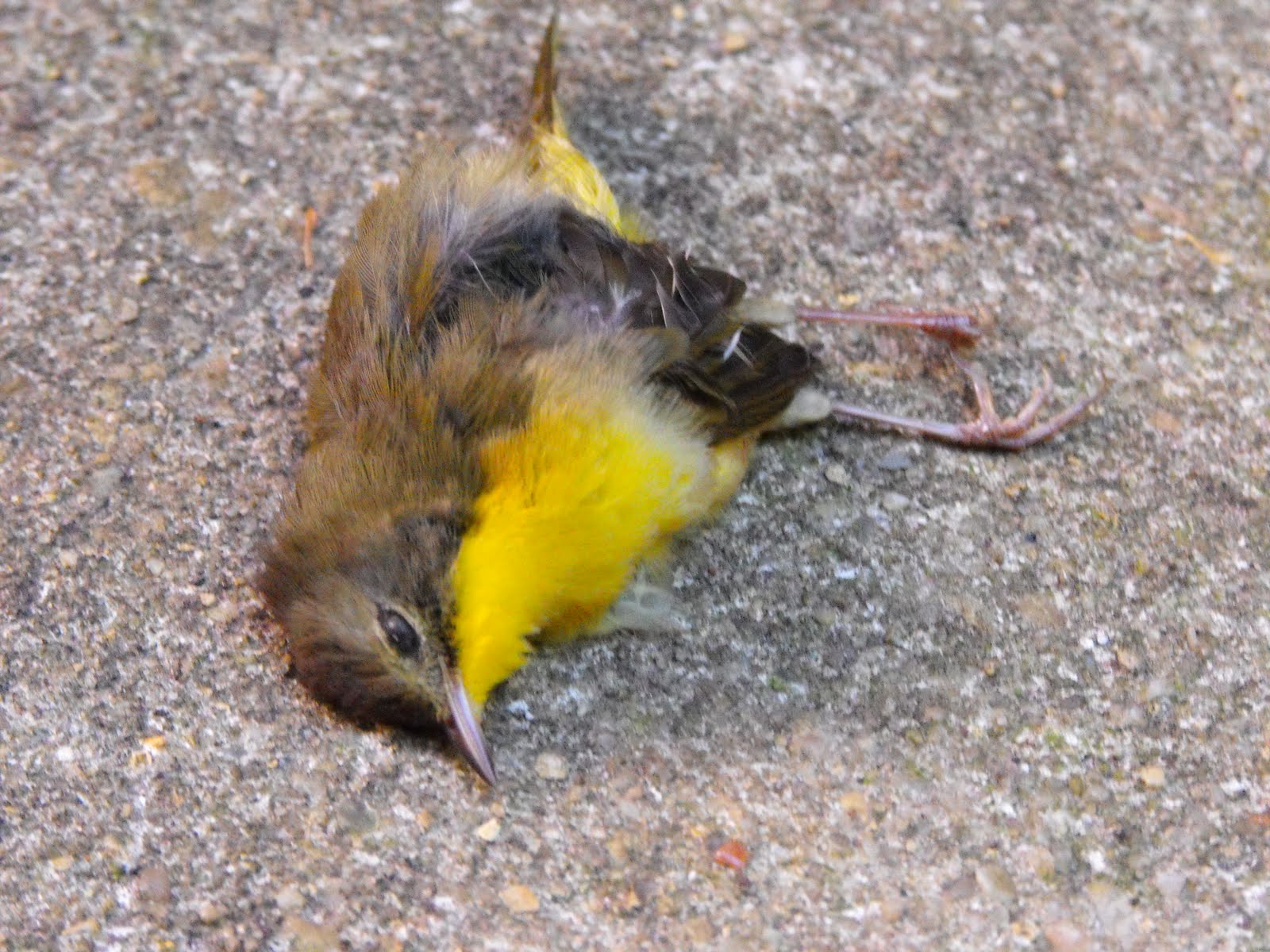
It was a Yellow Bellied Flycatcher.

Miss Gray Kitty murdered a beautiful little bird.

After she quickly tired of her morning plaything, she walked off and left me to clean up her dirty deed. In this case, the cover-up was not worse than the actual crime.

I picked two large Sum and Substance host leaves, dug a hole, placed the Yellow Bellied Flycatcher between the leaves, and carefully placed the bundle into the hole. Onto its grave I place a few coleus leaves, and a sprig of diminutive Liriope flowers.

Though the burial ceremony was brief, I replayed in my mind over and over that scene from The Hours in which Virginia Woolf, played by Nicole Kidman, performed a bird funeral with her niece, Angelica Bell. My experience felt just as moving. But I just couldn’t lie down next to the bird as Virginia (or Nicole) had done. Not because I lacked feeling, but because the back area of the garden emitted an atrocious odor, as Gramsci had used what he thinks to be his outdoor litter box (that is, my entire garden) just 30 minutes prior. All I could think of was accidentally putting my face into a pile of Gramsci poop.

So, goodbye little birdie. Forgive me for skimping on your funeral. And forgive Miss Gray Kitty for her feline antics. 


A Bridge into Autumn


So often the visitor and casual observer of the garden asks of the gardener friend, “which is your favorite flower?” The question has the same irritatingly demanding, damnable, and impossible-to-answer quality as the “if your house were burning and you could only save one of your several children, who would you save?” hypothetical tragic query we hope we never have to face. Surely I inflate the moral imperative of the decidedly more innocuous gardening variation, but the theme remains the same.

Of course, gardeners have favorites—but notice the plural use of the word: favorites, as in multiple, many, more than a few. To isolate a single flower is the pronounce irrelevance on the rest, to erase the montage that becomes and is the garden, even if the gardener reverses the conventional gardening equation of flower over foliage, and opts instead to celebrate and showcase foliage texture and color over flower, which is only occasionally deployed as accent.

Most gardeners would be polite and respond to the question, though I suspect many would probably disregard the singularity of the expected response and offer a plurality of responses—typically one for each of the major seasons. Though perhaps surprised, the questioner would most assuredly understand the folly of the question and accept distinct seasonal (spring, summer, and autumn) responses. That might be the best kind of response: one that adequately (if a tad excessively for the questioner’s proclivities) indulges the questioner’s curiosity about the tastes of the gardener, and one that politely responds to the question being asked but implicitly warns the questioner to either never ask this kind of question, or to frame it such that it at the very least captures variation, both floral and aesthetic.
 
No. The better response is a storm. Interlocution becomes monologic litany. The questioner will soon be embarrassed (and ultimately sorry) he or she asked. Even a simple list of primary seasonal favorites will not suffice, but rather a listing of flowers in order of micro-seasonal appearance: that is, early, mid, and late spring, summer, and autumn flowers, with perhaps even a winter flower or two (usually witch hazel, perhaps Winter Jasmine, and maybe even Hellebores which technically begin blooming in winter though many would associate it with spring) thrown in for spectacular, learned and comprehensive effect. Why? Because, as every gardener experiences, seasons are disaggregated into distinct micro-periods given variation in temperature, light, and moisture.

 I shan’t bore the reader with my own litany, for my favorites should be obvious: this blog is a testament to my varied tastes and favorites, from the early Blue Star Lithodora to the late mum, from Petasites to Pieris and iris (Siberian, Japanese, bearded) to (false) indigo (even if I killed it), and everything between and beyond.

But here, I should like to identify a trans-seasonal favorite: the dahlia. Space (as in my property) limits me severely, and thus I am unable to grow multiple varietals or have an array of plants without looking like I had a few too many gin and tonics (always a danger with me). The disciplinary effect of geography and income have been good for me, despite my desires for more property on which to garden, for I have learned to be selective about plants; have been forced to reign in my promiscuous ways; have been forced to research each beauty with whom I would like to begin a life-long, intense love affair—for I need to be discriminating in terms of balancing design and aesthetics in my small spaces, and in terms of plant needs in my very peculiar and multiple micro-climates caused by soil, temperature (brick absorbs and thus radiates heat, for instance, thus creating an entirely different kind of micro-garden within the space of one foot), and drastic variation in light and moisture.

So I selected this blood red dahlia two years ago. She both coheres with my mid to late summer garden bathed in the intense vibrancy of summer colors, and serves as a dynamic yet complementary counter to my early autumn blues and purples which mellow her own intensity all the while accentuating her distinctiveness. She blooms from July until our first frost (usually in late October or early November). She rewards me.

This trans-seasonal favorite seems an appropriate muse, a perfect parallel to one of my heroes in life, Dag Hammarskjöld, the 2nd Secretary-General of the United Nations, who died on this date 49 years ago in a plane crash while negotiating a peace in the Congo. His example, like the dahlia’s garden presence, like all of our heroes, illuminates and uplifts, inspires and compels from us the very best of our efforts.   


Tuesday, September 14, 2010

The Waning Days of Summer

If summer is the full throttle of gardening life, then autumn is not many a gardeners’ friend. Crops are harvested, seeds begin to set, plants gradually fade, and the incandescence of summer gives way to the muted hues of burnt, subdued rusts and ochres, pumpkins and burgundies, umbers and persimmons.


Autumn: that other book end of the gardening season.

If spring inflates, autumn deflates. If spring vitalizes, autumn devitalizes. If spring is celebrated for renewal and rebirth, esteemed for deliverance from the depths of winter, revered for buds and pastel flowers, then autumn is appreciated for the maturation of that which will soon pass.

Autumn signifies the decline of that which we have labored over for several months. Autumn compels us to face the passage of time—and the passage of time, in the linearity of human life, can only mean decline and decay. No wonder so many become glum in the elongating shadows of the midday sun, a melancholy punctuated only by the burning landscape of autumn color.

The Greeks had two words for life: zoē and bios. If the former referred to mere biological life in the sense of birth, maturation, decline, death, and decay, then the latter captured the very essence that makes us human: the projects and identities that make us idiosyncratic individuals and that give zoē meaning. We might learn something valuable from the Greek. Our melancholy at the passing of time is but a manifestation of our natural selves. But to be melancholy is to privilege the biological and to arrest that other form of life.

So, in these waning days of summer when the effects of autumn already appear, I look around and delight in the myriad of changes that begin to pepper the garden. Seemingly overnight, Rose Mallow shed her vibrant summer dress of green and chartreuse for her understatedly elegant burgundy gown. The one seed pod I allowed to remain on her stalks has turned a rich caramel (I do want her babies, but not so many of them!) The oat-like panicles of the Northern Sea Oats Grass have begun to redden on their way to a bronze finish, and I am warmed by his chromatic complement to Rose’s autumnal beauty.

And of course the season for pumpkins is rapidly approaching.

But in my garden, I just never know where “the pumpkin” will appear.