Tuesday, August 30, 2011

Adult Pleasures XII: Showing your Privates in Public

Who doesn't like a bit of privacy?

The patchwork quilt created by ubiquitous fence lines around our neighborhoods indicate how covetous we are of sheltering our outdoor rooms from prying eyes and nosy neighbors.

In the garden world, these barriers translate into secret gardens, walled gardens, and a sense of mystery and awe when one encounters a private garden. We feel privileged to witness that which is usually screened from the world, privy to some bit of classified information that heightens our own sense of self-worth or at least titillates our desire to know what others do behind closed doors. Perhaps this is why garden tours are so popular. If, to be kind, a love of plants and desire to expand one's horticultural, botanical, and design horizons instigates the drive to attend such a tour, then entering others' private spaces is icing on the proverbial cake.


In other words, garden touring is but another manifestation of the "keeping up with the Jones'" phenomenon.

But garden tours--for those who list their gardens on such tours--are also manifestations of a deep psychological need for our privacy to be violated, penetrated by sustained gazes. This is one of the many contradictions wrapped up in the human condition.

We need publicity as much as we need privacy. We crave recognition, if not in our gardening lives then in our professional lives and in our social world. Social media like Facebook only exacerbates this tendency, and in (or on?) Facebook we witness many a publicization of private things (and much boasting).

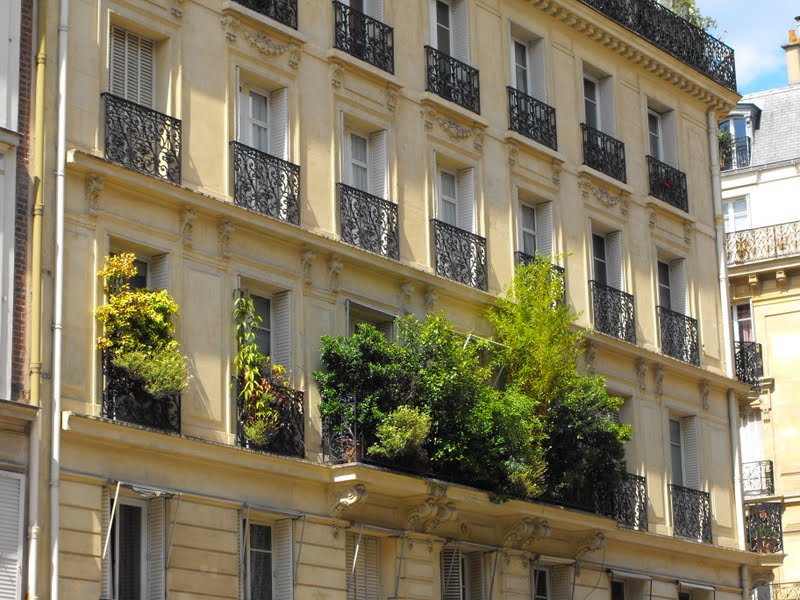
Paris and Parisians no doubt publicly tantalize with balcony gardens and festooned windows with geraniums, ivies,  flowering vines, and potted plants wired to the building.

But in terms of garden spaces, well, Parisians love, covet, and guard their privacy. As with Belgians, they insulate their gardens from nosy tourists and general public view.

Disastrous.

They even adorn their wrought iron fences and car port gates with material to prevent unwanted glimpses into their secret gardens.

But leave it to me to find holes into which to stick my camera to capture what's beyond,

 boxes on which to climb to get that garden shot (and capture an unknowning gardener at work),


and the one suburban Parisian house without a fence.

Garden privacy be damned.

But in the end, no matter my incessant need to see others' gardens and understand their design principles, criteria for plant selection, and motivation behind gardening, I deeply get their need to insulate their creations from intrusions. In other words, I can dish it, but can't take it. (Confessions be damned!)

**And many thanks to Erin B. for her felicitous renaming of this entry.**

Sunday, August 28, 2011

Hot Pink, Beyond the Storm

Irene has passed, leaving us with only occasional gusts of wind this morning here in northern Delaware.

The wind-driven torrential rain last night transformed the street into a rivulet, washing all of the storm's debris down the hill with it. Thus, there really isn't much to clean up, at least in the front garden.

In the rear shade garden, I needn't fall back on that law of succession as I mused yesterday, for time continues. A Pieris japonica did suffer some severed limbs as a dead tree branch fell upon it, and a few hostas and ferns were crumpled by clumps of leaves clinging to small branches. But the garden fared well.

And as a sign of wellness (we need such significations, don't we?), Rose Mallow, nearly prostrate at the height of the storm but now managing to upright herself, issued a proud, vibrant flower this morning: a flash of color in an otherwise grey landscape.

Saturday, August 27, 2011

Cool Blues, Waiting for the Storm

So we have a Hurricane on the way.  Irene. Her arms stretch wide: for while her eye remains in North Carolina, slightly over an hour ago the rains began here in northern Delaware.

So we wait. We wait for her torrential rains. We wait for her strong winds. We wait for the predicted flooding. We wait for potential downed power lines and the loss of water supply.

We wait.

The garden seems resigned this morning, though we know that is but an anthropomorphic attribution. More aptly, I am resigned this morning to the potential damage.

A friend from Denver--Michael--wished my garden well this morning; I thought that very sweet and thoughtful of him, especially as the garden is more susceptible to damage than me. And gardens are important (otherwise, why would they have a lineage for nearly the span humans have been on this earth?). And so I began to ponder about the very loss of control we humans actually have when it comes to the most primordial of our lived experience: nature.

Just this week, here in the mid-Atlantic region we experienced an earthquake (a mere tremor those folks on the West Coast would call it), and now we face a hurricane (a very slow moving one at that). My return from 4 weeks in Europe was welcomed with an outbreak of Sclerota Rolfsii, which has nearly claimed the life of one of two Lemon Drop Hostas, and is proving too formidable for a few Sum and Substance Hostas.

We just simply haven't mastered nature, try as we might.

Facebook informs me that us ordinary folk--those not invested in attempting to master nature--are now beginning to engage in binge drinking, parties, family game nights, and other activities.  We find ways to pass the time nature has forced upon us. Yes: nature forces us to break away from the frenetic paces we live and to confront our selves and the company we keep. Time must be lived and experienced, not filled, and that, perhaps, is the greatest fear many people face: the specter of time with its vast nothingness.

Here I sit, staring out onto the garden, prematurely wondering how to redesign and replant it if the neighbor's very diseased maple tree topples, or if Irene claims my own tree, both scenarios of which would render my shade garden a full sun garden. Perhaps it is a mental act of desperation, or perhaps it exemplifies the fear of being confronted with the vast nothingness of time (and potentially empty space for that matter). Perhaps.

Or perhaps it is simply a manifestation of the knowledge that time does not stop, that time continues. Perhaps it is a recognition of the movement of time itself: the primordial law of succession.

Gardening doesn't simply help me fill time: it forces me to feel and experience its inexorable march. So much compressed into a growing season: birth, maturation, decay, death, and the omnipresent hope of renewal. And all of this occurs simultaneously in different parts of the garden. Time is multiple, and multiplies itself. The gardener struggles not simply to keep up and make sense of it all, but to absorb and experience it, and to be at One with time.


Somehow, the predominance of blues and purples in the garden at the moment, ringed with the white lemon-scented flowers of Sum and Substance hostas, just seems to make the thought of loss and destruction all the more bearable, for the law of succession tells me that something will always come after...


Friday, August 26, 2011

Parisians Get a Rise...

Sometimes--nay, many times--these things are beyond the control (particularly of the male species).

Sometimes we are just excited by certain things.

No matter the strength of our will, we, well, respond.

Yes.

We respond. We get excited. And many, perhaps all, languages have engendered many a euphemism and slang to describe this excitable reaction.

So excited that we attribute a certain urgency to our actions. 

So imagine me, running around Paris, madly taking photos not of the Arc de Triumph or the Eiffel Tower (though there are those, of course), but of that which clearly gives Parisians and me a rise: balcony gardens.

Yes: Parisians have most assuredly taken gardening to new heights.


There were, of course, the de rigueur balcony gardens of potted geraniums: the ubiquitous Parisian flower, the Parisian's passport into gardening.


But there were also most astonishing, unexpected displays.

Some were quite exuberant in their vision: a Juliet balcony transformed into a full scale garden, even if the apparitional effect is crowded and overgrown.

Some were festooned with trees, like this Japanese Maple,

or this palm tree.

Others used bamboo as shields from the outside world, a botanical veil to enclose and protect.

Some employed the space to functional effect, as with these oranges (or tangerines?),

while others deployed functionality as a cooling mechanism, as with this "Green Wall."


Some framed their frames from which they view the Parisian world beyond,

while others color-coordinated their window box displays with their window shades.


That was the preeminent expression of French--or at least Parisian--fashion sensibility, and boy, did it give me a rise!


Thursday, August 25, 2011

Other People's Gardens: Jardin de Luxembourg

The Grand Duchy of Luxembourg, nestled between its territorially well-endowed neighbors France and Germany, and its more modest sized neighbors Belgium and the Netherlands, is both an amalgamation of identities and possessive of a distinctive one itself. Though the Luxembourgeois may speak out of necessity French, German, Dutch and, in our globalizing world, English, they also proudly retain their own language, Luxembourgish. Technically a Mosel-Frankish dialect, it first appeared in print in 1821 and was introduced in primary schools in 1912.

Luxembourg was on last year's European vacation, not this year's. So why am I writing about it?

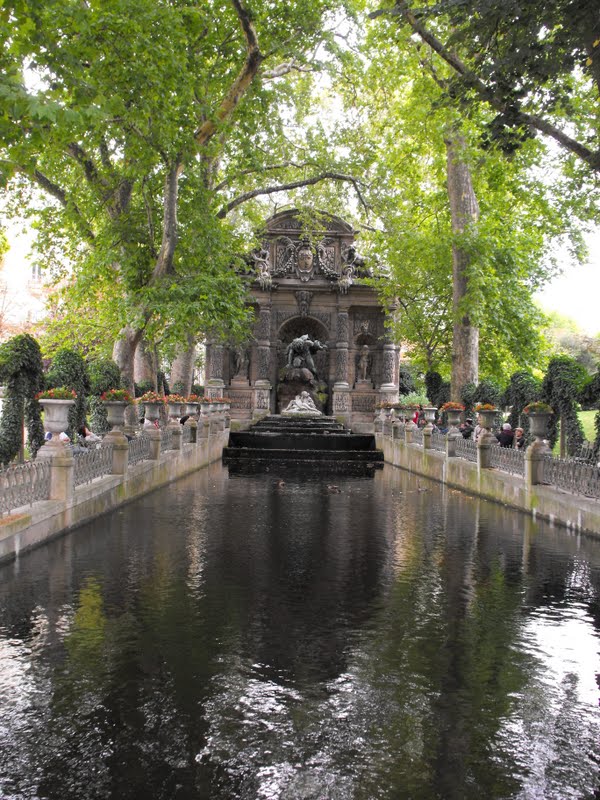
This year's trip took us to France (Paris, Etretat, Deauville) and Portugal (Lisbon and, for a conference, Porto). One day--probably the sunniest and the warmest during our stay in France--we visited the Jardin de Luxembourg. The garden is on the grounds of the Luxembourg palace which is home of the French Senat, and is, in my estimation, appropriately named: for, like the Grand Duchy itself, it is both an amalgamation--the official marque declares the gardens to be a "rich diversity of styles, which combines French geometric discipline, softened by the curved terraces, with the less ordered, more dreamy English design"--and a distinctive site.

Funny: though English cottage gardens are dreamy and disordered (those qualities are the cottage garden's charms), the remark almost seems like an insult.
 
Nevertheless, in 1610, one day after the assassination of her husband Henry IV, Maria de Medici (yes, of that famed Florentine family) now possessor of the throne until her young son, the future Louis XIII could enough to ascend, asked an architect to remodel the existing Hotel de Francois de Luxembourg to mimic her childhood Florentine home, the Pitti Palazzo. Then she began to create her gardens (perhaps out of grief, perhaps because, like the uber-wealthy, she had nothing better to do with her time).

The structure of the garden is remarkably user friendly. Two gigantic ellipses bisect, the longer one being perpendicular to the Senatorial palace, the shorter one parallel to it. Three allees of clipped chestnut trees extend from the ellipses and parterres, which are ringed with stone balustrades topped with urns overflowing with fuschia petunias. In the center of this arranged is situated a floating pond in which young boys race their sailing vessels.

The beds--geometric patterns that echo the basic architectural form of the garden--are filled with English "dreaminess," which this year is expressed in terms of a sumptuous array of yellows (triple dahlias, Rudbeckias, snapdragons, marigolds, and a few other unidentified flowers) and accented by orange single-petaled dahlias, burgundy leafed grasses, and blue/purple petunias. The effect is at once grand and sublime, for the variations on the theme of yellow, which otherwise would be lost, are ultimately trumpeted by the presence of orange and burgundy. The effect is, in so many words, very Luxembourgian.

In the end, the Jardin de Luxembourg is French, very French, for it is in its present form a survivor of that fabled French custom of kissing your hand one moment and lobbing off your head the next. Behind the opulence, behind the beauty, behind the sun worshippers and savvy urban sophisticates there lies the truths of Revolution and Hausmann's urban planning: the garden has been repeatedly beheaded.

Several times.

All that remains today of the once vast garden are 22.5 hectares. True, this is more than modest sum, but 22.5 hectares is but a shadow of the garden's former self.

But what a spectacular shadow it is! 

I hope you enjoy these photos...


Two views of the Medici Fountain...


Friday, July 22, 2011

My Filibuster, My Swiss, My Garden

41: the number of Senators needed to permit use of the Filibuster

41: the international dialing code for Switzerland

41: George W. Bush's nickname for his father, George H.W., the 41st President of the United States


41: Montana, as in the 41st U.S. state

41: the year Caligula was assassinated

41 (B.C.E.): the beginning of the Marc Antony - Cleopatra alliance (and their fabled love affair!)

41: cuarenta y uno, Mexican slang for "homosexuals" stemming from a scandal dubbed El baile de los cuarenta y uno (the Dance of the 41),  in reference to a 1901 raid on a private house which resulted in the arrest of 41 high society gays, and the ensuing efforts of the Porfirio Diaz government to cover-up the affair

41: the Jupiter Symphony, Mozart's last (only because he skipped the number 37)

41: the number of distinct genera of plants in my rear shade garden (to be clear, I count 80 species of 41 different genera in the rear shade garden)


41: a measure of time, not always an arbitrary number; both a singularity and a component in an infinite sequence

Time passes: neither can we deny or stop it. "Time," Heidegger mused, "is the truth of space." Space, therefore, is ontologically prior to time, and to understand time, we must understand space.

Yet, on my reading of his formulation, the only way we may understand space is through time. The two are inextricably linked. This is not to suggest a conception of space as linearity, but in a sense it is. While Life (with a capital L, a designation of the phenomenon) may be adequately denoted as a cycle (of birth, maturation, decline, and death), life as an individual phenomenon itself manifests the cycle but it cannot be renewed. Individual life is finite, and therefore linear.

Take any number: it is, in its singularity, both a beginning and an end. Set sequentially, though, it becomes a fleeting moment, a link to that which precedes and that which proceeds it. Both understandings ultimately get at why age is so significant: we are simultaneously linked and de-linked to a world beyond. Our individuality is inherently determined by our own acts of self-creation (and, to be a bit Hegelian, self-negation), but also by our sheer connectedness to a broader universe. We are Time and we are time, we are Life, and we are life.


The garden exemplifies this movement of the truth of space. Our plants become our selves, and our selves become enmeshed in a horticultural assemblage, a kingdom beyond our control but always connected to us.

That is why I take so many photographs of the garden. Every morning, every afternoon, every moment of time: each offers something new, whether in the opening of a blossom, the fading of a color, the growth of a stem, the appearance of a leaf. We may deem these insignificant moments, or moments to be fully appreciated on the weekend. But these almost inappreciable moments obtain significance, for, taken together, they become the pedagogy of the garden: it teaches us to be in the world, it envelops us in space. And always it makes us appreciate the passage of time, even as time for a brief moment, stands still.

 
The garden: it is my filibuster, it is my Switzerland, it is now, for this moment anyway, my 41.