Monday, July 5, 2010

Greetings and Goodbyes

Between the self and the world stands the greeting and the goodbye: the former an act of integration, the latter an act of separation. But despite their different functions, both are verbal indicators of involvement if not entrenchment in the world, a partaking of communality either for a moment or over a lifetime. Both are the essential, diametrical vocabulary of amor mundi, or love of the world.

Though we often attribute to taking leave, to our goodbyes, a poignancy, a difficulty, and an emotional drain, greetings, too, are enveloped in their own peculiar kind of anxiety. Greetings expose us to rejection, judgment, and self-doubt. Sometimes the greeting will enlighten and enrapture; other times the greeting will frustrate and enervate.

Take, for instance, two recent botanical greetings. Carpathian harebell (Campanula carpatica Blue Clips), which I welcomed to the garden on Friday, enjoys his new position, and cheerily tolls his bright blue-violet flowers, announcing his arrival with vigor and enthusiasm (even after I accidentally dropped a bag of mulch on him). Carpathian harebell surely is forgiving; perhaps his forgiveness is an homage to the orographic and geologic distinctiveness of its namesake mountains, a grouping of diversity that demands, whenever the unlike are thrown together, forgiveness, tolerance, and eventual acceptance. The smaller of the two Provence lavenders that survived the winter blizzards and which I transplanted last week (as Tall Purpletop Verbena was severely encroaching on its space), however, visibly remonstrates against her new residence. This week’s 100 degree plus temperatures and blazing sun surely won’t help her case, and I fear for her existence. A reluctant goodbye stands poised on my lips.

Yet any ache that may come from a failed reception to a greeting is invariably tempered by the fact that no previous relationship existed, and thus the losses may be minimal. And that is precisely why the goodbye possesses “a reputation.” Linguistically, we cover the goodbye with ‘see you later’, ‘so long’, or ‘until we meet again’—all in an effort to mask (perhaps) the pangs of sadness or loss we feel.

I approach the precipice of a goodbye in my own life, and this goodbye, though it shall be but a temporary one, weighs upon my heart (not to be overly dramatic about it, but also to be overly dramatic). Adventures await, life unfurls before us (we hope). This goodbye and its associated heaviness is very much an expression of amor mundi and the efforts expended on that love. But the division between that which came before and that which will come after demands to be marked: and goodbye is the most succinct symbol of demarcation that we linguistically, and perhaps emotionally, possess. Silence will not do.

And so I look to nature for my cue and my model. The spider waits ever so patiently, quietly, and when that particular vibration is felt across its web, it moves with alacrity, performing the necessary work to ensure a future meal. For the unfortunate, wayward insect, the parting is, I surmise, quick. Thus it shall be with this goodbye: recognition of the love, recognition of the life, a laconic verbal act of parting, and then a turning of the head to face the days ahead.

Sunday, July 4, 2010

Fireworks, and a Happy 4th!


Lately I’ve been preoccupied with naughty girls—Rose Mallow and her Japanese beetle thug paramours, Rose Campion and Anise Hyssop. Today marks the anniversary of another naughty girl and her very rebellious act that so ceremoniously dumped the vengeful and neglectful parent.

However, today is but a filler in a sense, an explanation of a decision. If Richard Henry Lee brought before the Continental Congress of the United Colonies a resolution declaring independence from Great Britain and nearly a month of debate ensued, then the formal vote for the absolution of political ties to the Crown occurred on 2 July 1776. The Declaration “merely,” formally stated the reasons for doing so.


Certain of the gravitas of the vote, John Adams write to his wife Abigail that the 2nd of July would “be the most memorable Epocha, in the History of America.” My, how history eludes even those most involved in its making.

 
And so, in a bit of metaphoric parallelism, I began mulching the front and back gardens on 2 July as a declaration of independence from our excessive heat and drought, a preparation for even more extreme temperatures to come this week. Mulching—as with the Congressional vote for independence, the debate that led up to it, and the opposition of Pennsylvania and South Carolina even down to the wire—was the hard work, the foundation that had to be set for the observances that would follow.

But the real display, the real celebration, comes on the 4th. Today, as is customary in the United States, fireworks regale me, and the bells toll—but these aren’t the usual trappings of an American Fourth. (Really: can there be anything but an American Fourth?!) Tall Purpletop Verbena gesticulates towards the heavens, while Carpathian Harebells (Campanula carpatica Blue Clips) ring the certainty of life against the starburst of Rudbeckia. Not to be outdone in the shade garden, Obsidian heuchera sends upwards delicate plumes of diminutive flowers and the hostas, not grown for their flowers, offer their own floral display of appreciation.
 
Happy Fourth!

Thursday, July 1, 2010

Bad-Boys: Watcha Gonna Do When They Come For You?

Surely it must be cliché that all fathers are protective of their daughters, especially when said daughters reach dating age. No paramour is good enough for your girl; no man is man enough, etc. etc.

And so it is with my Rose…no, no, not the flower, but Rose. Rose Mallow.

No father in his right mind would admit this publicly, but as I’m an unconventional guy in some respects, I'll do it. Okay, so here it goes: Rose is an attractive, even seductive gal. Sure, I’ve previously written about her, especially her taste in ‘clothes’. Though she usually dons a stunning burgundy colored gown, the summer heat compelled her to swap that out for more appropriate attire: a summer dress of a particularly attractive shade of lime green, accented by burgundy stockings. Even despite her clothes, Rose Mallow offers an intense, sharp appearance: her deeply lobed, palmated leaves extend from her slender legs, hands outstretched beckoning you to enjoy the summer breeze with her.

Lately I’ve noticed that Rose is attracting certain neighborhood thugs: Japanese beetles. Sure, they are attractive in their own right, and I can see what Rose sees in them: their copper-colored elytra and green thorax, accentuated by a glossy sheen that, when the light hits their body just so, makes them seem other-worldly, a masculine ruggedness encased in ethereal beauty. (Goodness, I feel an interlocutor in Plato’s Symposium just writing about this.) Almost love at first sight…Except when I stomp on them and smear their innards across the stone walkway—then, well, they are not so attractive.

As with most thugs, their initial bad-boy charm quickly erodes. Beauty compels us to do things we otherwise wouldn’t do, and so certain of our daughters—Rose Mallow and the "ordinary" roses, climbing hydrangeas and crepe myrtles, in short, the most lady like in the plant kingdom—allow these boys to engage in some rather enticing foreplay—little bites here and there. Oh, how titillating! At first this doesn’t bother, but then the bites become more extensive, and these paramours invite others to partake in what soon becomes an orgy. The gang takes advantage of her generosity, and soon our daughters are encased in beetles, their leaves rapidly becoming skeletal reminders of the dangers of seduction.

So let this be a warning, folks, of the dangers of bad-boys—especially those in gangs. If you see one, destroy him, because one attracts the others. And don’t buy those ridiculous pheromone traps, which have been proven to attract more than they trap and kill. Also, while many encourage you to shake your daughters’ branches and let the beetles drop into soapy water (yes, there is something tragically wonderful about watching these things drown), I find that several are smarmy enough to fly away.

My advice: be ruthless and grab those buggers by your hands, throw them to the ground, and quickly stomp. It’s much more effective.

So, bad boys, watcha gonna do when I come for you?!

Die, that’s what.

Tuesday, June 29, 2010

Happy Anniversary


Today marks the 3rd anniversary closing on the house at 410.

I stood in the backyard the next morning (picture by realtor, above), in complete awe of the bourgeois pleasure of property-ownership, and in complete elation of the blank garden slate that was mine.

The grassy area on the right of the above photo marks the edges of what became the east side shade bed, which I thought would be an appropriate focus (on transformation and process) for this anniversary blog entry.

There are those who think gardening involves putting plants in the ground and calling it a day. Joy evolves from watching those plants grow and fill the spaces into which they were thrust.

And there are those who reject that view as somehow anathema to the concept of gardening. Let's get grammatical for a moment. Gardening, to be technical, is the present participle of the verb “to garden,” and therefore speaks to an activity or a process—perhaps without end. Gardening is about transformation—of design, of plantings, of arrangements, and of self. I consider myself part of this crowd. The east side shade bed illustrates.

We devoted the first year in the house to interior sorts of projects. By the spring of 2008, I was ready to begin gardening (see above photo). I soon discovered that the ground on which 410 sat consisted of dense, heavily compacted, bedrock quality clay. And so began the task of digging out by hand what would become the east side shade bed: one foot down, 7 feet in width, and 16 feet in length. (And why did I not rent a rototiller?) After working into the soil approximately 800 pounds of manure (which I have discovered was not nearly enough), I began planting thanks to the generosity of friends Jim and Patricia, and Phyllis, about whom I wrote in an earlier entry.

In 2009, Viet and I purchased 2 palletes of rock, removed the concrete walkway and patio, and constructed stone walls around the beds. I re-shaped the east side shade bed, and created a new, Buddha Bed, which I then connected to the existing bed with a small ‘isthmus’ in which I planted European ginger and Lady’s Mantle, which Gramsci decided he did not like and so, consequently, over-watered. 

This year, I introduced a few new plants into the east side bed—Corydalis flexuousa, Big Blue hosta, Petasites japonicus, a Tassel Fern, and Ligularia Britt-Marie Crawford—but am increasingly convinced that the central area of the bed needs redesign. One hosta simply doesn't like its current situation; the Tassel Fern was soon overtaken by one of the hostas; and I am frankly tired of the ostrich ferns (at least those in the middle, all of which are now beginning to aestivate, while the ones more protected from the harsh sun are 'holding their own'). The Nikko Blue Hydrangea is feeling rather blue (and not in a good way) since the winter storms took down one of the largest evergreens in the neighbor's yard--the very one that shaded the hydrangea from the late morning and early afternoon sun.  The poor thing droops each day, and I must douse it with a bucket of water to keep it properly hydrated.

But that renovation will have to wait until early next spring. Already the projects line up, and I look forward not to enjoying the remainder of this sweltering summer, but to next year and all the things that can, and must, be done.

Good thing, as we face another 27 years of mortgage!

Sunday, June 27, 2010

Sirius and the Slug

Warning: aestivating plants are not pretty.


Sirius did not earn its name for being just an ordinary star. No. The Greeks christened this astral illuminate Σείριος or Seirios, meaning scorcher. Sirius was so serious, in fact, that Homer devoted a few lines in the Iliad to it:

      On summer nights, star of stars,
      Orion's Dog they call it, brightest
      Of all, but an evil portent, bringing heat
      And fevers to suffering humanity

Even Aristotle in his Physics devoted a one-liner to the “dog-days” –an homage to this brightest of stars (apart from the Sun, of course).

(Perhaps my ‘moon burn’ owes its origins elsewhere!)

The Egyptians searched the nighttime skies for Sirius, which appeared just prior to the flooding of the Nile. Ah, the irony, for Sirius here in more northern latitudes signifies paucity, not abundance, of water.

The Romans understood and experienced this irony, and came to refer to those driest and hottest of days (for them, 24 July – 24 August) as diēs caniculārēs, which comes down to us moderns as the “dogs days of summer,” when Sirius illuminates the constellation Canis Major. Perhaps an early recognition of ‘global warming’, The Old Farmer’s Almanac pushed up the beginning of those dog days to 3 July. Editors take heed: that starting date may need to be moved up even further.

This summer in Delaware, the dog days began in mid June. According to the National Weather Service, northern Delaware has experienced its second hottest spring in 116 years, and, for the period April – May, the 4th driest. (Read: it could be worse, though or lack of precipitation in June might very well make this situation worse.) Consequently, the Ostrich ferns and Corydalis flexuousa Purple Leaf varietal have begun aestivation, or summer hibernation, rather early. Last year, the Ostrich ferns did not recede until late July. This is my first experience with Purple Leaf Corydalis, and I have learned that he usually re-emerges once the heat passes and conditions favor his sensitive constitution.

Though we may curse Sirius for heralding ‘heat and fevers to suffering humanity’, and for compelling the more sensitive of the garden pack to hibernate, summer dormancy has one particular perk for the gardener: invertebrates like snails and slugs, as their habitats dry, also aestivate. (And I thought my chemical warfare killed them off.)

So, in between the constant watering, let the gardener enjoy the hostas sans slug damage, temper Sirius’ seriousness with gin and tonics, margaritas, and mojitos, and celebrate the temporary demise of the slug with a very Martha Stewart toast: “It’s a Good Thing!”

Saturday, June 26, 2010

Color in the Garden: Red


Hours before its partial eclipse, and hours before its totality, the waxing gibbous moon rose in the dusky blue sky above Wilmington. At first, it was barely noticeable, a faint disk set against a hazy, steel-blue backdrop. But as it ascended into the darkening azure sky, its color became more pronounced: its reddish hue became deeper, richer, then gradually shaded to salmon, and now, at 9:11 p.m., appears vibrant red-orange. Here it is: the Strawberry or Rose Moon, Vanguard of the Early Summer Evening Sky.

Red: the color of the lascivious and the corporeal. Red pulses through our veins; titillates the extremities and urges; commands attention; connotes courage; signals danger and, in some cultures, death; and pushes the bounds of excitability.

Tempestuous and audacious, the primal force of red awakens the creative spirit, propels, compels, seizes, and rejects. The most dynamic of colors, red magnifies its own power, elevates its self, and projects energy into the world. Paired with the vibrancy of green, red is intensified and uplifts. Juxtaposing red to yellows and oranges inflames its passion. Red set against blues or silvers at first dramatizes, then tames an otherwise mercurial display.

Red—electric and bedazzling—needs tempering, and I think Rose Mallow (Hibiscus coccineus, ‘Blaze Starr’ varietal) knows it. For now, she has swapped the stunning burgundy red hue she has donned over her deeply lobed, palmated leaves for a vibrant green. And I have a theory. In a few weeks, she will sport those accoutrements than have earned her the nickname ‘summer poinsettia’: stunning scarlet red flowers, each with 5 elongated petals, yearning to be ogled and touched.

Rose Mallow is a refreshing garden resident. Her stalwart beauty cheerily greets all who venture to 410’s front steps. And she is confident without being cocky; she relies not always on her floral display to attract attention, but is content to permit her unusual red-hued, serrated foliage to do the work for her. And yet even while she shines, she comfortably recedes into the panoply.

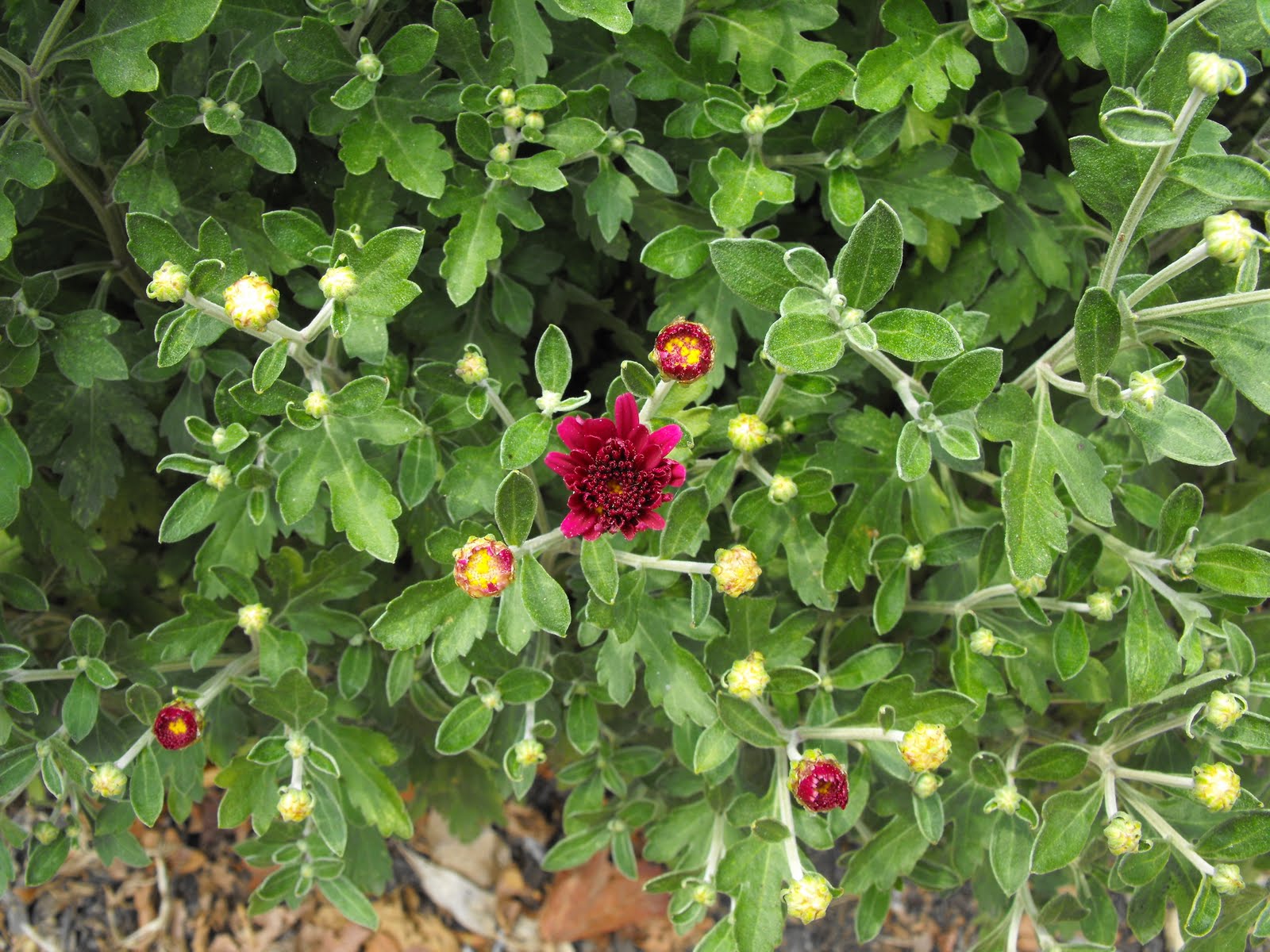
This year red lacks a prominent floral display in my garden: Rose Mallow and a blood red dahlia are left to carry the load that was once shared with red chrysanthemums, among others, which the February winter storms eliminated. But I am finding that lack of red acceptable, for it concentrates and thus heightens the impact of this most vibrant of colors.

I have also found opportunity in those winter losses: I welcomed both Rose Mallow and a Japanese maple into the garden this spring. And I have (re)discovered the joys of texture, color, and variation of foliage—certainly a more understated approach to introducing diversity into the garden, and, I sometimes think, a more effective way of communicating to the outside world and working with color. Sure, we all want to seduced by brilliant, colorful flowers—but too much can be, well, too much. The eye scans, cannot rest, and the garden is a blur. Pockets of color interspersed among rich tapestries of textured, serrated, variegated, hued foliage offers the eye and, more importantly the mind, opportunity for repose and reflection. The garden becomes you, and you become the garden. And we take it with us.
 
This year, the brilliant red new growth star-shaped leaves of Mountain Fire Pieris japonica, Rose Mallow’s burgundy attire, the potted Vancouver Geranium’s rich burnt red (which intensifies with increased exposure to the sun), Ligularia dentate (Britt Marie Crawford) and the quintessential red Japanese maple serve as the Vanguard of the Garden, quietly ascending, offering, like the Strawberry Moon, a dazzling array of colorful variation and permitting us to see deep into and beyond the early summer haze.

Tuesday, June 22, 2010

Abuzz with Activity


Hardly a place for repose, the garden is quite the contrary the center of activity.

I write this from the garden in early morning; of course I am not equipped with my camera to capture the yellow jacket that just drank from Gramsci’s water dish; or the honey bees that visited the hosta flowers; or the cardinal that sat atop the Buddha, then flew to the pot in which the Japanese maple resides (for now), and then to the bistro chair, and finally over to the Lady in Red Hydrangea before it flew away; or the moth that fluttered about; or even the worms that perform their composting digestive feats below the surface.

So much happened this morning, but now, mid-afternoon, the garden is quiet. A slight breeze occasionally blows, just enough to ruffle the leaves but not enough to make Lena’s maracas clatter. The heat of the day stifles; even the birds, though they chirp, are not as active as they were this morning.

But the bees still gather pollen, and Gramsci cat rouses from his afternoon slumber to eat a few blades of grass and Liriope.

And the first chrysanthemum blooms, heralding a not so long march towards autumn.